Wheat & Chaff

SSA Photography (165 of 400)

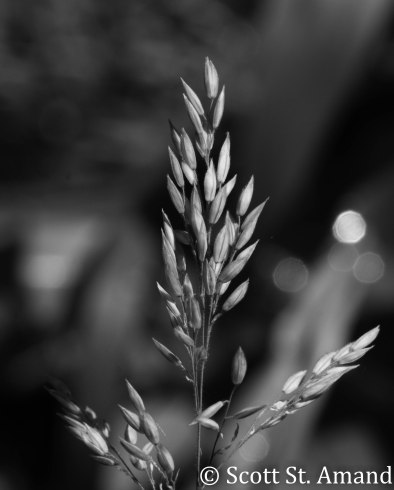
This photograph of a seedhead of tall ryegrass was taken on a high in Panthertown Creek, outside of Cashiers, North Carolina.  It is a simple photograph, and one which I would normally have skipped right over when I was sifting through the hundreds I took that day.  Nevertheless, something caught my eye in the simple elegance of the seeds and the blur and bokeh of the background.  Although not actual wheat, this native grass reminded me of the old aphorism “to separate the wheat from the chaff,” which is exactly what I do when I cull through the photographs to find the “keepers.”  The irony is not lost on me that the “chaff” nearly included this photograph.

Click here for a larger version.


Silhouette

calnov2016-9

The word silhouette is derived from the name of Étienne de Silhouette, a French finance minister who, in the mid eighteenth century, was forced by France’s credit crisis during the Seven Years’ War to impose severe economic demands upon the French people, particularly the wealthy.  Because of de Silhouette’s austere economies, his name became synonymous with anything done or made cheaply.  Prior to the advent of photography, silhouette profiles cut from black card were the cheapest way of recording a person’s appearance.  I think that this silhouette of the female photographer on the rock is one of my best black and white compositions.  The mist and morning layer in the background contrasts sharply with the wet stone in the foreground, with the tiniest break in the line of the outcropping (in perfect thirds, I might add) made by the photographer.  I cannot say that my eye was drawn to her initially, but once it caught her, my eye became curious and could not look away – and if I did, I was always drawn back.

Click here for a larger version.

Hokusai

SSA Photography (242 of 400)

I took hundreds of photographs, waiting for the waves to crash on the rocks at just the right angle, with just the right force.  This photograph evoked feelings of “The Great Wave” the famous woodblock print by by the Japanese ukiyo-e artist Hokusai in his series Thirty-Six Views of Mt. Fuji.  It also made me think of the creation myth of Aphrodite, which unlike Botticelli’s Birth of Venus, was, by all accounts, a violent affair.  Although Aphrodite can be broken down into “aphros” (foam) and “ditos” (risen), there is no direct etymological derivation.  This did not stop the Greeks (Hesiod, specifically) from crafting a story of Aphrodite rising from the foam after a great battle between Cronus and Uranus, which would foreshadow the same father-son battle between Zeus and Cronus.  In the whitewash, I can almost see Aphrodite throwing her hair back, casting off the spray as she nears the coastline.  But then, I suppose that’s what you get when your two favorite subjects in school were Latin and Art History…

Click here for a larger version, as well as a more stylized version.

Invasive Beauty

SSA Photography (179 of 400)

This post was originally titled “Native Beauty,” as I had seen these beautiful purple flowers up and down the coast near Carmel, California.  With a bit of research, however, I found that these stunning flowers are an invasive species known as Pride of Madeira (Echium candicans).  In fact, forestry officials are removing them from native plant communities as part of habitat restoration efforts in coastal parks such as the Golden Gate National Recreation Area.  The genus name is from an ancient Greek word for the plant. It is derived from “echion,” with the root word “echis” meaning “viper.”  There are conflicting etymological justifications for the name, including that the shape of the seed resembles that of a viper’s head, and  that Echium Vulgare, a related plant, was a historically thought to be a remedy for the adder’s bite.  Candicans or “shining white” refers to one of the more famous varietals in Madeira, Portugal, where the plants originate.  It was originally referred to as Echium Fatuosum, which is where the “pride” in the name originated.  In California, however, the purple E. Candicans varietal shown in the photograph is the most common.

Click here for a larger version.

As They Saw It

SSA Photography (249 of 400)

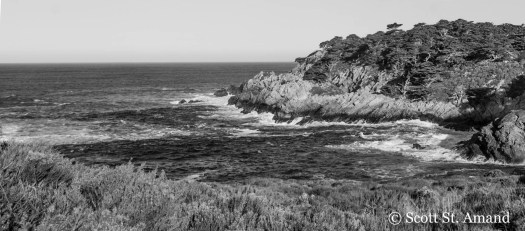
I have published many posts taken at Point Lobos, but none yet of the point itself.  Point Lobos is located a few miles south down the coast from Carmel-by-the-Sea, California, and it is one of our favorite destinations when we visit Carmel.  When I took this picture, I wanted to capture the ruggedness of the point as well as the grove of Monterey Cypresses, which as I mentioned in a previous post, is one of two groves left in the world where the cypresses grow naturally.  When I went to “develop” or post-process the photograph, and I decided to go monochromatic, I was struck by the similarities to postcards I had seen in town from the 1930s and 1940s.  The coastline remained the same, albeit a bit more worn by the waves.  They cypresses were just as withered and topped by the constant winds.  The great Californian poet Robinson Jeffers wrote extensively about the coastline in his verses, and as I gazed at the photograph, I thought to myself, this is as he would have seen it – hence the genesis of the title of the post.

Click here for a larger version (and a color version).

Bee and Balm

SSA Photography (164 of 400)

This photograph is a companion to Anna’s Hummingbird, which I posted on Wednesday.  This photograph shows a bee and its balm, specifically a Halictus Poeyi (sweat “furrow” bee) about to collect pollen from a Monarda Clinopodia (white “bergamot” bee balm).  The sweat bee and bee balm are native to North Carolina, where this photograph was taken.  I was busy taking macro photographs of the native flowers in the beautiful gardens of a family friend, and I hardly noticed this little bee hovering near the dew-kissed bee balm.  I was looking at my camera screen to see whether I had captured a focused shot of the flower when he drew closer, and I was able to catch him mid-flight.  I would have loved to increase the shutter speed to catch his wings, as I did with Anna’s Hummingbird, but the lighting under the the dense rhododendrons was not conducive to such a shot.

Click here for a larger version.

Wabi-Sabi

SSA Photography (106 of 400)

“Nothing lasts, nothing is finished, and nothing is perfect.”

This quote sums up the Japanese philosophy of wabi-sabi, which has no direct translation in English. “Wabi” is said to be defined as “rustic simplicity” or “understated elegance.” “Sabi” is translated to “taking pleasure in the imperfect.”  This photograph of an abandoned toy truck captures the principle beautifully.  The imperfection of the truck (and even the photograph thereof) is evident.  Although the truck lost its wheels long before I took this photograph, its purpose has not yet been fulfilled – not completely.  It is now immortalized in this photograph, which has subsequently become the subject of this post.  Nothing is finished, really.  This post will be replaced tomorrow by a less melancholy subject, and slowly it will fade from memory.  Nothing lasts.  The Romantic poets were students of the ephemeral, finding beauty in the brief life of all things.  Even the Augustan poet Horace, famous for his introduction of the phrase “carpe diem,” was fascinated with fleeting time.  There is a beauty to this photograph, though; however, I could not put my finger on it before I connected it with wabi-sabi.  Now it has become clear why its perfectly imperfect composition and subject evoked such strong feelings of melancholy on the one hand, and pleasant nostalgia on the other.  The Japanese phrase captures in two words, what it has taken me a lifetime to understand.

Nothing lasts.  Nothing is finished.  Nothing is perfect.

Click here for a larger version.

Anna’s Hummingbird

SSA Photography (213 of 400)

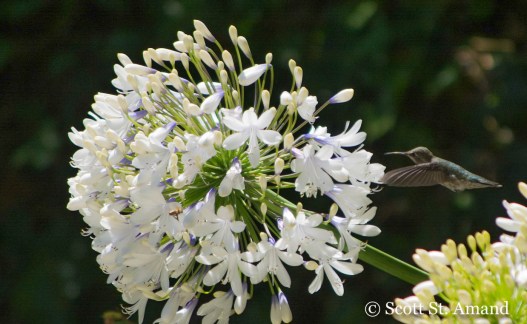
This photograph of a female Anna’s Hummingbird (Calypte Anna) feeding on alium flowers was taken in my in-laws’ garden in Carmel-by-the-Sea, California.  She visited the flowers nearly every day we were there, but she always visited alone.  Her mate would have had beautiful pink plumage around his neck.  I have always been fascinated by the drab colors of female birds (such as cardinals and tanagers) in contrast to the fantastically colored feathers of the males.  My grandfather was an avid bird-watcher, and he was the first to teach me to distinguish between the sexes of birds.   My mom carried on his love for watching and identifying birds, which she passed on to me.  I have already begun teaching Kemper the species of birds that live in our yard.  He was especially fond of the “tipmouse” that took up residence in our garage over the summer.

Click here for a larger version.

Perspective

Perspective

This photograph was taken in Glacier Bay National Park in Alaska.  Of all the waterfalls we saw, this was perhaps the most impressive.  Without the two people standing at its base, this would have been a great picture – a study in contrasts; but the two individuals lend such perspective to the grand scale of the waterfall that I could not, in good conscience, leave them out.  Perspective is a term that covers all manner of sins, from the linear perspective of Da Vinci, to the perspective one gains from a tragedy, to even the perspective that you grasp from the sheer insignificance of two humans set against the backdrop of indefatigable nature.

Click here for a larger version.

Cypress Bluff

SSA Photography (204 of 400)

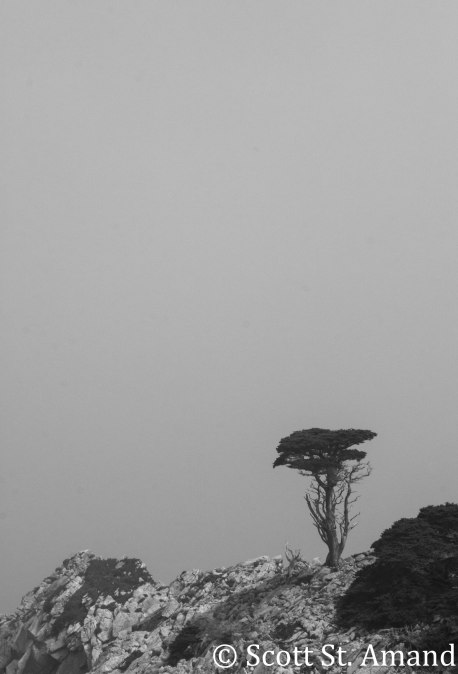
This photograph of a solitary Monterey Cypress (Hesperocyparis Macrocarpa) was taken at Point Lobos in Carmel, California. The species is native to the central coast of California, but now is confined to two small relict populations – Cypress Point in Pebble Beach and Point Lobos.  The most famous of the trees is the Lone Cypress, which is found along Seventeen Mile Drive in Pebble Beach.  Though the trees can grow to over forty feet, they are generally stunted by the strong winds that blow from the Pacific, which gives them their iconic flat-topped appearance.  Although it has long been held that some of the cypresses are two millennia old, this is a romantic conception of seaside literature, and the oldest of the cypresses are likely closer to 300 years old than 2,000.  Although only two native groves remain, the trees have been widely planted outside its native range, particularly along the coasts of California and Oregon.  Indeed, some intrepid seeds have even made it to Great Britain (including the Isle of Man and the Channel Islands), France, Ireland, Greece, Italy, Portugal, and Sicily.

Click here for a larger version.