Iridescence

SSA Photography (129 of 400)

This photograph is a macro shot of an Augochlora Pura (Green Sweat Bee) on a Monarda Fistulosa (a wild bergamot or bee balm).  As the title of the post suggests, I was captivated (and I still am) by the iridescence of the sweat bee’s green head and thorax, and his purple wings that look like stained glass.  This photograph was taken in Brevard, North Carolina on the property of a family friend.  I had to be terribly patient to get this shot, but in the end it paid off with a beautiful capture.

Click here for a larger version.

Oaken Post

SSA Photography (160 of 400)

This photograph was taken in the Pisgah National Forest outside of Asheville, North Carolina.  The hollowed stump was in a grove of chestnut oaks (Quercus Prinus), and the cavity had become a repository for layers upon layers of chestnut oak leaves, where a small seedling was beginning to grow from an acorn, which had fallen in just the right spot.  As I spoke about the ephemerality of nature in the Emergence post, just days ago, I am also astounded by the rhythm and circularity of nature.  In the chaos of the ferns and brambles, an old hollowed stump sheltered and fostered a month-old seedling, which will some day soon overtake the stump and take root itself.

Click here for a larger version.

Kemper at the Cypress

SSA Photography (323 of 400)

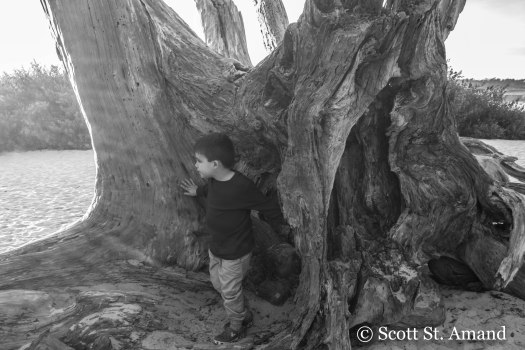
I rarely take portraits of people, though the ones I have taken are some of my favorites. In my photography, I try to be as unobtrusive as possible.  My son Kemper, however, is a willing and able model when I get the itch to add a human touch to my photographs.  This gnarled Monterey Cypress trunk just off of Ocean Avenue in Carmel, California would have been interesting enough with the rays of the late afternoon sun coming in from the southwest, but Kemper’s knowing stare off into the distance gives the photograph so much more meaning.

Click here for a larger version.

Emergence

SSA Photography (169 of 400)

This photograph of an allium (a member of the garlic family) breaking out of its protective sheath has been one of my favorite photographs since I took it a couple years ago.  To me, this photograph is evocative on so many levels.  It was taken, like Herrick’s Bud in my in-laws’ garden in Carmel, California.  Although I thought that the emergence would be relatively slow, I came back the next day and the buds had fully emerged, with the sheath having shriveled up and hanging by the wayside.  The ephemera of nature is simply amazing to me.  I hope you enjoy this photograph as much as I do.

Click here for a larger version.

Left Behind

SSA Photography (395 of 400)

This photograph was taken on the moors outside Haworth, West Yorkshire, England.  The two figures in the distance are my mother-in-law and her brother, who left my wife, Anna, and I to scramble up and down the moors in a vain attempt to keep them in our sight.  The “walk” (and I use this term loosely) was gorgeous in hindsight, as the pictures attest; however, during the trip (which I contend was on average 98% vertical), I thought my legs were going to give out at least three times.  Nevertheless, I made it, and that in and of itself was an accomplishment.  The photographs that I took were icing on the proverbial cake.

Click here for a larger version.

Kintsugi

SSA Photography (78 of 400)

In an series of three poignant essays, F. Scott Fitzgerald once wrote that he was fractured like a dinner plate that you would hide from the neighbors if they came over.  One of the greatest writers of the early 20th Century had indeed “cracked” under the pressure of his own success.  I identified with Fitzgerald’s essays—and Fitzgerald himself—on many levels, except that once cracked up, Fitzgerald never ventured to put himself back together again.

The Japanese have a beautiful word, kintsugi, which is the art of repairing broken pottery with lacquer, generally mixed with powdered precious metals like gold.  Kintsugi, however, stretches far beyond the art form.  It has become a philosophy, which accentuates the breakage and repair of the object as evidence of its history—rather than something to disguise or sweep into the dustbin.  The fractures are part of the object’s story, part of its beautiful memory.

We are all broken, some of us more than others, but these faults, these breaks shape who we are when we come out the other side—but only if we venture to put ourselves back together again like a shattered vase in the hands of an artist.

Click here for a larger version.

Shadow Play

SSA Photography (89 of 400)

Taken at Big Talbot Island, north of Jacksonville, Florida, the lines and shadows of this photograph of driftwood cobbled together on the beach draw the eye to the center of the mass of wood.  After the hurricane last year, this particular grouping of driftwood is no longer on the beach, so I was fortunate to capture it when I did.

Click here for a larger version.

Stepped Ruins

SSA Photography (107 of 400)

This photograph was taken in Brevard, North Carolina.  The property was once home to a summer camp and hippie commune, and was frequented by Woodie Guthrie, Pete Seeger and their ilk.  All that remains of this cabin are low walls and these steps.  Though I usually opt for monochrome photographs, the colors of the stones were so unique that I did not want to lose them in converting the photograph to black and white.

Click here for a larger version.

Rivulets


SSA Photography (272 of 400)

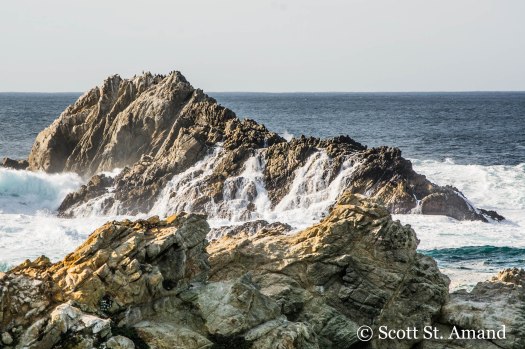
The beauty of the coastline of California is undeniable.  The  Pacific is magnetic, and I am drawn back to the West Coast when I am away for any length of time.  This outcropping, just off the coast of Carmel-by-the-Sea, fascinates me, and I spent quite a while trying to capture a photograph to do it justice.  I wanted to take one of the august waves crashing over the top, but ultimately I was struck by the hidden power of the little silent rivers that have carved away the stone over the millennia.  There is no great force to the rivulets; they work by sheer repetition and determination.  The streams of water cascade over the outcropping each time even a moderately sized wave crashes upon the rock, carrying a grain of sand or two, and slowly they peel away the layers of the hard stone – a testament to the often-hidden power of nature.

Click here for a larger version.