Bee and Balm

SSA Photography (164 of 400)

This photograph is a companion to Anna’s Hummingbird, which I posted on Wednesday.  This photograph shows a bee and its balm, specifically a Halictus Poeyi (sweat “furrow” bee) about to collect pollen from a Monarda Clinopodia (white “bergamot” bee balm).  The sweat bee and bee balm are native to North Carolina, where this photograph was taken.  I was busy taking macro photographs of the native flowers in the beautiful gardens of a family friend, and I hardly noticed this little bee hovering near the dew-kissed bee balm.  I was looking at my camera screen to see whether I had captured a focused shot of the flower when he drew closer, and I was able to catch him mid-flight.  I would have loved to increase the shutter speed to catch his wings, as I did with Anna’s Hummingbird, but the lighting under the the dense rhododendrons was not conducive to such a shot.

Click here for a larger version.

Wabi-Sabi

SSA Photography (106 of 400)

“Nothing lasts, nothing is finished, and nothing is perfect.”

This quote sums up the Japanese philosophy of wabi-sabi, which has no direct translation in English. “Wabi” is said to be defined as “rustic simplicity” or “understated elegance.” “Sabi” is translated to “taking pleasure in the imperfect.”  This photograph of an abandoned toy truck captures the principle beautifully.  The imperfection of the truck (and even the photograph thereof) is evident.  Although the truck lost its wheels long before I took this photograph, its purpose has not yet been fulfilled – not completely.  It is now immortalized in this photograph, which has subsequently become the subject of this post.  Nothing is finished, really.  This post will be replaced tomorrow by a less melancholy subject, and slowly it will fade from memory.  Nothing lasts.  The Romantic poets were students of the ephemeral, finding beauty in the brief life of all things.  Even the Augustan poet Horace, famous for his introduction of the phrase “carpe diem,” was fascinated with fleeting time.  There is a beauty to this photograph, though; however, I could not put my finger on it before I connected it with wabi-sabi.  Now it has become clear why its perfectly imperfect composition and subject evoked such strong feelings of melancholy on the one hand, and pleasant nostalgia on the other.  The Japanese phrase captures in two words, what it has taken me a lifetime to understand.

Nothing lasts.  Nothing is finished.  Nothing is perfect.

Click here for a larger version.

Anna’s Hummingbird

SSA Photography (213 of 400)

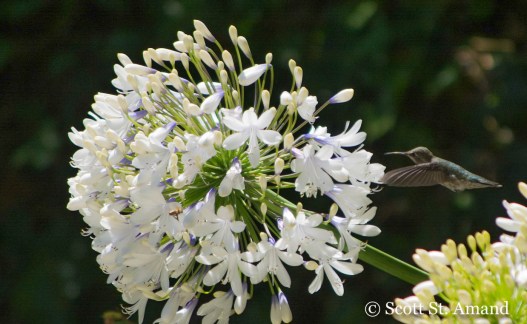
This photograph of a female Anna’s Hummingbird (Calypte Anna) feeding on alium flowers was taken in my in-laws’ garden in Carmel-by-the-Sea, California.  She visited the flowers nearly every day we were there, but she always visited alone.  Her mate would have had beautiful pink plumage around his neck.  I have always been fascinated by the drab colors of female birds (such as cardinals and tanagers) in contrast to the fantastically colored feathers of the males.  My grandfather was an avid bird-watcher, and he was the first to teach me to distinguish between the sexes of birds.   My mom carried on his love for watching and identifying birds, which she passed on to me.  I have already begun teaching Kemper the species of birds that live in our yard.  He was especially fond of the “tipmouse” that took up residence in our garage over the summer.

Click here for a larger version.

Perspective

Perspective

This photograph was taken in Glacier Bay National Park in Alaska.  Of all the waterfalls we saw, this was perhaps the most impressive.  Without the two people standing at its base, this would have been a great picture – a study in contrasts; but the two individuals lend such perspective to the grand scale of the waterfall that I could not, in good conscience, leave them out.  Perspective is a term that covers all manner of sins, from the linear perspective of Da Vinci, to the perspective one gains from a tragedy, to even the perspective that you grasp from the sheer insignificance of two humans set against the backdrop of indefatigable nature.

Click here for a larger version.

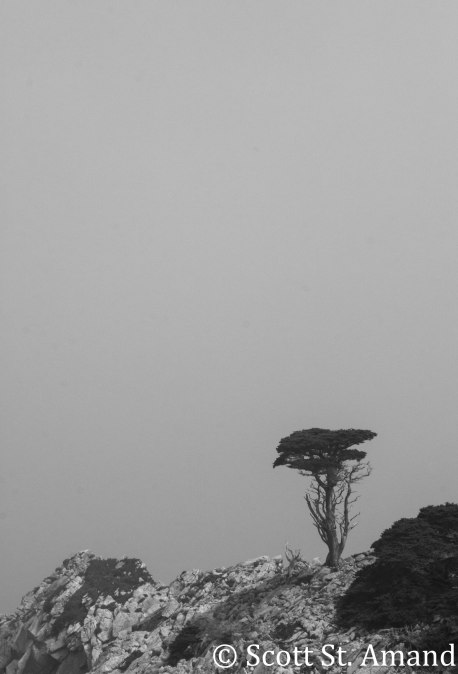
Cypress Bluff

SSA Photography (204 of 400)

This photograph of a solitary Monterey Cypress (Hesperocyparis Macrocarpa) was taken at Point Lobos in Carmel, California. The species is native to the central coast of California, but now is confined to two small relict populations – Cypress Point in Pebble Beach and Point Lobos.  The most famous of the trees is the Lone Cypress, which is found along Seventeen Mile Drive in Pebble Beach.  Though the trees can grow to over forty feet, they are generally stunted by the strong winds that blow from the Pacific, which gives them their iconic flat-topped appearance.  Although it has long been held that some of the cypresses are two millennia old, this is a romantic conception of seaside literature, and the oldest of the cypresses are likely closer to 300 years old than 2,000.  Although only two native groves remain, the trees have been widely planted outside its native range, particularly along the coasts of California and Oregon.  Indeed, some intrepid seeds have even made it to Great Britain (including the Isle of Man and the Channel Islands), France, Ireland, Greece, Italy, Portugal, and Sicily.

Click here for a larger version.


Etched

SSA Photography (392 of 400)

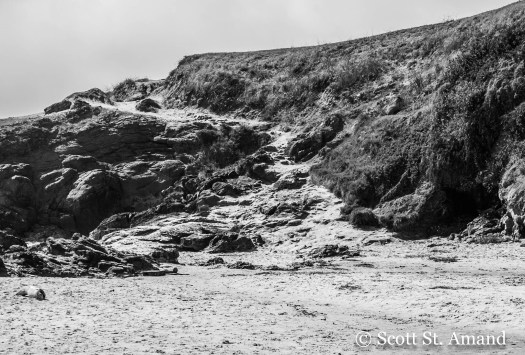
“Etch” comes to us from the German ätzen meaning “to eat” via the Dutch etsen.  Etching is the traditional process of using an acid to cut into the unprotected parts of a surface to create an intaglio (incised) design on the surface.  The word has been borrowed for human application, with it meaning something that is affixed permanently in one’s memory.  This photograph has elements of both meanings.  The breaks in the heather and scrub are beautiful, lasting reminders of what has come before.  The paths on the moors have been etched by the footfalls of generations of Yorkshiremen and, indeed, even us outsiders.  Likewise, the scenes captured along such paths, as if created by old masters, have been indelibly etched into my mind.

Click here for a larger version.

Mission Ranch

SSA Photography (332 of 400)

This photograph of my son Kemper, who was four at the time, was taken at Mission Ranch in Carmel Valley, California.  As you can see from the long shadows of the sheep, I captured this scene just before dusk as the sun had nearly set in the western sky.  Kemper adores all animals, and he wanted nothing more than to stand on the fence and watch the sheep herded into their barn for the night.  That we missed our dinner reservation was a small price to pay to see him so carefree and joyful.

Click here for a larger version.

Pod

SSA Photography (212 of 400)

I took the photograph of this pod of pelicans off of Point Lobos, in Carmel, California.  This is only the front of a much longer line of pelicans that was flying down the coast, and I thought the panorama captured them nicely against the bay and the creeping marine layer.  I love how they are all in different stages of flight, some coasting and some flapping frenetically.

Click here for a larger version (and a color version).

Starry Night

starry-night

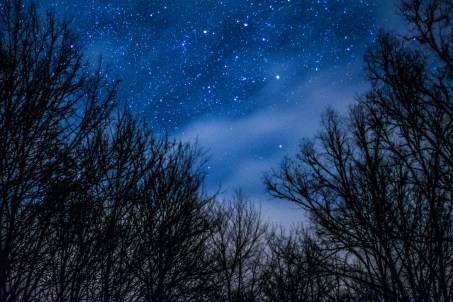
This photograph was taken around midnight in Brevard, North Carolina.  I hiked about a mile up to a remote field on the property of a family friend, where there was little to no light pollution.  It was my first attempt at astral photography, and aside from the stars being a tad out of focus, I was thrilled at how the photograph turned out.  The moon had not risen, and the field was pitch black.  I used a 30 second exposure, and I was pleasantly surprised at how the sky was illuminated.  The wisps of clouds immediately made me think of Van Gogh’s “Starry Night.”  After I uploaded the photograph and did some very minor post-processing, I trekked back up to the field.  Unfortunately, the wisps of clouds had turned into a think blanket, and all of the stars were obscured.  When we return at the new year, I hope for clear skies and good weather so that I can capture more of these scenes.

Click here for a larger version.