Herrick’s Bud

SSA Photography (171 of 400)

It’s rare that I can combine both my Latin and English major in a photography post, so I apologize for the length up front.

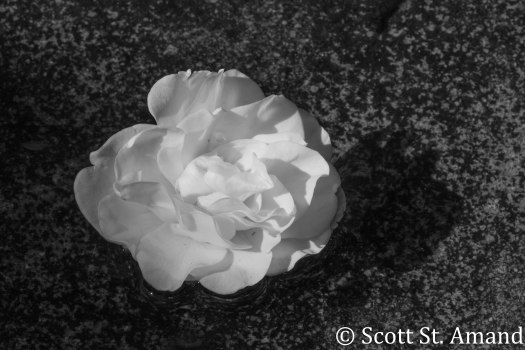
This photograph was taken in my in-laws’ garden in Carmel-by-the-Sea, California.  The title refers to the first line of the 1648 poem by Robert Herrick’s, “To the Virgins, Make Much of Time,” which even non-English majors will remember from the scene in Dead Poet’s Society.  As Robin Williams’ character notes, the theme of the poem is carpe diem – seize the day.  Carpe diem is one of those phrases that has stood the test of time and meandered its way into the modern lexicon both in its original Latin and in its widely accepted translation.  Unlike phrases such as et cetera or even cave canem (a common phrase, even written on a floor mosaic in Pompeii), carpe diem has a wonderfully beautiful, poetic history.

The ephemerality of life has long been a preoccupation of poets, and it should, therefore, be no surprise that the greatest poets of the greatest ages wrote about the transient nature of beautiful things.  One of the earliest (extant) examples is Quintus Horatius FlaccusOde 1.11, which features the line from which the phrase originates: “Sapias, vina liques, et spatio brevi spem longam reseces.  Dum loquimur, fugerit invida aetas: carpe diem, quam minimum credula postero.”  Translated, this means “Be wise, strain your wines, and because time is brief, cut short your long-term hopes.  Even while we are speaking, jealous time will have fled: so, seize the day, trusting as little as possible in what comes next.”

Carpe” is an agrarian word, and though it can be (and usually is) translated as “seize,” it would have been understood by the readers of the Ode to mean “pluck” (like a grape from the vine).  It is this meaning that Herrick ascribes to when he says, “Gather ye rosebuds while ye may / old Time is still a-flying / and this same flower that smiles today / to-morrow will be dying.”  And it is this meaning I ascribed to the photograph, which I took after my son Kemper (who was four at the time) plucked this bud for his mother, who ultimately set it afloat in the birdbath outside our window.

Click here for a larger version.

Aesacus

SSA Photography (253 of 400)

This panorama was taken near Carmel Point, the southernmost point of the coastline in Carmel-by-the-Sea, California.  The title, Aesacus, alludes to the myth memorialized in Chapter 11 of Ovid’s Metamorphoses.  The youth Aesacus fell in love with Hesperia.  As he pursued her, she was bitten by a snake and died.  Aesacus gives a brief soliloquy lamenting her death, which he says was caused by him and the snake equally.  The sentence after his speech contains one of my favorite images in Augustan-era poetry: “Dixit et e scopulo, quem rauca subederat unda, se dedit in pontum.”  (“So he spoke, and from the cliff, which the rough waves had eaten away below, he gave himself to the sea.”)  As Aesacus fell, the ocean goddess Tethys took pity on him and changed him into a diving bird.  Watching the five diving birds in the photograph flying between rocks (eaten away by the sea) made me think at once of the Aesacus myth, which gave the scene such a mournful subtext.

Click here for a larger version.
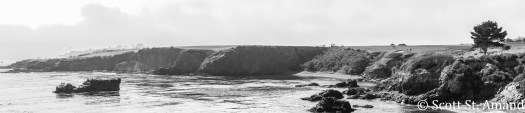
 

Pebble Hill Cypress

SSA Photography (221 of 400)

This photograph is a morning panorama of the Pebble Hill golf course just outside of Carmel, California.  In fact, the photograph was taken on the beach of Carmel Bay.  Beyond the point at the far left of the photograph is Spyglass Cove, where I have sat a number of times and just watched the sea otters and harbor seals bob between the long, whip-like strands of bull kelp.

Click here for a larger version.

Rhododendron

SSA Photography (157 of 400)

This photograph of a rhododendron bulb was one of the first macro photographs that I ever took.  It was taken in Deep Gap, North Carolina (near Brevard and Cashiers) on the property of a very close friend where my family spends two weeks in July and again at Christmas each year.   The word rhododendron is Greek for “rose tree” and counts azaleas among its many varietals.  The beautiful white-petaled flowers on this Rhododendron Maximum (“Rosebay” or “American” Rhododendron) had not yet emerged on the trees on the property, but the compact tulip-like bulbs were ripe to bloom very soon thereafter.

Click here for a larger version.

Pisgah Bridge

SSA Photography (114 of 400)

This photograph was taken in the Pisgah National Forest in western North Carolina, near Asheville and Hendersonville.  The Pisgah, as it is known, is a stunning forest with dozens if not hundreds of waterfalls and scenic trails.  There are multiple creeks and rivers running through the forest, with the Davidson being the primary tributary to the French Broad that runs the length of the forest.  The simple beauty and shadow-play of this stone bridge struck me to such a degree that I pulled off the side of the road to try to capture the chiaroscuro in a photograph. I may have nearly fallen down the embankment, but I got the picture…

Click here for a larger version.

Jewel

SSA Photography (26 of 400)

This photograph was taken in a fjord near Skagway, Alaska while on a cruise up the inner passage.  The colors and striations on the ice, especially on the glaciers (which you can see in my gallery “Ice“) were simply breathtaking.  This little iceberg was no exception.  The deep teal of the water and the smokiness of the ice made the ice look like an uncut gemstone.  The reflection on the lower left side of the ice gives it some depth, and alludes to the ninety-percent of the “jewel” which remains unseen under the water.

Click here for a larger version.

Twa Corbies

SSA Photography (235 of 400)

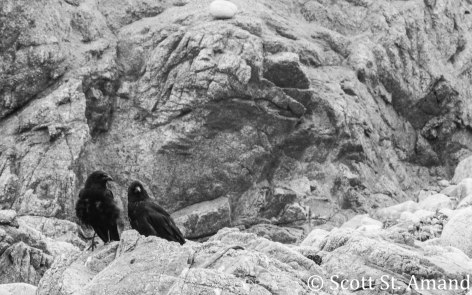
This photograph was taken on Spanish Beach, just off of Seventeen Mile Drive in Monterey, California during the Sobersanes wild fire.  The sky was sepia, and the general mood was foreboding.  When I saw these two crows (twa corbies) seemingly conspiring with one another, my mind turned back to the macabre Middle English folk song, “The Twa Corbies.”

Click here for a larger version.

Across the Way

SSA Photography (345 of 400)

This photograph was taken mid-morning from the top of the driveway of the home that my wife’s grandfather built stone by stone over decades from a ruined ostler’s barn that sat on a hill overlooking the home in which my mother-in-law grew up in West Yorkshire, England.  When the Worth Valley Railway was being built, many of the horses used to build the rails were kept in the ostler’s barn on the property, just a short walk to the eventual railway station in Oxenhope.  Anna’s grandfather was a fighter pilot in World War II, and later a textile mill owner, as well as a self-taught stone mason, who worked and kept adding to the home (nicknamed “Ostlerhouse”) quite literally until the day he died.

Click here for a larger version.