Triple Falls

_DSC1835

Like many of my photographs of waterfalls, this one was taken in the Pisgah National Forest outside of Asheville, North Carolina.  Although I quickly shy away from the compliments and comparisons some have drawn between my black and white landscape shots and the photographs of the great Ansel Adams, this one does remind me of some of his shots of the falls in Yellowstone.  If I can be half of the photographer Adams was, I think that will be accomplishment enough.

Click here for a larger version.

Path Less Travelled

Two roads diverged in a yellow wood,
And sorry I could not travel both
And be one traveler, long I stood
And looked down one as far as I could
To where it bent in the undergrowth.
-Robert Frost
These opening lines from Frost’s “The Road Not Taken” are familiar to most, as are the last two (I took the one less traveled by /and that has made all the difference), but the melancholy of the poem is seldom analyzed.  Frost wished that he could travel both paths at the same time, to be “one traveler” on both.  Frost’s poem is so relatable, both because of its simplicity and rhythmic overtones, and because we have all faced a fork in the road between one path and another.  Like Frost, we have had to make the difficult decision to trod down one path to the exclusion of the other, and like Frost, we wonder where our lives would have taken us had we ventured down the other path.
This photograph was taken in the forest surrounding Glacier Bay National Park in the southeast portion of the Inside Passage in Alaska.  I took it before I discovered my love for photography in earnest, but it has remained one of my favorite photographs.  As I have shared before, photographs of paths are a common and beloved subject of mine.  Like Frost, I am fascinated by those who have come before me–those who have “trodden the leaves black,” if you will.  I am likewise curious who will come after me, and whether they will see what I saw in the continuum of the path–its past, my present, and its future.  Perhaps this one will wash away, and a new one will be cut through the undergrowth in its place.  Perhaps it will fall out of favor, in lieu of a straighter, more direct path.  Perhaps someday a young poet will be faced with the choice between the two, and he will think of Frost like I did those years ago.

Through the Briar Patch

SSA Photography (115 of 400)

Nostalgia is a beautiful word.  It is a is learned formation of a Greek compound, consisting of the Homeric word νόστος (nóstos), meaning “homecoming” and ἄλγος (álgos), meaning “pain” or “ache”, and was coined by a 17th-century medical student to describe the anxieties displayed by Swiss mercenaries fighting away from home.  Nostalgia is a sentimentality for the past, typically for a period or place with happy personal associations.  For me, nothing evokes nostalgia like the mountains of North Carolina.  The earliest associations are of visiting the Smoky Mountains with my family when I was much younger, and later the mountains close to Winston-Salem, which were only a short drive away from Wake Forest.  For reasons I cannot explain, the feelings are strongest in the winter, when the wind has stripped away the leaves from the branches, and you can see through the skeletons of the trees through the valleys and to the peaks.  This photograph, taken outside of Brevard, North Carolina, evokes so many strong memories – all positive – which was not always the case in North Carolina.  Hindsight and nostalgia are curious like that, though.  No matter the number of disheartening days and nights, I still long to be back in the mountains.  We’re going up for a week after Christmas, and I know the feelings will rush back, satisfying the homesickness for a while.  Until then, in my mind, I’m going to Carolina…

Click here for a larger version.

Wheat & Chaff

SSA Photography (165 of 400)

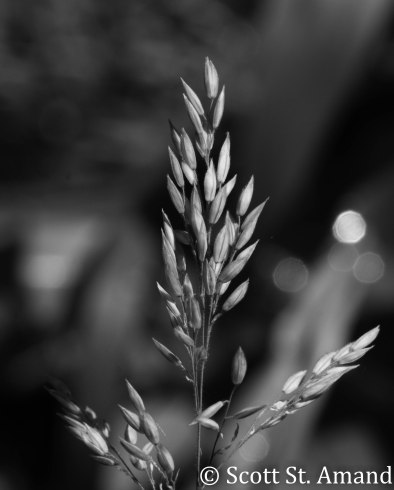
This photograph of a seedhead of tall ryegrass was taken on a high in Panthertown Creek, outside of Cashiers, North Carolina.  It is a simple photograph, and one which I would normally have skipped right over when I was sifting through the hundreds I took that day.  Nevertheless, something caught my eye in the simple elegance of the seeds and the blur and bokeh of the background.  Although not actual wheat, this native grass reminded me of the old aphorism “to separate the wheat from the chaff,” which is exactly what I do when I cull through the photographs to find the “keepers.”  The irony is not lost on me that the “chaff” nearly included this photograph.

Click here for a larger version.


Silhouette

calnov2016-9

The word silhouette is derived from the name of Étienne de Silhouette, a French finance minister who, in the mid eighteenth century, was forced by France’s credit crisis during the Seven Years’ War to impose severe economic demands upon the French people, particularly the wealthy.  Because of de Silhouette’s austere economies, his name became synonymous with anything done or made cheaply.  Prior to the advent of photography, silhouette profiles cut from black card were the cheapest way of recording a person’s appearance.  I think that this silhouette of the female photographer on the rock is one of my best black and white compositions.  The mist and morning layer in the background contrasts sharply with the wet stone in the foreground, with the tiniest break in the line of the outcropping (in perfect thirds, I might add) made by the photographer.  I cannot say that my eye was drawn to her initially, but once it caught her, my eye became curious and could not look away – and if I did, I was always drawn back.

Click here for a larger version.

Hokusai

SSA Photography (242 of 400)

I took hundreds of photographs, waiting for the waves to crash on the rocks at just the right angle, with just the right force.  This photograph evoked feelings of “The Great Wave” the famous woodblock print by by the Japanese ukiyo-e artist Hokusai in his series Thirty-Six Views of Mt. Fuji.  It also made me think of the creation myth of Aphrodite, which unlike Botticelli’s Birth of Venus, was, by all accounts, a violent affair.  Although Aphrodite can be broken down into “aphros” (foam) and “ditos” (risen), there is no direct etymological derivation.  This did not stop the Greeks (Hesiod, specifically) from crafting a story of Aphrodite rising from the foam after a great battle between Cronus and Uranus, which would foreshadow the same father-son battle between Zeus and Cronus.  In the whitewash, I can almost see Aphrodite throwing her hair back, casting off the spray as she nears the coastline.  But then, I suppose that’s what you get when your two favorite subjects in school were Latin and Art History…

Click here for a larger version, as well as a more stylized version.

As They Saw It

SSA Photography (249 of 400)

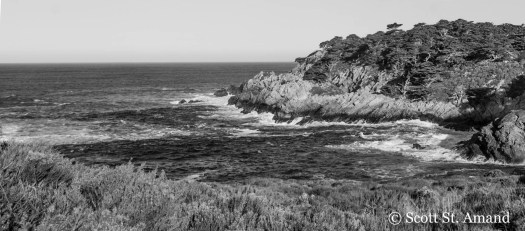
I have published many posts taken at Point Lobos, but none yet of the point itself.  Point Lobos is located a few miles south down the coast from Carmel-by-the-Sea, California, and it is one of our favorite destinations when we visit Carmel.  When I took this picture, I wanted to capture the ruggedness of the point as well as the grove of Monterey Cypresses, which as I mentioned in a previous post, is one of two groves left in the world where the cypresses grow naturally.  When I went to “develop” or post-process the photograph, and I decided to go monochromatic, I was struck by the similarities to postcards I had seen in town from the 1930s and 1940s.  The coastline remained the same, albeit a bit more worn by the waves.  They cypresses were just as withered and topped by the constant winds.  The great Californian poet Robinson Jeffers wrote extensively about the coastline in his verses, and as I gazed at the photograph, I thought to myself, this is as he would have seen it – hence the genesis of the title of the post.

Click here for a larger version (and a color version).

Perspective

Perspective

This photograph was taken in Glacier Bay National Park in Alaska.  Of all the waterfalls we saw, this was perhaps the most impressive.  Without the two people standing at its base, this would have been a great picture – a study in contrasts; but the two individuals lend such perspective to the grand scale of the waterfall that I could not, in good conscience, leave them out.  Perspective is a term that covers all manner of sins, from the linear perspective of Da Vinci, to the perspective one gains from a tragedy, to even the perspective that you grasp from the sheer insignificance of two humans set against the backdrop of indefatigable nature.

Click here for a larger version.

Cypress Bluff

SSA Photography (204 of 400)

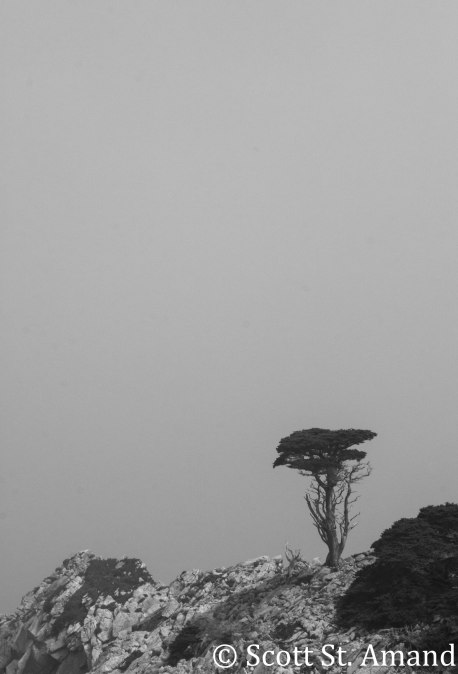
This photograph of a solitary Monterey Cypress (Hesperocyparis Macrocarpa) was taken at Point Lobos in Carmel, California. The species is native to the central coast of California, but now is confined to two small relict populations – Cypress Point in Pebble Beach and Point Lobos.  The most famous of the trees is the Lone Cypress, which is found along Seventeen Mile Drive in Pebble Beach.  Though the trees can grow to over forty feet, they are generally stunted by the strong winds that blow from the Pacific, which gives them their iconic flat-topped appearance.  Although it has long been held that some of the cypresses are two millennia old, this is a romantic conception of seaside literature, and the oldest of the cypresses are likely closer to 300 years old than 2,000.  Although only two native groves remain, the trees have been widely planted outside its native range, particularly along the coasts of California and Oregon.  Indeed, some intrepid seeds have even made it to Great Britain (including the Isle of Man and the Channel Islands), France, Ireland, Greece, Italy, Portugal, and Sicily.

Click here for a larger version.


Etched

SSA Photography (392 of 400)

“Etch” comes to us from the German ätzen meaning “to eat” via the Dutch etsen.  Etching is the traditional process of using an acid to cut into the unprotected parts of a surface to create an intaglio (incised) design on the surface.  The word has been borrowed for human application, with it meaning something that is affixed permanently in one’s memory.  This photograph has elements of both meanings.  The breaks in the heather and scrub are beautiful, lasting reminders of what has come before.  The paths on the moors have been etched by the footfalls of generations of Yorkshiremen and, indeed, even us outsiders.  Likewise, the scenes captured along such paths, as if created by old masters, have been indelibly etched into my mind.

Click here for a larger version.