Zinger

SSA Photography (140 of 400)

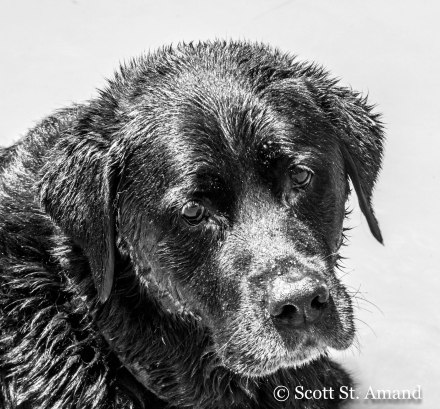
As I mentioned in a previous post, I am less comfortable taking portraits of anyone except my son, who is a willing subject.  This portrait, however, is one of my all time favorites.  Zinger was born just as the Red Sox clinched the 2004 World Series.  I was home from college, and I watched him being born to our sweet girl Hannah.  She nipped his umbilical cord too close to him, and he was left bleeding profusely.  My sister took him in her arms and staunched the blood for hours until he healed.  He was hers from that moment forward.  He loved the water, and he loved North Carolina – which is where I found him in this photograph.  We had to say goodbye to Zinger a few months ago, but he will always occupy a warm place in our hearts.

Click here for a larger version.

Remnant

SSA Photography (376 of 400)

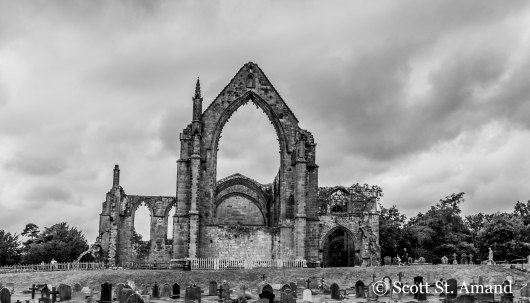
I studied art history in high school and college, learning from incredible teachers and professors.  I went to museums and saw visiting collections, but I never stood in the middle of St. Peter’s square or under the arches of a gothic cathedral until 2006 when I stood in La Seu, visited Pompeii, and walked into the middle of the Piazza San Pietro, marveling at the history that surrounded me.  Yet something about Bolton Abbey, the skeleton of which I captured in this photograph, struck me more than even walking through the ancient streets of Pompeii.  Perhaps because I was older, I had a new appreciation for the feats of architecture.  Perhaps, too, it was because I was alone with my camera and my thoughts, not being bustled about by tour guides or other eager tourists.  Whatever the difference, Bolton Abbey was more majestic to me than even St. Peter’s.  It is a memory, a remnant of time gone by, of the monarchy, of the Reformation, and of the shifting sands of faith.  While other abbeys were deconstructed during the Dissolution of the Monasteries, and all that remains of them is rubble, Bolton Abbey remains – like a fossil, its bones bared and resolute.  When I stood in the nave, I placed my hand on a monolithic column, lingering for a moment and hoping to physically connect to the priory.  With the weathered stone pressed against my hand, I wondered how many generations had set their hands upon the stonework, and at that moment I felt truly connected to a continuum of time – those who had come before and those who would come after to admire the remnant as I had.

Click here for a larger version.

Stillwater Cove

SSA Photography (215 of 400)

This photograph, which is part of my Solitary collection, was taken a little after sunrise on the banks of Stillwater Cove in Carmel-by-the-Sea, California, just below Pebble Beach.  The photograph is hazy, as the Soberanes fire was burning uncontrolled in the highlands during our visit, casting everything in a sepia glow.  This little sailboat was bobbing amongst the bull kelp and sea otters that frequent the cove.  I was captivated by the lone person on the bow of the boat, who sat there unaffected by the world that was only a hundred yards or so from him.  I, too, was by myself this morning, lost in the beauty of the cove, though the dogs on their morning walks brought me back to reality as they rollicked in the waves.

Click here for a larger version.

Oaken Post

SSA Photography (160 of 400)

This photograph was taken in the Pisgah National Forest outside of Asheville, North Carolina.  The hollowed stump was in a grove of chestnut oaks (Quercus Prinus), and the cavity had become a repository for layers upon layers of chestnut oak leaves, where a small seedling was beginning to grow from an acorn, which had fallen in just the right spot.  As I spoke about the ephemerality of nature in the Emergence post, just days ago, I am also astounded by the rhythm and circularity of nature.  In the chaos of the ferns and brambles, an old hollowed stump sheltered and fostered a month-old seedling, which will some day soon overtake the stump and take root itself.

Click here for a larger version.

Emergence

SSA Photography (169 of 400)

This photograph of an allium (a member of the garlic family) breaking out of its protective sheath has been one of my favorite photographs since I took it a couple years ago.  To me, this photograph is evocative on so many levels.  It was taken, like Herrick’s Bud in my in-laws’ garden in Carmel, California.  Although I thought that the emergence would be relatively slow, I came back the next day and the buds had fully emerged, with the sheath having shriveled up and hanging by the wayside.  The ephemera of nature is simply amazing to me.  I hope you enjoy this photograph as much as I do.

Click here for a larger version.

Left Behind

SSA Photography (395 of 400)

This photograph was taken on the moors outside Haworth, West Yorkshire, England.  The two figures in the distance are my mother-in-law and her brother, who left my wife, Anna, and I to scramble up and down the moors in a vain attempt to keep them in our sight.  The “walk” (and I use this term loosely) was gorgeous in hindsight, as the pictures attest; however, during the trip (which I contend was on average 98% vertical), I thought my legs were going to give out at least three times.  Nevertheless, I made it, and that in and of itself was an accomplishment.  The photographs that I took were icing on the proverbial cake.

Click here for a larger version.

Kintsugi

SSA Photography (78 of 400)

In an series of three poignant essays, F. Scott Fitzgerald once wrote that he was fractured like a dinner plate that you would hide from the neighbors if they came over.  One of the greatest writers of the early 20th Century had indeed “cracked” under the pressure of his own success.  I identified with Fitzgerald’s essays—and Fitzgerald himself—on many levels, except that once cracked up, Fitzgerald never ventured to put himself back together again.

The Japanese have a beautiful word, kintsugi, which is the art of repairing broken pottery with lacquer, generally mixed with powdered precious metals like gold.  Kintsugi, however, stretches far beyond the art form.  It has become a philosophy, which accentuates the breakage and repair of the object as evidence of its history—rather than something to disguise or sweep into the dustbin.  The fractures are part of the object’s story, part of its beautiful memory.

We are all broken, some of us more than others, but these faults, these breaks shape who we are when we come out the other side—but only if we venture to put ourselves back together again like a shattered vase in the hands of an artist.

Click here for a larger version.

Shadow Play

SSA Photography (89 of 400)

Taken at Big Talbot Island, north of Jacksonville, Florida, the lines and shadows of this photograph of driftwood cobbled together on the beach draw the eye to the center of the mass of wood.  After the hurricane last year, this particular grouping of driftwood is no longer on the beach, so I was fortunate to capture it when I did.

Click here for a larger version.

Wooded Ways

SSA Photography (16 of 400)

I have a fascination with taking photographs of paths, which is evident by my whole gallery of them.  This photo of a rainforest path was taken on a hike in Glacier Bay National Park in southeast Alaska.

For me, paths evoke transience and the journey that we are all on.  In keeping with my spate of Latin-related posts, I was reminded of a quote by the Augustan-era poet Catullus, who understood this journey down the path of life well, and who often wrote about it in his Carmena.  In Carmen 46, Catullus bids farewell to his friends in Bithynia (a city in Asia Minor near Nicea) as he heads back home to Rome.  On leaving, he declares, “Farewell, sweet company of friends, who, having also wandered far from home, diverse paths carry back.”  (O dulces comitum valete coetus / longe quos simul a domo profectos / diversae varie viae reportant.)

Click here for a larger version.