Worth

MoorWalk-8.jpg

How I arrived at the top of this particular moor, I don’t really care to recount.  It suffices to say, that in a land of paths cut by more intrepid travelers over the centuries, there were no paths at the top of this moor, as we were, apparently, four of the only masochists to decide that it was prudent to visit the rock in the left foreground of the photograph.  I would have grumbled the entire way, as I am wont to do, but I had no breath.  Thus, the grumbling was internal–albeit vociferous.  Nevertheless, when we reached the apex of this last moor (we had already traversed at least four), my grumbling ceased.  I even managed to catch my breath, and yet I did not utter a discouraging word.  How could I at such a magnificent sight.  The purple heather that I disregarded with certain animosity as I trapsed through it was gorgeous, and gave the moors on the horizon an almost surreal violet hue in patches.

Three miles or so down in the Worth Valley is where Anna’s grandfather build their house, stone by stone, from the ruins of an ostler barn.  It is where Anna’s mother grew up, and where I proposed to her in a field across the valley from the house–but in a line of sight from the kitchen window, so that we could always look over to the field when we were at the house.  Looking further into the horizon, you can make out a pinpoint landmark, which is the rock outcropping that we came to mount.  This is where the Brontë sisters wrote their novels, and in fact Top Withens, the inspiration for Heathcliff’s home in Wuthering Heights, sat only minutes away atop an adjacent moor.  A steam train runs through the middle of the valley, on which tracks Anna’s great-great-grandfather was an engineer.  The valley is of another time, and it affects me like no other place I have visited in the world.

Click here for a larger version.

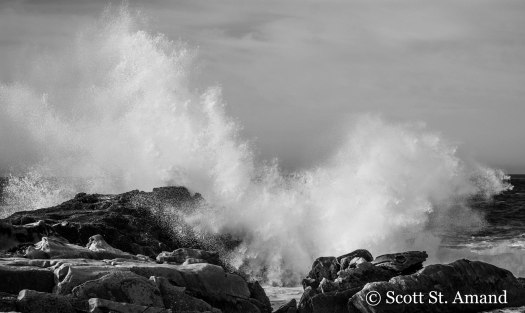
Crash

SSA Photography (266 of 400)

The Pacific intrigues me like no other body of water.  Having grown up minutes from the Atlantic Ocean, I am accustomed to what I always considered crashing waves.  I remember the muscle memory as a child of being tossed and rolled in the waves after a visit to the beach lasting for hours after we arrived back home.  The sheer strength of the Pacific dulls these memories somewhat, and forces me to reconsider the awe of my childhood fascination with the placid Atlantic.

This photograph was taken amongst the rocks in Carmel Bay.  Although the crash of the waves in this photograph is impressive, the highest swells and tallest sprays seemed to come the moment I turned my camera off after waiting for the next great wave to roll in.  Kemper joined me on this trek down to the water’s edge, but he was more interested in throwing pebbles to the tide pools than the august waves and cacophony of them extinguishing themselves on the rocks.  Perhaps he is jaded, having grown up with the Pacific, or perhaps he is simply a child, whose attention is drawn more by his controlling of nature than nature’s control over the elements.

The morning layer was thick when I dragged him from bed to amble down to the coastline, and the colors were muted.  The deep dark shades of the wet rocks and the brilliant white of the salt spray were perfect contrasts, and so my inclination to monochrome most of my photographs was well founded in this one.   Although I am taking more photographs with Kemper in them, which capture his growth and my fondness of him journeying with me as I did with my father, I had not yet begun this practice when I captured this wave against the rocks of Carmel Bay.  When we return, hopefully soon, to California, I will rectify this shortcoming.  Perhaps he is old enough now to appreciate the power of the Pacific, but more likely, he will return to his old pursuits of watching his ripples in the tide pools as I wait for the great wave.

Click here for a larger version.

Morning through the Maples

NCWinter2018-85

Dawn is often a foggy affair in the mountains.  This photograph was taken off of the front porch of our cabin in Brevard, North Carolina.  We have come up for a week, and though we have been up for only two days, I am reinvigorated after a long year at work.  Foggy beginnings seem familiar and yet foreign.  Though I am nostalgic for many things, living in a metaphorical fog is not amongst them.  Waking up, walking outside with a hot cup of tea, and watching as the low clouds creep through the maples is something different entirely.  Being here with my family, who walked through the fog with me, and seeing my son slushing through the creeks on the property like I did when I was his age is inspiring.  Even though the dawn is foggy, the sunlight burns through in the end.

Click here for a larger version.

Cumulus Trails

SSA Photography (30 of 400)

The beautiful irony of this photograph is that I have little memory of where it was taken in Alaska.  The tall mountain, offset by thirds from the center, may or may not have a name, and then, it may only be known to the natives.  It is tall enough to be the highest peak in a number of the contiguous states, tall enough to catch the cumulus clouds that passed by, hooking them on its summit, and tall enough that it should be memorable–but that is the awful truth of Alaska’s wilderness, the majesty is overwhelming.  For nature lovers like I am, it was a total sensory overload.  I snapped thousands of pictures, not photographs, but pictures to simply document what I could not trust my visual cortex to process.  That I managed to take this photograph and others as beautiful was simple dumb luck.  Even a blind squirrel finds an acorn every once in a while.

I long to go back to Alaska with better gear and a better understanding of what to expect.  Using kit lenses on my Nikon D40 in automatic mode was like cutting one’s first filet mignon with a teaspoon, ultimately effective, but crude and personally unsatisfying in hindsight.  Still, I cannot regret the photographic experience totally.  I stumbled on some amazing photographs through the law of averages.  When your subject is so magnificent, it is hard not to capture some inkling of the awe, as here with this unnamed mountain, likely passed by in a matter of minutes during our cruise up the inside passage as the clouds passed with equal celerity over the peak, trailing it like a wispy pennant casually waving in the boreal air.

Click here for a larger version, and see the rest of my Alaska portfolio here.

Setting above the Sycamores

SSA Photography (397 of 400)

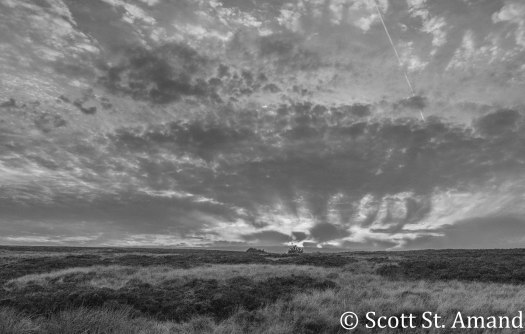
This was the last photograph I took on our trip to England in late August of this year.  I was tired, having climbed over moors, through the dales and back again at least four times over the course of the three hours or so.  The flatness of this picture belies the vertical bent of everything in England.  The sunset was magnificent because the clouds in the sky possessed such an impressionist character.  The patch of sycamores on the horizon grew closer and closer as we approached the setting sun, with Top Withens (the inspiration for Wuthering Heights) behind us.  There were no paths towards the top of the hike, which should have been an early harbinger of the difficulty of the climb.  For all I knew (and willingly shared with the rest of the hiking group), we were likely the only masochists to have made the hike for generations.  As we wended our way through the dense heather and tall wild grasses and bracken ferns, and I gasped for breath at manageable intervals, I thought back on that field twelve years prior where I proposed in a similar field across the valley from Anna’s grandparent’s house, amongst a small herd black and white Friesians.

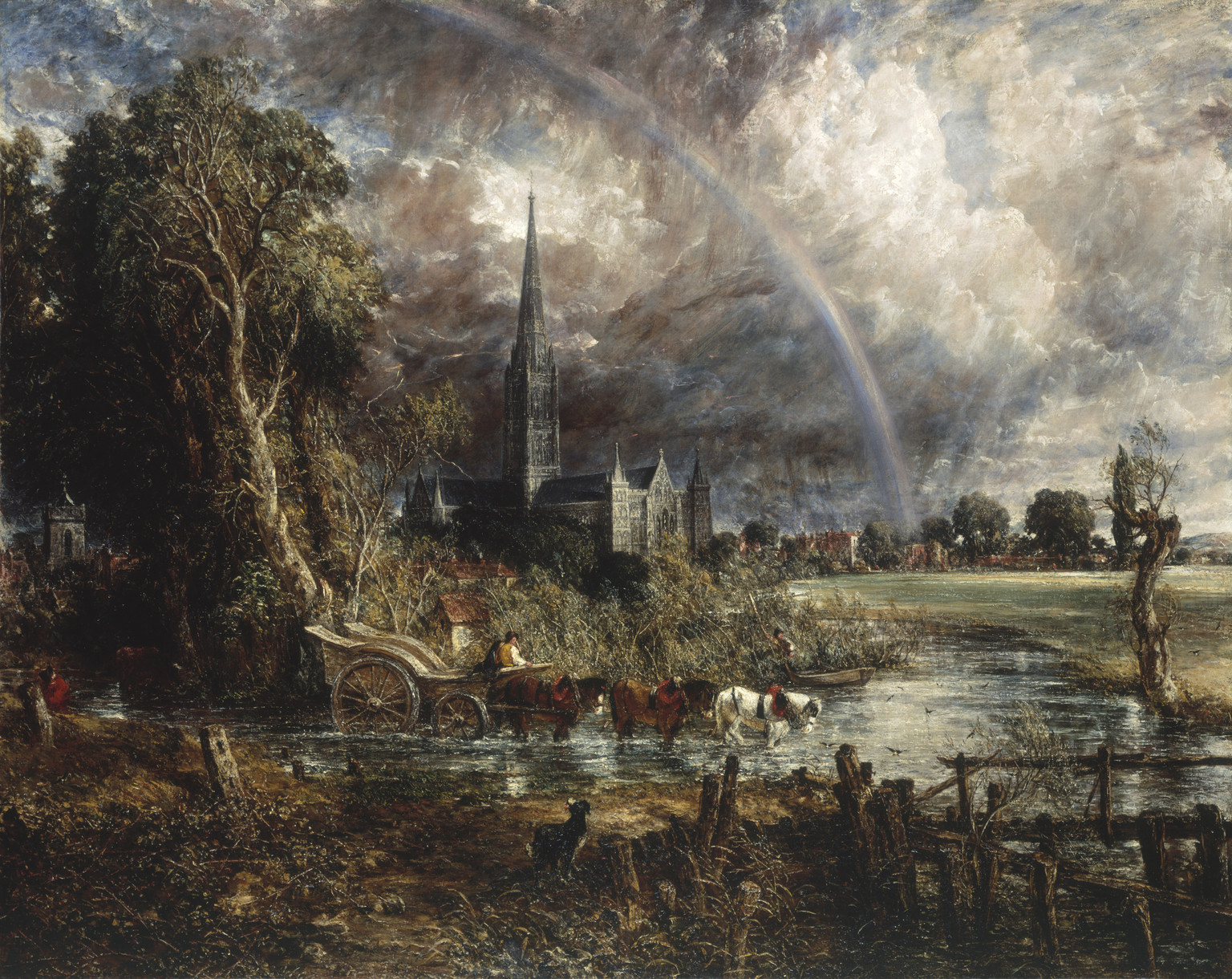
The beauty of Yorkshire has ceased to surprise me.  By this, I do not mean that it has become any less wondrous or awe inspiring, only that I have come to expect to look out on a field and see the beauty that inspired the Brontës and Wordsworth and John Constable and all of the other artists that have spent their lives’ work attempting to capture the magnificence of this landscape.  Indeed, the sky was something out of Constable’s painting of Salisbury Cathedral (sans the rainbow).  The beauty is almost laughably ubiquitous.  I have been to England three times now, and each time I am left with the distinct sensation that I was born on the wrong continent.  My archaic turns of phrases, my passion for history and ancient things, all find root in the mother country.  Anna’s grandmother, a strong Yorkshire woman, who still travels the world at 94, has adopted me as her “cloth” grandson, an appellation that I take very seriously, and I have been warmly embraced by the network of aunties and cousins — just the toe-holds I needed to claim a bit of Yorkshire as my own.

Click here for a larger version.

Among the Ferns

SSA Photography (390 of 400)

These bracken ferns on the moors in Yorkshire are substantially shorter than those in the lake district; nevertheless, they nearly engulfed my wife, Anna, as she tried to follow the path cut between the fiddleheads that popped out from the skeletons of heather, long since overcome by the dark green ferns.  This photograph was taken at dusk outside of Haworth, England, where the Brontë sisters lived and wrote.  Their stories were heavily   influenced by the moors and the hardy people who lived on them (especially Wuthering Heights).  Indeed, in this photograph, on the horizon to the left, there is a lone sycamore next to the barely perceptible ruins of a farmhouse (Top Withens), which is said to be the inspiration for Wuthering Heights.  My mother-in-law grew up among the ferns on the moors, and she is closer to nature than anyone I have ever met.  Yorkshire does something indelible to a person.  The first time you walk over the top of a moor and look down into the Worth Valley at the train steaming along the tracks towards Leeds, you realize that you are in a living snapshot of a much simpler time.

Click here for a larger version.

China Cove

SSA Photography (207 of 400)

The colors of China Cove in Point Lobos State Natural Reserve are surreal.  The first time I saw China Cove was on a postcard in Carmel.  That postcard, and this photograph do not do justice to the emeralds and turquoises of the water, framed by dense, dark bull kelp.  I took this picture before I came into possession of a ultra wide angle lens, and so I am looking forward to capturing the whole cove when we go back to California next.

Click here for a larger version.
Etched

SSA Photography (392 of 400)

“Etch” comes to us from the German ätzen meaning “to eat” via the Dutch etsen.  Etching is the traditional process of using an acid to cut into the unprotected parts of a surface to create an intaglio (incised) design on the surface.  The word has been borrowed for human application, with it meaning something that is affixed permanently in one’s memory.  This photograph has elements of both meanings.  The breaks in the heather and scrub are beautiful, lasting reminders of what has come before.  The paths on the moors have been etched by the footfalls of generations of Yorkshiremen and, indeed, even us outsiders.  Likewise, the scenes captured along such paths, as if created by old masters, have been indelibly etched into my mind.

Click here for a larger version.

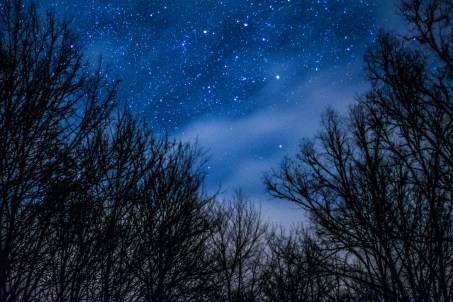
Starry Night

starry-night

This photograph was taken around midnight in Brevard, North Carolina.  I hiked about a mile up to a remote field on the property of a family friend, where there was little to no light pollution.  It was my first attempt at astral photography, and aside from the stars being a tad out of focus, I was thrilled at how the photograph turned out.  The moon had not risen, and the field was pitch black.  I used a 30 second exposure, and I was pleasantly surprised at how the sky was illuminated.  The wisps of clouds immediately made me think of Van Gogh’s “Starry Night.”  After I uploaded the photograph and did some very minor post-processing, I trekked back up to the field.  Unfortunately, the wisps of clouds had turned into a think blanket, and all of the stars were obscured.  When we return at the new year, I hope for clear skies and good weather so that I can capture more of these scenes.

Click here for a larger version.

Bixby Canyon Bridge

SSA Photography (174 of 400)

I descended a dusty gravel ridge
Beneath the Bixby Canyon Bridge
Until I eventually arrived
At the place where your soul had died
Barefoot in the shallow creek,
I grabbed some stones from underneath
And waited for you to speak to me
And the silence; it became so very clear
That you had long ago disappeared
I cursed myself for being surprised
That this didn’t play like it did in my mind
-Death Cab for Cutie
This photograph of the Bixby Canyon Bridge in Big Sur, California, just after dawn shows the marine layer lifting from the bay, slowly creeping up the mountains, only to burn off completely by the early afternoon.  The bridge spanning Bixby Creek is one of many on Route 1 down the coast of California south of Carmel, but it is probably the most famous.  The bridge has a rich history, opening in 1932 to connect the residents of Big Sur with Carmel and San Francisco further to the north.  When it was built, it was the longest concrete arch span the west coast.  It remains one of the tallest single-span concrete bridges in the world.  It is narrower (by eight feet) than the required width of modern bridges, but due to its historic relevance, expansion is unlikely.
Click here for a larger version.