Wheat & Chaff

SSA Photography (165 of 400)

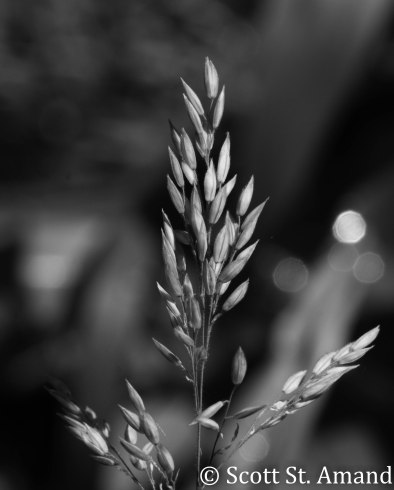
This photograph of a seedhead of tall ryegrass was taken on a high in Panthertown Creek, outside of Cashiers, North Carolina.  It is a simple photograph, and one which I would normally have skipped right over when I was sifting through the hundreds I took that day.  Nevertheless, something caught my eye in the simple elegance of the seeds and the blur and bokeh of the background.  Although not actual wheat, this native grass reminded me of the old aphorism “to separate the wheat from the chaff,” which is exactly what I do when I cull through the photographs to find the “keepers.”  The irony is not lost on me that the “chaff” nearly included this photograph.

Click here for a larger version.


Silhouette

calnov2016-9

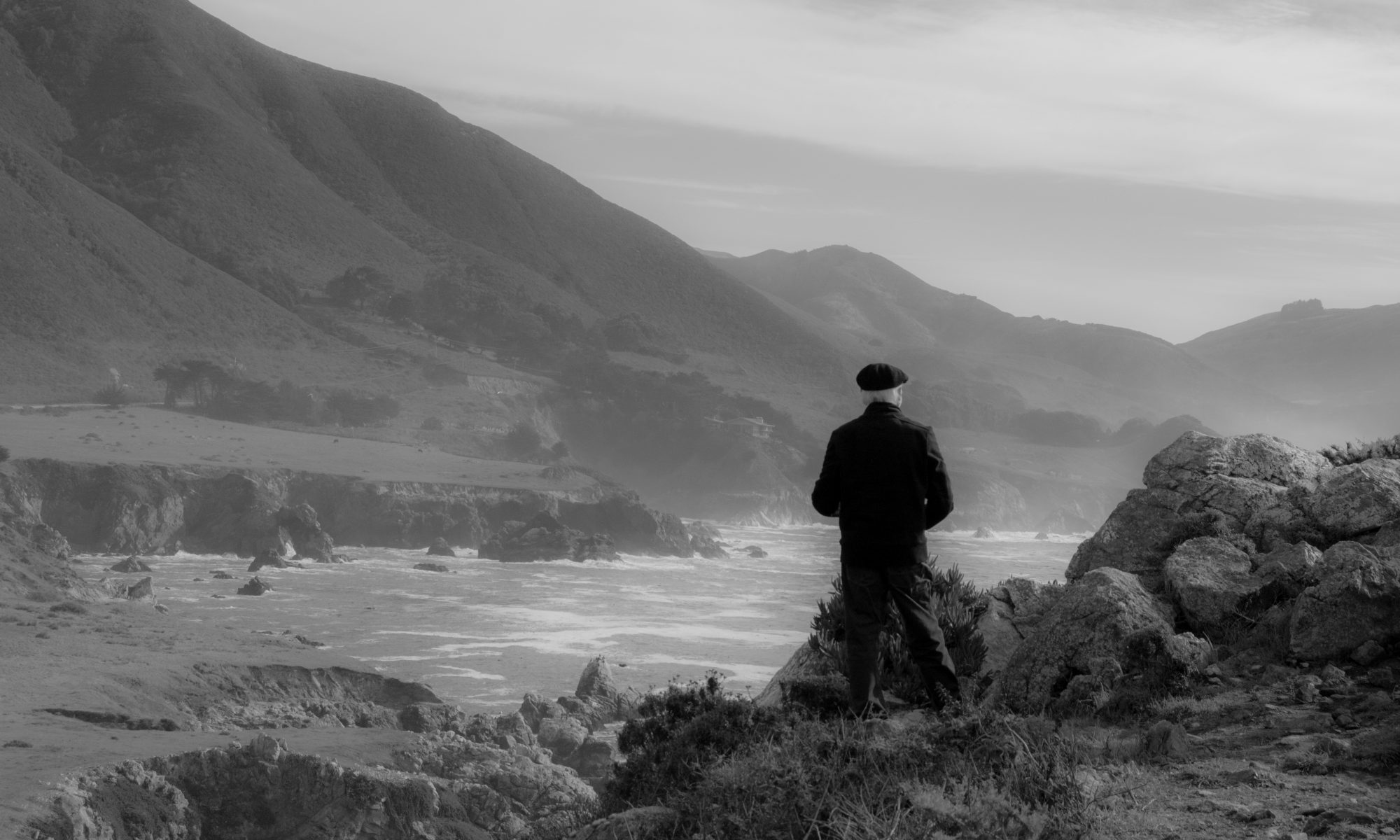
The word silhouette is derived from the name of Étienne de Silhouette, a French finance minister who, in the mid eighteenth century, was forced by France’s credit crisis during the Seven Years’ War to impose severe economic demands upon the French people, particularly the wealthy.  Because of de Silhouette’s austere economies, his name became synonymous with anything done or made cheaply.  Prior to the advent of photography, silhouette profiles cut from black card were the cheapest way of recording a person’s appearance.  I think that this silhouette of the female photographer on the rock is one of my best black and white compositions.  The mist and morning layer in the background contrasts sharply with the wet stone in the foreground, with the tiniest break in the line of the outcropping (in perfect thirds, I might add) made by the photographer.  I cannot say that my eye was drawn to her initially, but once it caught her, my eye became curious and could not look away – and if I did, I was always drawn back.

Click here for a larger version.
Hokusai

SSA Photography (242 of 400)

I took hundreds of photographs, waiting for the waves to crash on the rocks at just the right angle, with just the right force.  This photograph evoked feelings of “The Great Wave” the famous woodblock print by by the Japanese ukiyo-e artist Hokusai in his series Thirty-Six Views of Mt. Fuji.  It also made me think of the creation myth of Aphrodite, which unlike Botticelli’s Birth of Venus, was, by all accounts, a violent affair.  Although Aphrodite can be broken down into “aphros” (foam) and “ditos” (risen), there is no direct etymological derivation.  This did not stop the Greeks (Hesiod, specifically) from crafting a story of Aphrodite rising from the foam after a great battle between Cronus and Uranus, which would foreshadow the same father-son battle between Zeus and Cronus.  In the whitewash, I can almost see Aphrodite throwing her hair back, casting off the spray as she nears the coastline.  But then, I suppose that’s what you get when your two favorite subjects in school were Latin and Art History…

Click here for a larger version, as well as a more stylized version.

As They Saw It

SSA Photography (249 of 400)

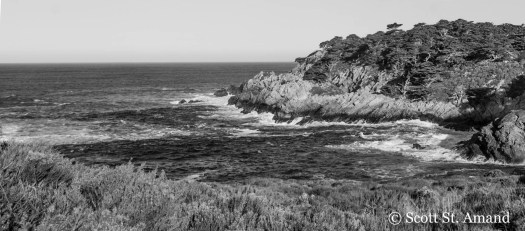
I have published many posts taken at Point Lobos, but none yet of the point itself.  Point Lobos is located a few miles south down the coast from Carmel-by-the-Sea, California, and it is one of our favorite destinations when we visit Carmel.  When I took this picture, I wanted to capture the ruggedness of the point as well as the grove of Monterey Cypresses, which as I mentioned in a previous post, is one of two groves left in the world where the cypresses grow naturally.  When I went to “develop” or post-process the photograph, and I decided to go monochromatic, I was struck by the similarities to postcards I had seen in town from the 1930s and 1940s.  The coastline remained the same, albeit a bit more worn by the waves.  They cypresses were just as withered and topped by the constant winds.  The great Californian poet Robinson Jeffers wrote extensively about the coastline in his verses, and as I gazed at the photograph, I thought to myself, this is as he would have seen it – hence the genesis of the title of the post.

Click here for a larger version (and a color version).

Bee and Balm

SSA Photography (164 of 400)

This photograph is a companion to Anna’s Hummingbird, which I posted on Wednesday.  This photograph shows a bee and its balm, specifically a Halictus Poeyi (sweat “furrow” bee) about to collect pollen from a Monarda Clinopodia (white “bergamot” bee balm).  The sweat bee and bee balm are native to North Carolina, where this photograph was taken.  I was busy taking macro photographs of the native flowers in the beautiful gardens of a family friend, and I hardly noticed this little bee hovering near the dew-kissed bee balm.  I was looking at my camera screen to see whether I had captured a focused shot of the flower when he drew closer, and I was able to catch him mid-flight.  I would have loved to increase the shutter speed to catch his wings, as I did with Anna’s Hummingbird, but the lighting under the the dense rhododendrons was not conducive to such a shot.

Click here for a larger version.

Daylight on the Davidson

Version 2

“The gray-eyed morn smiles on the frowning night,
checkering the eastern clouds with streaks of light…”
-Shakespeare
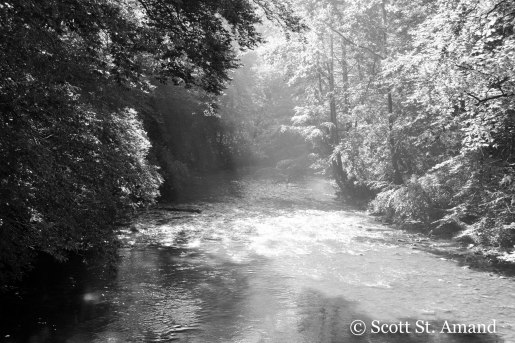
This photograph was taken at dawn in the Pisgah National Forest on the banks of the Davidson River.  The sun through the dappled leaves left streaks in the dewy air, which I attempted to capture in this photograph.  The shadow-play made the exposure a bit tricky, but overall I have always enjoyed this photograph and its even its color version.  We are venturing back to the Pisgah in December, and I look forward to capturing even more scenes of the rivers and falls once there.
Click here for a larger version (and a color version).

Bixby Canyon Bridge

SSA Photography (174 of 400)

I descended a dusty gravel ridge
Beneath the Bixby Canyon Bridge
Until I eventually arrived
At the place where your soul had died
Barefoot in the shallow creek,
I grabbed some stones from underneath
And waited for you to speak to me
And the silence; it became so very clear
That you had long ago disappeared
I cursed myself for being surprised
That this didn’t play like it did in my mind
-Death Cab for Cutie
This photograph of the Bixby Canyon Bridge in Big Sur, California, just after dawn shows the marine layer lifting from the bay, slowly creeping up the mountains, only to burn off completely by the early afternoon.  The bridge spanning Bixby Creek is one of many on Route 1 down the coast of California south of Carmel, but it is probably the most famous.  The bridge has a rich history, opening in 1932 to connect the residents of Big Sur with Carmel and San Francisco further to the north.  When it was built, it was the longest concrete arch span the west coast.  It remains one of the tallest single-span concrete bridges in the world.  It is narrower (by eight feet) than the required width of modern bridges, but due to its historic relevance, expansion is unlikely.
Click here for a larger version.

Roil

SSA Photography (262 of 400)

This photograph was taken on a blustery morning in Carmel-by-the-Sea, California.  The winds were coming through the bay at a fierce clip, and the waves were the largest I had ever seen.  We went on a hike to Point Lobos, and I captured this scene after one of the larger waves had crashed across the rocks – completely covering them in a mix of foam and roil.  One of the apocryphal origins to the name Aphrodite is “risen from the foam,” but I cannot imagine that this was the type of scene the ancients envisioned of her birth.  I think Botticelli got it right.  The violence of the waves made me marvel at the strength of the stone, which has invariably been battered for eons.  Love is like that in many ways, often beaten but never broken…so perhaps the ancients were onto something…

Click here for a larger version.

Stillwater Cove

SSA Photography (215 of 400)

This photograph, which is part of my Solitary collection, was taken a little after sunrise on the banks of Stillwater Cove in Carmel-by-the-Sea, California, just below Pebble Beach.  The photograph is hazy, as the Soberanes fire was burning uncontrolled in the highlands during our visit, casting everything in a sepia glow.  This little sailboat was bobbing amongst the bull kelp and sea otters that frequent the cove.  I was captivated by the lone person on the bow of the boat, who sat there unaffected by the world that was only a hundred yards or so from him.  I, too, was by myself this morning, lost in the beauty of the cove, though the dogs on their morning walks brought me back to reality as they rollicked in the waves.

Click here for a larger version.
Oaken Post

SSA Photography (160 of 400)

This photograph was taken in the Pisgah National Forest outside of Asheville, North Carolina.  The hollowed stump was in a grove of chestnut oaks (Quercus Prinus), and the cavity had become a repository for layers upon layers of chestnut oak leaves, where a small seedling was beginning to grow from an acorn, which had fallen in just the right spot.  As I spoke about the ephemerality of nature in the Emergence post, just days ago, I am also astounded by the rhythm and circularity of nature.  In the chaos of the ferns and brambles, an old hollowed stump sheltered and fostered a month-old seedling, which will some day soon overtake the stump and take root itself.

Click here for a larger version.
