Among the Ferns

SSA Photography (390 of 400)

These bracken ferns on the moors in Yorkshire are substantially shorter than those in the lake district; nevertheless, they nearly engulfed my wife, Anna, as she tried to follow the path cut between the fiddleheads that popped out from the skeletons of heather, long since overcome by the dark green ferns.  This photograph was taken at dusk outside of Haworth, England, where the Brontë sisters lived and wrote.  Their stories were heavily   influenced by the moors and the hardy people who lived on them (especially Wuthering Heights).  Indeed, in this photograph, on the horizon to the left, there is a lone sycamore next to the barely perceptible ruins of a farmhouse (Top Withens), which is said to be the inspiration for Wuthering Heights.  My mother-in-law grew up among the ferns on the moors, and she is closer to nature than anyone I have ever met.  Yorkshire does something indelible to a person.  The first time you walk over the top of a moor and look down into the Worth Valley at the train steaming along the tracks towards Leeds, you realize that you are in a living snapshot of a much simpler time.

Click here for a larger version.

China Cove

SSA Photography (207 of 400)

The colors of China Cove in Point Lobos State Natural Reserve are surreal.  The first time I saw China Cove was on a postcard in Carmel.  That postcard, and this photograph do not do justice to the emeralds and turquoises of the water, framed by dense, dark bull kelp.  I took this picture before I came into possession of a ultra wide angle lens, and so I am looking forward to capturing the whole cove when we go back to California next.

Click here for a larger version.

Wheat & Chaff

SSA Photography (165 of 400)

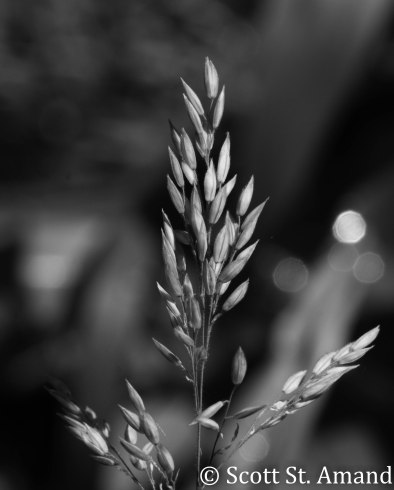
This photograph of a seedhead of tall ryegrass was taken on a high in Panthertown Creek, outside of Cashiers, North Carolina.  It is a simple photograph, and one which I would normally have skipped right over when I was sifting through the hundreds I took that day.  Nevertheless, something caught my eye in the simple elegance of the seeds and the blur and bokeh of the background.  Although not actual wheat, this native grass reminded me of the old aphorism “to separate the wheat from the chaff,” which is exactly what I do when I cull through the photographs to find the “keepers.”  The irony is not lost on me that the “chaff” nearly included this photograph.

Click here for a larger version.


Silhouette

calnov2016-9

The word silhouette is derived from the name of Étienne de Silhouette, a French finance minister who, in the mid eighteenth century, was forced by France’s credit crisis during the Seven Years’ War to impose severe economic demands upon the French people, particularly the wealthy.  Because of de Silhouette’s austere economies, his name became synonymous with anything done or made cheaply.  Prior to the advent of photography, silhouette profiles cut from black card were the cheapest way of recording a person’s appearance.  I think that this silhouette of the female photographer on the rock is one of my best black and white compositions.  The mist and morning layer in the background contrasts sharply with the wet stone in the foreground, with the tiniest break in the line of the outcropping (in perfect thirds, I might add) made by the photographer.  I cannot say that my eye was drawn to her initially, but once it caught her, my eye became curious and could not look away – and if I did, I was always drawn back.

Click here for a larger version.

Hokusai

SSA Photography (242 of 400)

I took hundreds of photographs, waiting for the waves to crash on the rocks at just the right angle, with just the right force.  This photograph evoked feelings of “The Great Wave” the famous woodblock print by by the Japanese ukiyo-e artist Hokusai in his series Thirty-Six Views of Mt. Fuji.  It also made me think of the creation myth of Aphrodite, which unlike Botticelli’s Birth of Venus, was, by all accounts, a violent affair.  Although Aphrodite can be broken down into “aphros” (foam) and “ditos” (risen), there is no direct etymological derivation.  This did not stop the Greeks (Hesiod, specifically) from crafting a story of Aphrodite rising from the foam after a great battle between Cronus and Uranus, which would foreshadow the same father-son battle between Zeus and Cronus.  In the whitewash, I can almost see Aphrodite throwing her hair back, casting off the spray as she nears the coastline.  But then, I suppose that’s what you get when your two favorite subjects in school were Latin and Art History…

Click here for a larger version, as well as a more stylized version.

As They Saw It

SSA Photography (249 of 400)

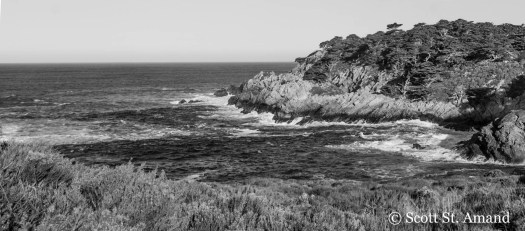
I have published many posts taken at Point Lobos, but none yet of the point itself.  Point Lobos is located a few miles south down the coast from Carmel-by-the-Sea, California, and it is one of our favorite destinations when we visit Carmel.  When I took this picture, I wanted to capture the ruggedness of the point as well as the grove of Monterey Cypresses, which as I mentioned in a previous post, is one of two groves left in the world where the cypresses grow naturally.  When I went to “develop” or post-process the photograph, and I decided to go monochromatic, I was struck by the similarities to postcards I had seen in town from the 1930s and 1940s.  The coastline remained the same, albeit a bit more worn by the waves.  They cypresses were just as withered and topped by the constant winds.  The great Californian poet Robinson Jeffers wrote extensively about the coastline in his verses, and as I gazed at the photograph, I thought to myself, this is as he would have seen it – hence the genesis of the title of the post.

Click here for a larger version (and a color version).

Bee and Balm

SSA Photography (164 of 400)

This photograph is a companion to Anna’s Hummingbird, which I posted on Wednesday.  This photograph shows a bee and its balm, specifically a Halictus Poeyi (sweat “furrow” bee) about to collect pollen from a Monarda Clinopodia (white “bergamot” bee balm).  The sweat bee and bee balm are native to North Carolina, where this photograph was taken.  I was busy taking macro photographs of the native flowers in the beautiful gardens of a family friend, and I hardly noticed this little bee hovering near the dew-kissed bee balm.  I was looking at my camera screen to see whether I had captured a focused shot of the flower when he drew closer, and I was able to catch him mid-flight.  I would have loved to increase the shutter speed to catch his wings, as I did with Anna’s Hummingbird, but the lighting under the the dense rhododendrons was not conducive to such a shot.

Click here for a larger version.

Etched

SSA Photography (392 of 400)

“Etch” comes to us from the German ätzen meaning “to eat” via the Dutch etsen.  Etching is the traditional process of using an acid to cut into the unprotected parts of a surface to create an intaglio (incised) design on the surface.  The word has been borrowed for human application, with it meaning something that is affixed permanently in one’s memory.  This photograph has elements of both meanings.  The breaks in the heather and scrub are beautiful, lasting reminders of what has come before.  The paths on the moors have been etched by the footfalls of generations of Yorkshiremen and, indeed, even us outsiders.  Likewise, the scenes captured along such paths, as if created by old masters, have been indelibly etched into my mind.

Click here for a larger version.
Daylight on the Davidson

Version 2

“The gray-eyed morn smiles on the frowning night,
checkering the eastern clouds with streaks of light…”
-Shakespeare
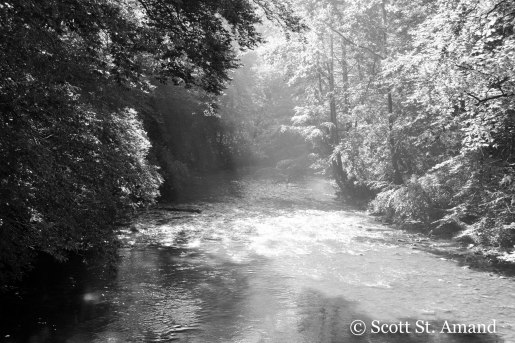
This photograph was taken at dawn in the Pisgah National Forest on the banks of the Davidson River.  The sun through the dappled leaves left streaks in the dewy air, which I attempted to capture in this photograph.  The shadow-play made the exposure a bit tricky, but overall I have always enjoyed this photograph and its even its color version.  We are venturing back to the Pisgah in December, and I look forward to capturing even more scenes of the rivers and falls once there.
Click here for a larger version (and a color version).