Cypress Sunset

SSA Photography (277 of 400)

I have observed many sunsets in California over the past three years.  The view west from my in-laws’ house peeks through the greenery to a patch of ocean and sky.  There was nothing particularly special about this night’s sunset.  The sky was a bit hazy, which somewhat amplified the corona, but there were no pinks or purples to speak of just above the horizon, as I had seen on a number of occasions.  Still, I managed to wrestle myself away from the others and stroll down to the path that runs along the ocean on Scenic Drive in Carmel-by-the-Sea.  I took a number of shots of the setting sun, but this one, framed by two yin and yang Monterey cypresses, was my favorite of the lot.

Click here for a larger version.

Worth

MoorWalk-8.jpg

How I arrived at the top of this particular moor, I don’t really care to recount.  It suffices to say, that in a land of paths cut by more intrepid travelers over the centuries, there were no paths at the top of this moor, as we were, apparently, four of the only masochists to decide that it was prudent to visit the rock in the left foreground of the photograph.  I would have grumbled the entire way, as I am wont to do, but I had no breath.  Thus, the grumbling was internal–albeit vociferous.  Nevertheless, when we reached the apex of this last moor (we had already traversed at least four), my grumbling ceased.  I even managed to catch my breath, and yet I did not utter a discouraging word.  How could I at such a magnificent sight.  The purple heather that I disregarded with certain animosity as I trapsed through it was gorgeous, and gave the moors on the horizon an almost surreal violet hue in patches.

Three miles or so down in the Worth Valley is where Anna’s grandfather build their house, stone by stone, from the ruins of an ostler barn.  It is where Anna’s mother grew up, and where I proposed to her in a field across the valley from the house–but in a line of sight from the kitchen window, so that we could always look over to the field when we were at the house.  Looking further into the horizon, you can make out a pinpoint landmark, which is the rock outcropping that we came to mount.  This is where the Brontë sisters wrote their novels, and in fact Top Withens, the inspiration for Heathcliff’s home in Wuthering Heights, sat only minutes away atop an adjacent moor.  A steam train runs through the middle of the valley, on which tracks Anna’s great-great-grandfather was an engineer.  The valley is of another time, and it affects me like no other place I have visited in the world.

Click here for a larger version.

Setting above the Sycamores

SSA Photography (397 of 400)

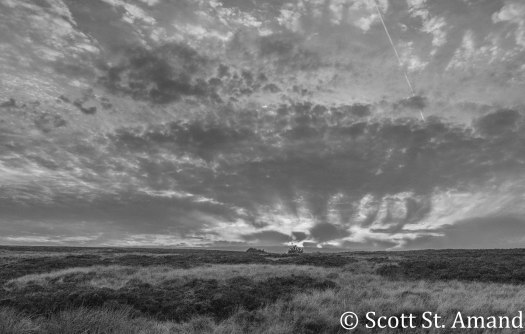
This was the last photograph I took on our trip to England in late August of this year.  I was tired, having climbed over moors, through the dales and back again at least four times over the course of the three hours or so.  The flatness of this picture belies the vertical bent of everything in England.  The sunset was magnificent because the clouds in the sky possessed such an impressionist character.  The patch of sycamores on the horizon grew closer and closer as we approached the setting sun, with Top Withens (the inspiration for Wuthering Heights) behind us.  There were no paths towards the top of the hike, which should have been an early harbinger of the difficulty of the climb.  For all I knew (and willingly shared with the rest of the hiking group), we were likely the only masochists to have made the hike for generations.  As we wended our way through the dense heather and tall wild grasses and bracken ferns, and I gasped for breath at manageable intervals, I thought back on that field twelve years prior where I proposed in a similar field across the valley from Anna’s grandparent’s house, amongst a small herd black and white Friesians.

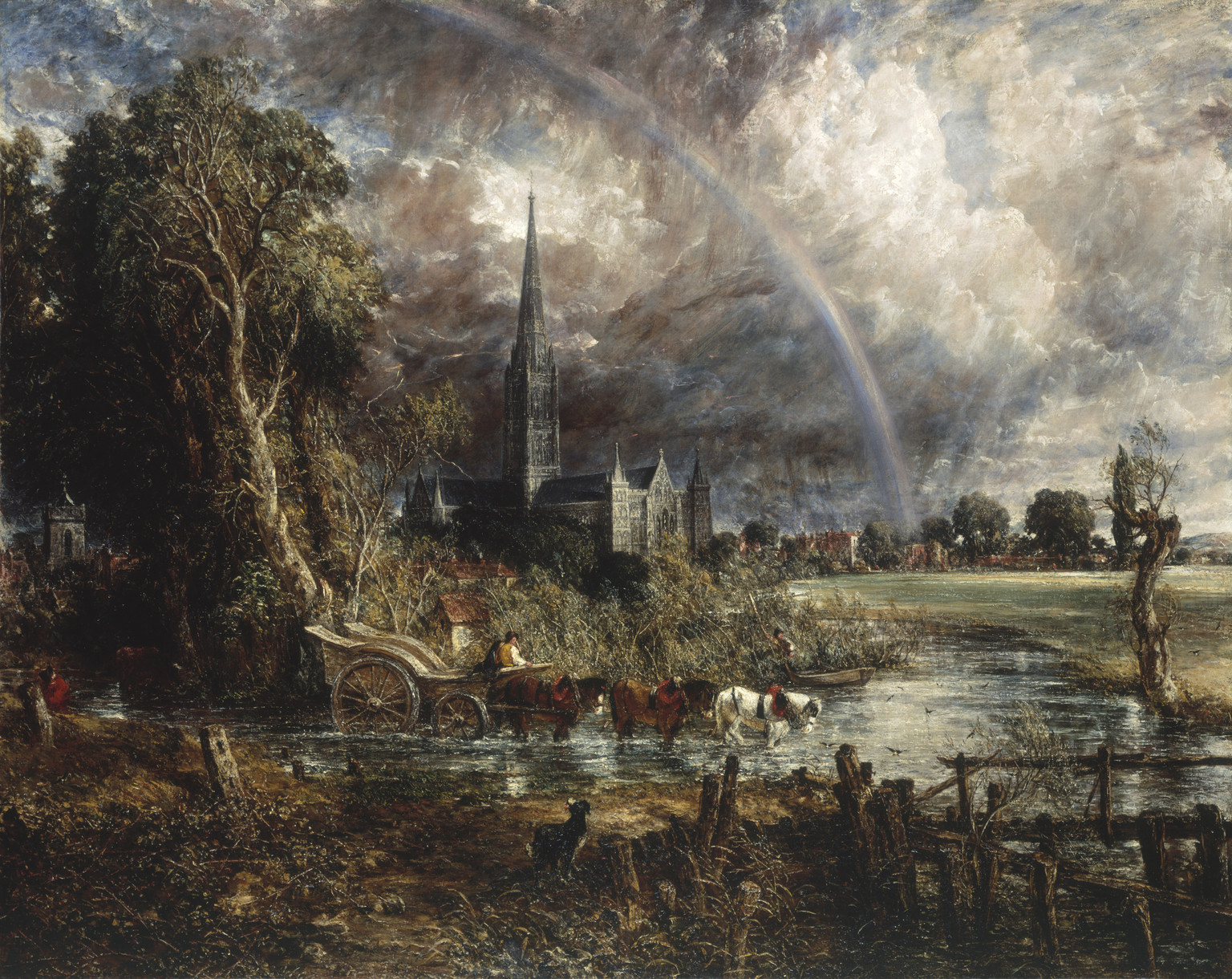
The beauty of Yorkshire has ceased to surprise me.  By this, I do not mean that it has become any less wondrous or awe inspiring, only that I have come to expect to look out on a field and see the beauty that inspired the Brontës and Wordsworth and John Constable and all of the other artists that have spent their lives’ work attempting to capture the magnificence of this landscape.  Indeed, the sky was something out of Constable’s painting of Salisbury Cathedral (sans the rainbow).  The beauty is almost laughably ubiquitous.  I have been to England three times now, and each time I am left with the distinct sensation that I was born on the wrong continent.  My archaic turns of phrases, my passion for history and ancient things, all find root in the mother country.  Anna’s grandmother, a strong Yorkshire woman, who still travels the world at 94, has adopted me as her “cloth” grandson, an appellation that I take very seriously, and I have been warmly embraced by the network of aunties and cousins — just the toe-holds I needed to claim a bit of Yorkshire as my own.

Click here for a larger version.

Among the Ferns

SSA Photography (390 of 400)

These bracken ferns on the moors in Yorkshire are substantially shorter than those in the lake district; nevertheless, they nearly engulfed my wife, Anna, as she tried to follow the path cut between the fiddleheads that popped out from the skeletons of heather, long since overcome by the dark green ferns.  This photograph was taken at dusk outside of Haworth, England, where the Brontë sisters lived and wrote.  Their stories were heavily   influenced by the moors and the hardy people who lived on them (especially Wuthering Heights).  Indeed, in this photograph, on the horizon to the left, there is a lone sycamore next to the barely perceptible ruins of a farmhouse (Top Withens), which is said to be the inspiration for Wuthering Heights.  My mother-in-law grew up among the ferns on the moors, and she is closer to nature than anyone I have ever met.  Yorkshire does something indelible to a person.  The first time you walk over the top of a moor and look down into the Worth Valley at the train steaming along the tracks towards Leeds, you realize that you are in a living snapshot of a much simpler time.

Click here for a larger version.

Through the Briar Patch

SSA Photography (115 of 400)

Nostalgia is a beautiful word.  It is a is learned formation of a Greek compound, consisting of the Homeric word νόστος (nóstos), meaning “homecoming” and ἄλγος (álgos), meaning “pain” or “ache”, and was coined by a 17th-century medical student to describe the anxieties displayed by Swiss mercenaries fighting away from home.  Nostalgia is a sentimentality for the past, typically for a period or place with happy personal associations.  For me, nothing evokes nostalgia like the mountains of North Carolina.  The earliest associations are of visiting the Smoky Mountains with my family when I was much younger, and later the mountains close to Winston-Salem, which were only a short drive away from Wake Forest.  For reasons I cannot explain, the feelings are strongest in the winter, when the wind has stripped away the leaves from the branches, and you can see through the skeletons of the trees through the valleys and to the peaks.  This photograph, taken outside of Brevard, North Carolina, evokes so many strong memories – all positive – which was not always the case in North Carolina.  Hindsight and nostalgia are curious like that, though.  No matter the number of disheartening days and nights, I still long to be back in the mountains.  We’re going up for a week after Christmas, and I know the feelings will rush back, satisfying the homesickness for a while.  Until then, in my mind, I’m going to Carolina…

Click here for a larger version.

Hokusai

SSA Photography (242 of 400)

I took hundreds of photographs, waiting for the waves to crash on the rocks at just the right angle, with just the right force.  This photograph evoked feelings of “The Great Wave” the famous woodblock print by by the Japanese ukiyo-e artist Hokusai in his series Thirty-Six Views of Mt. Fuji.  It also made me think of the creation myth of Aphrodite, which unlike Botticelli’s Birth of Venus, was, by all accounts, a violent affair.  Although Aphrodite can be broken down into “aphros” (foam) and “ditos” (risen), there is no direct etymological derivation.  This did not stop the Greeks (Hesiod, specifically) from crafting a story of Aphrodite rising from the foam after a great battle between Cronus and Uranus, which would foreshadow the same father-son battle between Zeus and Cronus.  In the whitewash, I can almost see Aphrodite throwing her hair back, casting off the spray as she nears the coastline.  But then, I suppose that’s what you get when your two favorite subjects in school were Latin and Art History…

Click here for a larger version, as well as a more stylized version.

Cypress Bluff

SSA Photography (204 of 400)

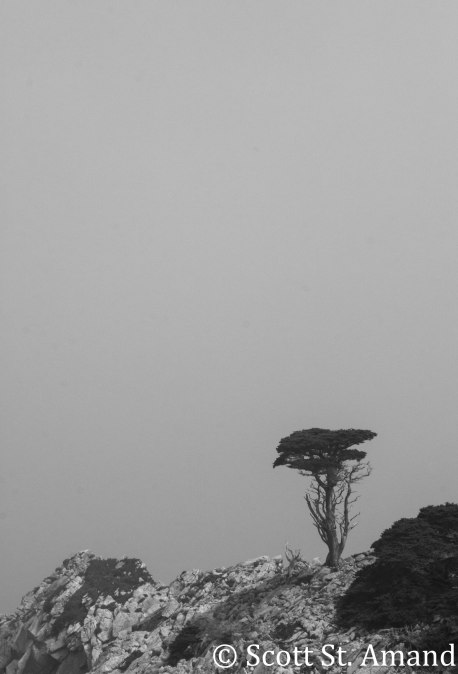
This photograph of a solitary Monterey Cypress (Hesperocyparis Macrocarpa) was taken at Point Lobos in Carmel, California. The species is native to the central coast of California, but now is confined to two small relict populations – Cypress Point in Pebble Beach and Point Lobos.  The most famous of the trees is the Lone Cypress, which is found along Seventeen Mile Drive in Pebble Beach.  Though the trees can grow to over forty feet, they are generally stunted by the strong winds that blow from the Pacific, which gives them their iconic flat-topped appearance.  Although it has long been held that some of the cypresses are two millennia old, this is a romantic conception of seaside literature, and the oldest of the cypresses are likely closer to 300 years old than 2,000.  Although only two native groves remain, the trees have been widely planted outside its native range, particularly along the coasts of California and Oregon.  Indeed, some intrepid seeds have even made it to Great Britain (including the Isle of Man and the Channel Islands), France, Ireland, Greece, Italy, Portugal, and Sicily.

Click here for a larger version.


Etched

SSA Photography (392 of 400)

“Etch” comes to us from the German ätzen meaning “to eat” via the Dutch etsen.  Etching is the traditional process of using an acid to cut into the unprotected parts of a surface to create an intaglio (incised) design on the surface.  The word has been borrowed for human application, with it meaning something that is affixed permanently in one’s memory.  This photograph has elements of both meanings.  The breaks in the heather and scrub are beautiful, lasting reminders of what has come before.  The paths on the moors have been etched by the footfalls of generations of Yorkshiremen and, indeed, even us outsiders.  Likewise, the scenes captured along such paths, as if created by old masters, have been indelibly etched into my mind.

Click here for a larger version.

Tempest

SSA Photography (387 of 400)

“We are such stuff as dreams are made on, and our little life is rounded with a sleep.”
-Shakespeare, The Tempest
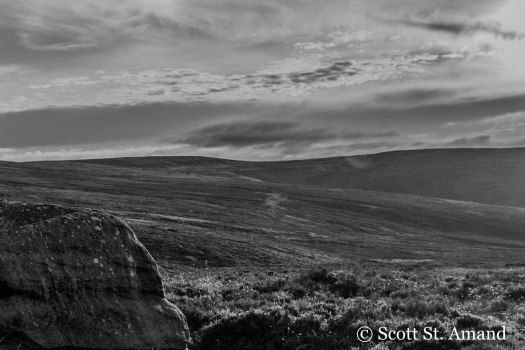
This photograph was taken on the moors outside of Haworth, England earlier this year.  It was cloudless until dusk, when shadows crept over the heather, and tempestuous clouds filled the sky.  The rock in the foreground is a landmark that can be seen for miles, and indeed it can be seen from the house which Anna’s grandfather built stone by stone from an old ostler house.  It is but a pinpoint on the horizon from the house, and we trekked miles up and down (and up again) through the heather and sheep until we reached it.  The views, as can be seen here, and in the gallery “The Moors” were breathtaking, and though I cursed Anna’s mother and uncle for taking us on such a hard-fought scramble up the moors, it was indeed worth it in the end.  And in the end, as the Bard said, “what’s past is prologue.”
Click here for a larger version.

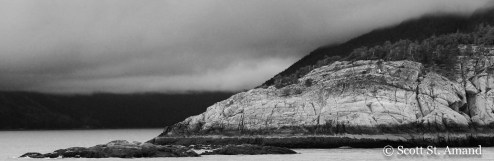
Skagway Mist

SSA Photography (18 of 400)

This small panorama was taken from the bow of a ship in the Inside Passage in Alaska, near Skagway.  To call the nature in Alaska untamed would be an understatement.  The glaciers are so plentiful that some have no names, and the fjords stretch for days.  All of the stones have stories, variegated and striated like this one from eons of ebbing and flowing tides.  The morning mist was a beautiful phenomenon, which I attempted to capture in this photograph.  It blanketed everything in a soft, dense fog, which sometimes did not burn off until well into the afternoon, when the blue skies brought out the deep cerulean of the glaciers.  Although beautiful in full color, I felt that the black and white of this photograph worked ever so well with the natural contrasts of the subject.

Click here for a larger version.