Turkey Tails

AngelColor-14

This photograph of the “turkey tail” mushroom (Trametes Versicolor) was taken in the Nocatee Preserve on Christmas morning with Kemper as my photographer’s assistant.  I gave him my old Nikon D40, which was the first DSLR that I ever had.  It has seen Alaska and many other beautiful places, and it served me well until I upgraded to my current D7100.  Kemper took to photography like a duckling to water.  As I am drawn to paths and mushrooms and other natural wonders, he is drawn to sticks and mosses and the sky.

A number of his photographs turned out, though we need to work on focusing a bit more.  His hands are a bit small yet for back-button focusing, and so I reset the camera to focus on depressing the shutter button by half.  I think he gets so excited when he is ready to take a shot (as evidenced by The Pose).

I love taking photographs of mushroom, because they have some of the most beautiful variety of any natural phenomenon.  Some are medicinal, while others are deathly poisonous.  Some are edible, while some are deathly poisonous.  Some are beautiful, and some are beautiful and deathly poisonous.  The turkey tail has gorgeous growth rings that show up especially well in black and white.  Like many woodear mushrooms, they are harbingers of doom for the tree that they grow on, but even as such, they are beautiful to look at and to photograph.

Click here for a larger version.

A Sunday Walk (In Florida)

AngelColor-5

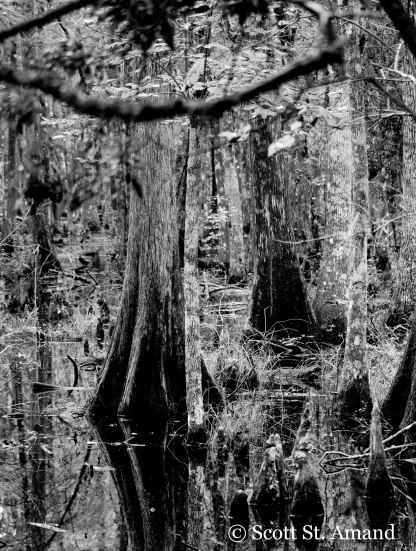
Being from Florida and going to college in North Carolina, the natural questions often arose as to whether I kept an alligator as a pet or whether I lived in a swamp.  The latter question was more on point, as most of Florida is a swamp.  We live near two nature preserves, Guana Tolomato Matanzas National Estuarine Research Reserve and Nocatee Preserve.  I love taking Kemper in either, as his wonder for nature is still brimming with optimism and zeal.  I could not pry him away from his animal figurines, and so I went to Nocatee Preserve by myself.  I made a concerted effort to view the swamp that surrounds the paths through his eyes, and I snagged a number of photographs that captured a child-like whimsy that I had lost long ago (when it comes to swamps).  This photograph of grove of bald cypresses (Taxodium Distichum) typifies this approach.  I have seen so many in my life, that I take their majesty for granted.  In the wild, these august trees can live for thousands of years.  The largest and oldest, the “Senator” was estimated to be 3,500 years old.  One of the bald cypress’ most unusual characteristics is its “knees.”  The knees are conical growths protruding up from the root system that radiates out from the tree’s trunk.  They often have a knobby, knee-like appearance at the top.  Their function is unknown, although studies suggest they may help the cypress absorb oxygen and remain stable in loose wet soils.  Approaching the swamp with a renewed perspective (a truly Florida tack) was a great lesson for me to learn.  As this photo attests, there is beauty even in the brackish, tannin-dyed waters of the Florida swamps.

Click here for a larger version.

Southern Needleleaf

AngelColor-2

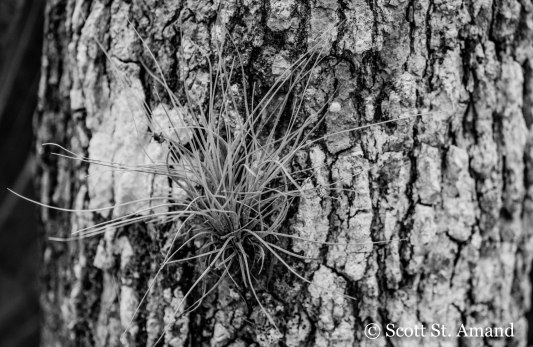
This photograph of a southern needleleaf air plant (Tillandsia Setecea) on a water oak (Quercus Nigra) was taken on a hike in Nocatee Preserve near my home in Ponte Vedra Beach, Florida.  The needleleaf is an epiphyte, an organism that grows on the surface of a plant and derives its moisture and nutrients from the air, rain, and debris accumulating around it. I am fascinated by epiphytes, like the resurrection fern in an earlier post.  In Florida, they are everywhere.  We had a few large crepe myrtles in our back yard, and the needleleafs practically covered the trunks and branches of the trees.  I have always been curious how they take hold on their host tree.  Many people have seen these members of the bromelaid family, but few have ever seen the beautiful and delicate purple flowers that bloom for an instant and are gone.  I have been lucky enough to see the blossoms, having grown up around them, and perhaps as the Romantic Poets believed, they are all the more beautiful because they are so evanescent and fleeting.

Click here for a larger version.