Invasive Beauty

SSA Photography (179 of 400)

This post was originally titled “Native Beauty,” as I had seen these beautiful purple flowers up and down the coast near Carmel, California.  With a bit of research, however, I found that these stunning flowers are an invasive species known as Pride of Madeira (Echium candicans).  In fact, forestry officials are removing them from native plant communities as part of habitat restoration efforts in coastal parks such as the Golden Gate National Recreation Area.  The genus name is from an ancient Greek word for the plant. It is derived from “echion,” with the root word “echis” meaning “viper.”  There are conflicting etymological justifications for the name, including that the shape of the seed resembles that of a viper’s head, and  that Echium Vulgare, a related plant, was a historically thought to be a remedy for the adder’s bite.  Candicans or “shining white” refers to one of the more famous varietals in Madeira, Portugal, where the plants originate.  It was originally referred to as Echium Fatuosum, which is where the “pride” in the name originated.  In California, however, the purple E. Candicans varietal shown in the photograph is the most common.

Click here for a larger version.

Wabi-Sabi

SSA Photography (106 of 400)

“Nothing lasts, nothing is finished, and nothing is perfect.”

This quote sums up the Japanese philosophy of wabi-sabi, which has no direct translation in English. “Wabi” is said to be defined as “rustic simplicity” or “understated elegance.” “Sabi” is translated to “taking pleasure in the imperfect.”  This photograph of an abandoned toy truck captures the principle beautifully.  The imperfection of the truck (and even the photograph thereof) is evident.  Although the truck lost its wheels long before I took this photograph, its purpose has not yet been fulfilled – not completely.  It is now immortalized in this photograph, which has subsequently become the subject of this post.  Nothing is finished, really.  This post will be replaced tomorrow by a less melancholy subject, and slowly it will fade from memory.  Nothing lasts.  The Romantic poets were students of the ephemeral, finding beauty in the brief life of all things.  Even the Augustan poet Horace, famous for his introduction of the phrase “carpe diem,” was fascinated with fleeting time.  There is a beauty to this photograph, though; however, I could not put my finger on it before I connected it with wabi-sabi.  Now it has become clear why its perfectly imperfect composition and subject evoked such strong feelings of melancholy on the one hand, and pleasant nostalgia on the other.  The Japanese phrase captures in two words, what it has taken me a lifetime to understand.

Nothing lasts.  Nothing is finished.  Nothing is perfect.

Click here for a larger version.
Perspective

Perspective

This photograph was taken in Glacier Bay National Park in Alaska.  Of all the waterfalls we saw, this was perhaps the most impressive.  Without the two people standing at its base, this would have been a great picture – a study in contrasts; but the two individuals lend such perspective to the grand scale of the waterfall that I could not, in good conscience, leave them out.  Perspective is a term that covers all manner of sins, from the linear perspective of Da Vinci, to the perspective one gains from a tragedy, to even the perspective that you grasp from the sheer insignificance of two humans set against the backdrop of indefatigable nature.

Click here for a larger version.

Cypress Bluff

SSA Photography (204 of 400)

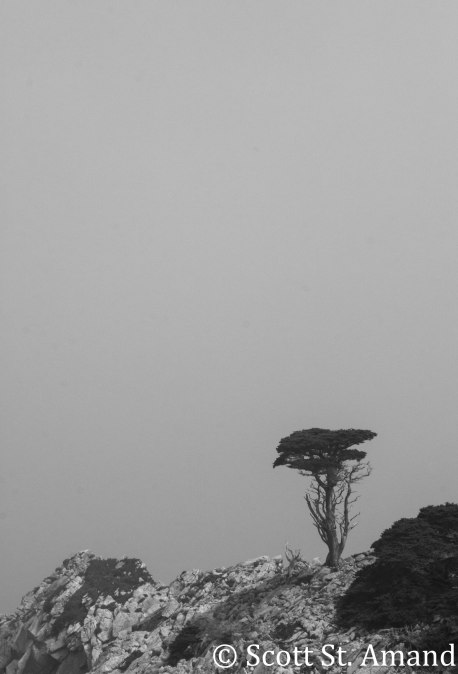
This photograph of a solitary Monterey Cypress (Hesperocyparis Macrocarpa) was taken at Point Lobos in Carmel, California. The species is native to the central coast of California, but now is confined to two small relict populations – Cypress Point in Pebble Beach and Point Lobos.  The most famous of the trees is the Lone Cypress, which is found along Seventeen Mile Drive in Pebble Beach.  Though the trees can grow to over forty feet, they are generally stunted by the strong winds that blow from the Pacific, which gives them their iconic flat-topped appearance.  Although it has long been held that some of the cypresses are two millennia old, this is a romantic conception of seaside literature, and the oldest of the cypresses are likely closer to 300 years old than 2,000.  Although only two native groves remain, the trees have been widely planted outside its native range, particularly along the coasts of California and Oregon.  Indeed, some intrepid seeds have even made it to Great Britain (including the Isle of Man and the Channel Islands), France, Ireland, Greece, Italy, Portugal, and Sicily.

Click here for a larger version.


Etched

SSA Photography (392 of 400)

“Etch” comes to us from the German ätzen meaning “to eat” via the Dutch etsen.  Etching is the traditional process of using an acid to cut into the unprotected parts of a surface to create an intaglio (incised) design on the surface.  The word has been borrowed for human application, with it meaning something that is affixed permanently in one’s memory.  This photograph has elements of both meanings.  The breaks in the heather and scrub are beautiful, lasting reminders of what has come before.  The paths on the moors have been etched by the footfalls of generations of Yorkshiremen and, indeed, even us outsiders.  Likewise, the scenes captured along such paths, as if created by old masters, have been indelibly etched into my mind.

Click here for a larger version.

Starry Night

starry-night

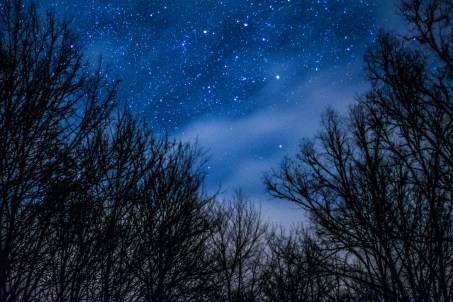
This photograph was taken around midnight in Brevard, North Carolina.  I hiked about a mile up to a remote field on the property of a family friend, where there was little to no light pollution.  It was my first attempt at astral photography, and aside from the stars being a tad out of focus, I was thrilled at how the photograph turned out.  The moon had not risen, and the field was pitch black.  I used a 30 second exposure, and I was pleasantly surprised at how the sky was illuminated.  The wisps of clouds immediately made me think of Van Gogh’s “Starry Night.”  After I uploaded the photograph and did some very minor post-processing, I trekked back up to the field.  Unfortunately, the wisps of clouds had turned into a think blanket, and all of the stars were obscured.  When we return at the new year, I hope for clear skies and good weather so that I can capture more of these scenes.

Click here for a larger version.
Morning Dew

SSA Photography (83 of 400)

This photograph was taken just after dawn on Little Talbot Island, north of Jacksonville, Florida.  It was one of the first macro photographs I took, and it remains one of my favorites.  I love how it captures the pendant dewdrop and the weight of the driftwood branch and the water.  The little bubbles add an interesting depth of field.

Click here for a larger version.

River of Ice

SSA Photography (20 of 400)

On the list of the most beautiful natural places I have ever been, Alaska ranks at the very top.  This glacier may have had a name, but so many others did not.  There were simply too many of them.  Beauty was within reach at every point on this trip, whether it was seeing the salmon in the rivers towards the end of their annual run, coming upon a group of ten bald eagles on the bank of a fjord, or paddling next to a huge river of ice that creeps along ever so slowly, carving mountains in its wake.  The force and the majesty of the state was almost overwhelming at times.  I could not capture it all, but this photograph is a stunning reminder of my trip there.  I cannot wait to go back with a renewed focus (and a better camera) to document the awe inspiring beauty of untouched nature.

Click here for a larger version.

Tempest

SSA Photography (387 of 400)

“We are such stuff as dreams are made on, and our little life is rounded with a sleep.”
-Shakespeare, The Tempest
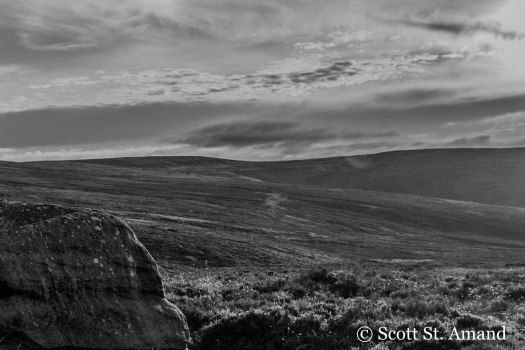
This photograph was taken on the moors outside of Haworth, England earlier this year.  It was cloudless until dusk, when shadows crept over the heather, and tempestuous clouds filled the sky.  The rock in the foreground is a landmark that can be seen for miles, and indeed it can be seen from the house which Anna’s grandfather built stone by stone from an old ostler house.  It is but a pinpoint on the horizon from the house, and we trekked miles up and down (and up again) through the heather and sheep until we reached it.  The views, as can be seen here, and in the gallery “The Moors” were breathtaking, and though I cursed Anna’s mother and uncle for taking us on such a hard-fought scramble up the moors, it was indeed worth it in the end.  And in the end, as the Bard said, “what’s past is prologue.”
Click here for a larger version.

Through the Ferns

SSA Photography (1 of 400)

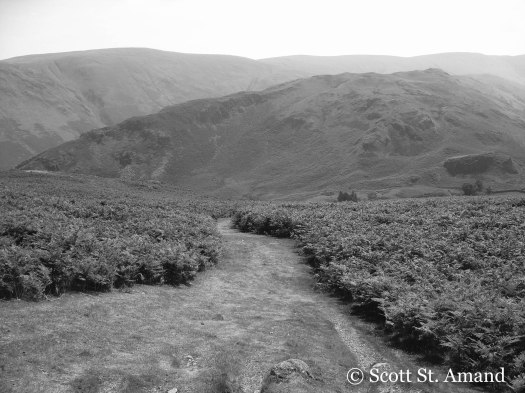
In 2006, I took the trip of a lifetime.  After decades studying literature and Latin, I stood in Dove Cottage, Wordsworth’s home, and amongst the columns in the forum of Pompeii.  We were young then, Anna and I, but to this day we love traveling with our families whether in North Carolina, or Alaska, or England where we were engaged and where this photograph was taken.  I saw many marvelous sights on that trip–Marseilles, Mallorca, and all of the little English hamlets we visited like Grasmere.  This photograph of a well-trod path through the bracken ferns was taken in the Lake District in Northwest England.  Though you cannot tell from the perspective of the photograph, the bracken are as tall as I was, and the white and black sheep cloistered themselves between the fronds.  I felt a bit like Alice, dwarfed by the thick blanket of beautiful green ferns.   The Lake District truly is a wonderland, and I cannot wait to return.

Click here for a larger version.