Remnant

SSA Photography (376 of 400)

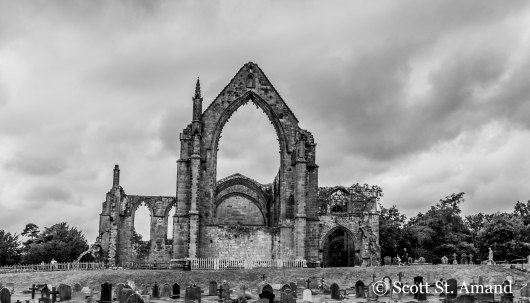
I studied art history in high school and college, learning from incredible teachers and professors.  I went to museums and saw visiting collections, but I never stood in the middle of St. Peter’s square or under the arches of a gothic cathedral until 2006 when I stood in La Seu, visited Pompeii, and walked into the middle of the Piazza San Pietro, marveling at the history that surrounded me.  Yet something about Bolton Abbey, the skeleton of which I captured in this photograph, struck me more than even walking through the ancient streets of Pompeii.  Perhaps because I was older, I had a new appreciation for the feats of architecture.  Perhaps, too, it was because I was alone with my camera and my thoughts, not being bustled about by tour guides or other eager tourists.  Whatever the difference, Bolton Abbey was more majestic to me than even St. Peter’s.  It is a memory, a remnant of time gone by, of the monarchy, of the Reformation, and of the shifting sands of faith.  While other abbeys were deconstructed during the Dissolution of the Monasteries, and all that remains of them is rubble, Bolton Abbey remains – like a fossil, its bones bared and resolute.  When I stood in the nave, I placed my hand on a monolithic column, lingering for a moment and hoping to physically connect to the priory.  With the weathered stone pressed against my hand, I wondered how many generations had set their hands upon the stonework, and at that moment I felt truly connected to a continuum of time – those who had come before and those who would come after to admire the remnant as I had.

Click here for a larger version.

Emergence

SSA Photography (169 of 400)

This photograph of an allium (a member of the garlic family) breaking out of its protective sheath has been one of my favorite photographs since I took it a couple years ago.  To me, this photograph is evocative on so many levels.  It was taken, like Herrick’s Bud in my in-laws’ garden in Carmel, California.  Although I thought that the emergence would be relatively slow, I came back the next day and the buds had fully emerged, with the sheath having shriveled up and hanging by the wayside.  The ephemera of nature is simply amazing to me.  I hope you enjoy this photograph as much as I do.

Click here for a larger version.

Left Behind

SSA Photography (395 of 400)

This photograph was taken on the moors outside Haworth, West Yorkshire, England.  The two figures in the distance are my mother-in-law and her brother, who left my wife, Anna, and I to scramble up and down the moors in a vain attempt to keep them in our sight.  The “walk” (and I use this term loosely) was gorgeous in hindsight, as the pictures attest; however, during the trip (which I contend was on average 98% vertical), I thought my legs were going to give out at least three times.  Nevertheless, I made it, and that in and of itself was an accomplishment.  The photographs that I took were icing on the proverbial cake.

Click here for a larger version.

Shadow Play

SSA Photography (89 of 400)

Taken at Big Talbot Island, north of Jacksonville, Florida, the lines and shadows of this photograph of driftwood cobbled together on the beach draw the eye to the center of the mass of wood.  After the hurricane last year, this particular grouping of driftwood is no longer on the beach, so I was fortunate to capture it when I did.

Click here for a larger version.

Chip off the Old Block

SSA Photography (13 of 400)

This photograph was taken from the shore of the bay, in Bar Harbor, Maine.  As I mentioned in an earlier post, my father is from southeastern Maine, and the place has always held great memories for me.  The weathered geometry of the rocks on the beaches struck me more during this trip than as a kid, when I was wont to be found between and betwixt the ocean-side boulders with knees perpetually skinned by the barnacles.  Though not taken at Goose Rocks or Old Orchard Beach, where my dad would have been found in the summers, Maine is synonymous with him, and I am nothing, if not a chip off the old block.

Click here for a larger version.

Rhododendron

SSA Photography (157 of 400)

This photograph of a rhododendron bulb was one of the first macro photographs that I ever took.  It was taken in Deep Gap, North Carolina (near Brevard and Cashiers) on the property of a very close friend where my family spends two weeks in July and again at Christmas each year.   The word rhododendron is Greek for “rose tree” and counts azaleas among its many varietals.  The beautiful white-petaled flowers on this Rhododendron Maximum (“Rosebay” or “American” Rhododendron) had not yet emerged on the trees on the property, but the compact tulip-like bulbs were ripe to bloom very soon thereafter.

Click here for a larger version.

Pisgah Bridge

SSA Photography (114 of 400)

This photograph was taken in the Pisgah National Forest in western North Carolina, near Asheville and Hendersonville.  The Pisgah, as it is known, is a stunning forest with dozens if not hundreds of waterfalls and scenic trails.  There are multiple creeks and rivers running through the forest, with the Davidson being the primary tributary to the French Broad that runs the length of the forest.  The simple beauty and shadow-play of this stone bridge struck me to such a degree that I pulled off the side of the road to try to capture the chiaroscuro in a photograph. I may have nearly fallen down the embankment, but I got the picture…

Click here for a larger version.

Across the Way

SSA Photography (345 of 400)

This photograph was taken mid-morning from the top of the driveway of the home that my wife’s grandfather built stone by stone over decades from a ruined ostler’s barn that sat on a hill overlooking the home in which my mother-in-law grew up in West Yorkshire, England.  When the Worth Valley Railway was being built, many of the horses used to build the rails were kept in the ostler’s barn on the property, just a short walk to the eventual railway station in Oxenhope.  Anna’s grandfather was a fighter pilot in World War II, and later a textile mill owner, as well as a self-taught stone mason, who worked and kept adding to the home (nicknamed “Ostlerhouse”) quite literally until the day he died.

Click here for a larger version.

Ordo Saxae

SSA Photography (197 of 400)

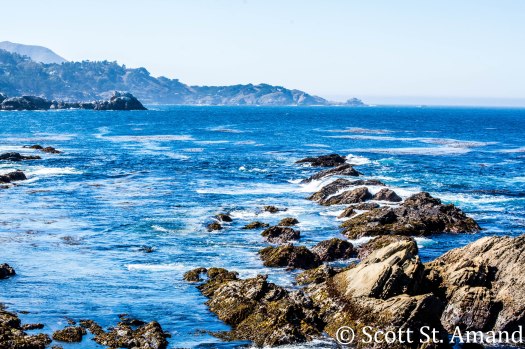
I find patterns in nature fascinating.  “Ordo Saxae” is Latin for a row of rocks.  As is always the case, there is something lost in translation – not only is it a row, but there is an order (ordo) about the perfect arrangement of the outcropping.  These particular rocks reach out across Carmel Bay towards Point Lobos State Natural Reserve.  The linear quality of the jagged rocks is offset by the jumbled ones in the foreground, but my eye keeps going back to the organic ordo ab chao of the rocks that stretch out towards Point Lobos in the distance.

Click here for a larger version.