Leaves of the Fall

NCWinter2018-57

Beyond any other pursuits, photography included, I am a writer.

I went to Wake Forest on a creative writing scholarship, and even got a full ride to Dartmouth for the same.  (I chose Wake, because in high school I didn’t drink or ski, two prerequisites to attending Dartmouth, I was informed.  I am forever grateful I made that decision, though I do have flights of fancy every so often as to where I would have ended up had I chosen the Ivy League track…)

The first real writing endeavor I undertook was when I was seven and wrote a short story about a kid surviving in the wilds of North Carolina.  It was wholly implausible, but at 15 typed pages (for a seven year old), it was a veritable novella.  When I was sixteen, I began writing what would turn out to be my first novel.  I completed it at Wake, which is to say, I wrote the words “The End” when it seemed appropriate; however, in my mind it remains unfinished and unpublishable in its current form.  Every so often I get a wild hair and re-write sections of it.  Some day, I will dedicate myself to rewriting it, and perhaps I will even submit it for publication.  It’s working title was “The Last of the Romantics,” though this gave way at some point in college to “The Leaves of the Fall,” which is what it remains to this day.  I love that title, and the symbolism that is packed into those five words.

I have gone through phases of dedicating myself to the craft of poetry, and then to drama, and then back to poetry, and then plays about writing poetry, but I always land back at the novel – that unfinished magnum opus that may never be.  I have written a couple of others in the interim, and a number of short stories – some of which I am more proud of than others – but none that I am so proud of as to submit them for any competition or publication.

In the end, I have always written for myself.  It was a release when I most needed it, and like my earlier post on melancholy, this desperation was a bountiful muse.  Now that I am in a happier, softer place, I do not need writing as I once did.  The craft will always draw me.  We are different poles of the same magnet, pulled together at all times, but somehow never quite managing to forever join together and fulfill our attraction to one another.  In some ways it is like a subtle addiction.  I can kick it from time to time, but when I let myself, I relapse into the world where I am consumed by writing.  These little daily epistles satiate me, for now, but they are like methadone to a heroin addict.  Although they replace the visceral need, they are a poor substitute for the real thing, the thing that I crave even when I am not actively thinking about it.

I generally do not stage my photographs.  I take them as they come, as they are presented to me.  In this way, my photographs are documentaries of how I encountered the world, rather than fictional accounts of how perfect I wanted the world to be.  In this case, I gave into my addiction, in part, and posed this water oak leaf on a stone staircase on the property up in North Carolina.  I wanted a shot that corresponded with the title of the novel.  I wanted cover art for a book that may never be bound.  Perhaps this is wishful thinking, or perhaps it is a subconscious recognition that some things I just cannot escape.

Unlike alcohol or any other addiction, I can be consumed with it without being consumed by it.  I am still whole the end of a poem or a chapter, perhaps even more so, having gained a bit more insight into my psyche.  I can live with that.

Click here for a larger version and a color version.

Winter Willows

NCWinter2018-55

I leave today, I’m packing light: a suitcase, some toiletries
The rolling hills and willow trees of Carolina wait for me

-Benjamin Gibbard, Carolina

When I set foot on Wake Forest’s campus, I knew it was home.  It is often difficult for me to recall the details of every important life moment, especially if I didn’t put much stock in the moment at the time.  Yet I remember pulling off of Silas Creek Parkway, and seeing the hedges at the entrance to Wake’s campus like it was yesterday.  It was the Fall, and the leaves had already begun to fall as my dad and I pulled through the gate and onto the main road into the campus.

Carolina is still home in many ways.  It is home insofar as I have deep, sometimes painful nostalgia for it.  Nostalgia comes from the Greek meaning an aching for home.  I ache to be back in the foothills, to be back when the leaves turn and fall.  For a long time, I ached to be back at college, but now that I am in a job I enjoy, in a place I love, I do not covet the thought of being back in the dorms and going to class every morning.  Too much has happened in the interim, and I am not the person I was when I was eighteen and stepped foot onto the campus.

Having said that, in many ways, I am more that eighteen-year-old now at thirty-four than I was at twenty-two when I left, or even thirty, when I hit the reset button and chose to fundamentally change who I had become.  To all who met me, I was a happy, laid-back person, who had the capacity to find the joy in the littlest things in life.  I was more this person than perhaps I gave myself credit for being, though at the time, I considered it quite the facade.  Today, I am returning to (or perhaps becoming for the first time) the person I so desperately wanted to be when I was at Wake.  As they say, selfishness and self-seeking have slipped away; I have a new outlook on life.  I comprehend serenity, and I know peace.  For me, North Carolina embodies these promises, and so, one day I will pack my back, to where the rolling hills and willow trees of Carolina wait for me.

Click here for a larger versions.

On Melancholy

LittleTalbot-5

I can barely conceive of a type of beauty in which there is no melancholy.
-Baudelaire
I stumbled on an article yesterday, entitled “The Benefits of a Blue Period.”  In short, the article posited that periods of melancholy in our lives allow us to more greatly appreciate periods of happiness.  I read the article with great curiosity and enthusiasm, as I wholeheartedly agreed with the hypothesis.  One of my favorite professors at Wake Forest, Eric Wilson, wrote a book to this end entitled Against Happiness: In Praise of Melancholy.  It is a brilliant little book, and I have read my copy multiple times.
Professor Wilson taught me to love Blake, and Wordsworth, and Shelley, and especially Keats, who wrote a beautiful poem entitled Ode on Melancholy, where he observed that pleasure and melancholy are two sides of the same coin (Keats’ metaphors are, of course, far more elegant); one cannot fully appreciate the prior without having first experienced the latter.  A rose is beautiful because it must die, because it is, at its core, ephemeral, as life itself is.
I took this photograph of my son, Kemper, earlier this year at Big Talbot Island State Park, just north of Jacksonville, Florida.  It is not the most elegant composition, but it evoked the memory of sitting in Professor Wilson’s class, engrossed as he discussed the wild Blake, and the addled Shelley, and the elder statesman, Wordsworth.  In 2007, I visited Dove Cottage, Wordsworth’s home, and I personally bore witness to the Lake District’s daffodils he was so fond of as I wandered lonely as a cloud.  I would soon thereafter realize, however, that I had not yet experienced true loneliness and solitude.
I have found myself in the depths of melancholy, with a singleness of isolation and anguish.  I was no better (or worse) than Coleridge, whose consumption of laudanum sustained his melancholic madness (that brought us Kubla Khan) until his death at 61.  I often thought I would end up like Coleridge, though with the ignominious distinction of anonymity to all but those who loved me.  Yet I persisted with my own course of self-medication until I was thirty.
I cannot say that I, with a fit of passion and self-realization, quickly emerged from the chasm of melancholy where I had made my home for nearly a decade.  My ascent was gradual, albeit progressive.  At some point along the way, I cannot say when, I gained the perspective of the Romantics – I did not regret the melancholy of my twenties, nor did I wish to shut the door on it.  I had been humanized and humbled by the darkness; because of it, the light shone that much brighter.  I am indebted to Professor Wilson for planting the seed, which, though it lay fallow for years, eventually grew of solid stock.
A rose plucked from a garden is beautiful because it must die, as all beautiful things must, one day, come to an end.  A silk rose in a glass vase is a pale imitation because it possesses no vitality, it is a mere imitation.  I recognize that I am an imitation – not a mimic, but a feigned likeness of a whole human held out to the world – a world, which chooses, most often, to accept me for what I seem rather than peering behind the curtain to who I truly am.
Before I get to afar afield, let me bring us back to melancholy and to a close.  As I am grateful to Professor Wilson, I am grateful for my melancholic past, and, yes, even for the fits of melancholy that I will continue to experience throughout my life.  Emerging from the darkness, the light is all the more vivid.
Click here for a larger version.

Walking On

NCWinter2018-45

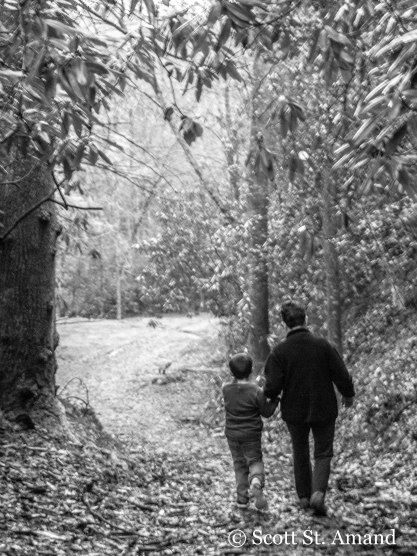
I was initially not pleased with how this photograph turned out.  The figures of my mom and Kemper are sharp, but the trees and leaves in the foreground are blurred, as I was fiddling with my settings to take earlier photographs with my wide angle lens and, candidly, I forgot to change them.  When I came back to it after a bit of contemplation, however, it grew on me.  The focus of this photograph is and should be my family, and the other blurred features, which seemed like a distraction at first, repose in a secondary position.

This is, I think, a good lesson learned once again from a photograph that has taken on a life of its own.  Family is, and should be, the focus.

I keep long hours in my job.  When I started, I would get in around 5:30 and leave after 7:00 in the evening.  I saw Nora and Kemper very little during the week, and it took a toll on me.  Nora was young enough that she changed daily, and getting home after she went to sleep meant that she had changed drastically in a week.  Kemper changed, too, but not as quickly.  Still, I missed being able to see them each day.

These days, I get into the office around 4:30 and leave around 5:30 or 6:00, and rarely do I miss either of them before they have to go to bed.  Nora runs to me now (or at least toddles quickly) and throws up her arms when she sees me.  I pick her up and she tells me about her day in her own language that she can only assume I understand.  I hesitate to put her down, even to give Kemp a hug, because this is our time.  When Anna feeds her and puts her to bed, Kemper and I have our time.  We have taken to lying in his bed and talking about both of our days, if for no other reason than to share that my days have their challenges as well.  He cherishes these “long talks.”  I do too.

My days are long, and I am worn out by the end.  I shoulder a lot of responsibilities in the hours that I am in the office, but as this picture attests, family is my focus – even if sometimes I lose sight of this for the blur that is the rest of my life.  Indeed, even when I forget to change the settings, the important things remain tack sharp.

Click here for a larger version.

Turkey Tails

AngelColor-14

This photograph of the “turkey tail” mushroom (Trametes Versicolor) was taken in the Nocatee Preserve on Christmas morning with Kemper as my photographer’s assistant.  I gave him my old Nikon D40, which was the first DSLR that I ever had.  It has seen Alaska and many other beautiful places, and it served me well until I upgraded to my current D7100.  Kemper took to photography like a duckling to water.  As I am drawn to paths and mushrooms and other natural wonders, he is drawn to sticks and mosses and the sky.

A number of his photographs turned out, though we need to work on focusing a bit more.  His hands are a bit small yet for back-button focusing, and so I reset the camera to focus on depressing the shutter button by half.  I think he gets so excited when he is ready to take a shot (as evidenced by The Pose).

I love taking photographs of mushroom, because they have some of the most beautiful variety of any natural phenomenon.  Some are medicinal, while others are deathly poisonous.  Some are edible, while some are deathly poisonous.  Some are beautiful, and some are beautiful and deathly poisonous.  The turkey tail has gorgeous growth rings that show up especially well in black and white.  Like many woodear mushrooms, they are harbingers of doom for the tree that they grow on, but even as such, they are beautiful to look at and to photograph.

Click here for a larger version.

Deer Moss

NCWinter2018-40

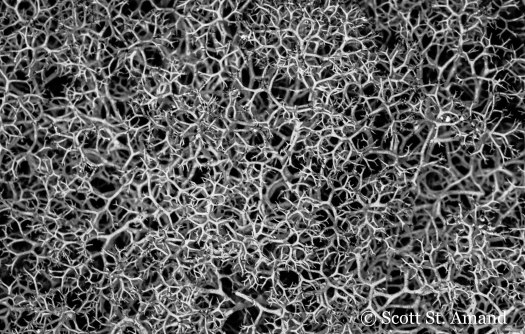
This lichen (Cladonia Evansii) is a familiar one.  Known mistakenly as “deer moss” this fungus is a lichen, not moss.  As the name suggests, this fruiticose lichen is important forage for whitetail deer in the eastern states.  Though not as plentiful amongst the trees as the usnea lichen that seems to attache to the branches and trunks of even the youngest saplings, among the rocky hills, the light ash-gray clumps of lichen are visible from long distances, interspersed between the darker slate-gray stones.   The lichen grows extremely slowly, only three to ten millimeters per year.

The patch that Kemper and I found on our walk down the driveway was decades old and thick with a radius of lichen stretching out ten feet from the center in all directions.  The thalli (branches) are interwoven, and the result is a springy, spongy mass.   This type of lichen (Cladonia) can be found all over the world, and its name varies as the animals that forage on it change.  In the northernmost reaches, it is known as reindeer moss, and further south it is known as caribou moss.  Kemper and I even found some in a Jacksonville swamp during a hike, and sure enough, cast in the mud was a hoof print of a small whitetail deer.

Click here for a larger version and a color version.
Kemp & Brynn

NCWinter2018-82

My sister and I were close as kids.  We lived across the river (literally) from our school friends, and we were often the only playmates the other had.  Nevertheless, I knew which buttons to push to get a rise from her, and I was like a churlish child on an elevator for the first time pressing all of them at once, at times, just to see them light up.  To my memory, she only paid me back once, when I was six or seven and learning to rollerblade.  I fell, and she tried to help me up with her foot…on my back…twice…  If this is the worst that I can remember, then I suppose we had a pretty good relationship.

Since we had kids (Claire’s daughter, Brynn on the left, and my son, Kemper on the right), however, we have grown much closer.  It may be the newfound maturity on both our parts, but I would like to think that we are just in a better place to be even closer than we were growing up.  She is a single parent, and a damn fine one.  My dad and I have both taken on the male figure in Brynn’s life, and in many ways I think that this has made me grow up even faster than just having two kids of my own.

I love seeing Kemp, Brynn, and now my daughter Nora, all playing together.  Kemp is gentle and kind with both girls, and very protective.  Brynn mothers Nora, and Nora adores them both.  We had the chance to spend a good chunk of time together in North Carolina over the New Year, and it is the best family vacation that I can remember.  Everyone was on their best behavior – even me – and the kids played constantly together.  This photograph was taken on a short hike on the property to an amphitheatre that was built for the boys’ camp that existed on the property in its earlier life.

Although I was trying to get Kemp and Brynn to pose for a shot, this one is candid.  It perfectly captures Brynn’s childish pleasure at being with the whole family (especially Kemper), and Kemper’s sly amusement at the world itself.  I love this shot, and I smile every time it comes up on my photo album that I have playing in my office at all times.  Claire and I were close, but I know that we want our kids to be even closer.  I think that is, ultimately, what we worked towards growing up without even knowing it.

Click here for a larger version.

Beneath the Rhododendrons

Panthertown Valley-10

The great rhododendrons (Rhododendron Maximum) are thick throughout western North Carolina, no less so in Panthertown Valley.  We hiked through the valley, and though the leaves had fallen from all but the paper birches, even the huge snowstorm the weeks before had not tempered the deep, rich green of the underbrush.

I don’t particularly care for the bare bushes, though in the summer when they are flowering, they can be quite lovely.  To me, they are glorified giant azaleas, which again, are beautiful only when they are in bloom.  Nevertheless, I respect them.  They are a native species, and they have retained their ground (with great aplomb) even where invasive species would have otherwise taken over.  Even the leaves of the rhododendron are persistent, lasting up to eight years on the plant itself, and then they are incredibly slow to decompose.  There is even some believe that the rhododendron is allelopathic (a biological phenomenon by which an organism produces chemicals that inhibit the growth or germination of other plants), which means it quite literally fights for its place in the forests through biochemical warfare.

There is, I admit, something to be admired about the lowly “great rhododendron” and the wide swath it has cut through Appalachia.  I count myself among a group of survivors, whose roots were set down deep by my parents, else I would have washed away long ago.  I feel a sort of kindred with them, and perhaps I did not care for them in the past because I saw a bit too much of myself in them.

Click here for a larger version.

Framed

SSA Photography (86 of 400)

Life is a kaleidoscope of perspectives.

I have had many perspectives in my relatively short life.  I have seen the world from the top and from about as low a bottom as anyone could imagine.  I have begged for forgiveness, often undeserved, and I have forgiven.  I have now even seen the world through my own children’s eyes.

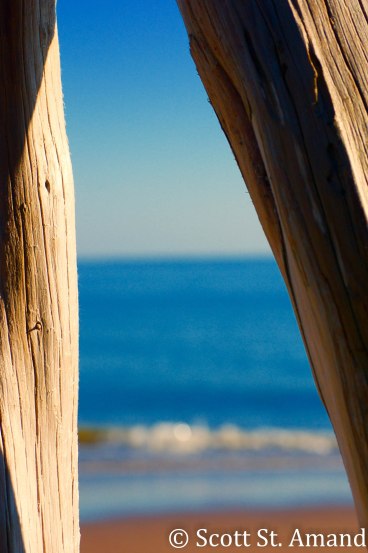
Photography allows me to manipulate perspectives, to frame them in ways that you may have never thought to look at a particular scene.  This photograph was taken at Big Talbot Island State Park, just north of Jacksonville, Florida.  It was a hot summer day, and in my infinite foresight, I arrived around noon, just as the sun was reaching its apex in the sky.  The shadows played on the driftwood as it began its slow descent to the West.  I came upon a particularly large live oak (Quercus Virginiana), which had two large branches reaching towards the sky.  One was perfectly vertical, and the other was at about thirty degrees.  I took a number of photographs of the geometry of the branches, but none were particularly aesthetically pleasing.  Although mathematics often make photographs interesting, when it is particularly complex like a fractal in a snail’s shell, when the shapes are so simple, they sometimes do not lend themselves to a pleasing composition.

Determined to use them for a shot, I evaluated what struck me about them.  I zoomed into one of the closer shots I took, which approximately resembled this final photograph, and I loved the contrast between the dark, shadowed wood, and the brightly lit ocean and clear blue sky.  I reframed the photograph, itself a frame, and captured this scene.  The fact that the wave rolled in at the exact right time with a sandy color to complete the triangle was a bonus that I only realized when I was touching the photo up later that day.

Click here for a larger version.

No Handbills

NCWinter2018-46

The floods from the melting snow unearthed two old metal signs on the property in Brevard, North Carolina, which we found on a morning walk.  They fallowed under cover of sweetgum leaves and time.  The signs, rusted and riddled with bullet holes, were still legible, and demonstrated the disdain for the hippies that once made the property their home, before they were forced out by a more puritanical wave of valley residents.

The property sits on a geologic fault line, and the streams on the property are headwaters for the French Broad River, one of the oldest rivers in the world.  The property was a summer camp in a former age, and the ruins of the old stone buildings are still visible.  As I mentioned in a previous post, the property was once a common stopping ground of a folk-singing, free-loving, cache of hippies and musicians, including Pete Seeger and Woodie Guthrie.

These signs are further reminders that we were not the first to enjoy the hills and fields where generations of boys spent their summers away from home and hippies did – well, what hippies do…

In the seven years my family has been coming here, the land has become a part of us, a memory we carry with us in our day to day lives in Florida.  I will never know who put the bullet holes in the signs, but they will remain nevertheless.  We have left our own marks on the property, no less visible or timeless.  Generations from now, the cabins may fall and the sapling white pines may overtake them, but our time on the property will still be felt.

Click here for a larger version.