Kemper

SSA Photography (187 of 400)

How my son has changed in the brief time since I took this candid portrait of him sitting on the parapets of his appropriated, improvised stone castle on the beach in Carmel-by-the-Sea, California…  This is my favorite picture of him at this age, then just four, and now about to turn six at the end of January.  I took a number of shots with him looking the camera dead to rights, but something, perhaps a wanton setter or retriever frolicking in the surf, caught his eye, and the shutter released at just the right moment to capture him as I see him often, wondering at the world, a younger version of me–for better or worse.

I have a distinct sense that he will eclipse me with photography.  His sensibilities and sensitivities are beyond his years, and he is patient and kind.  He is gregarious, unlike me, and perhaps he will be more comfortable approaching a stranger for a portrait.  Above all, he is curious.  He has not yet ceased to find awe in the smallest things, which it took me years and a good macro lens to rediscover from the bowers of my childhood.  We are going to North Carolina just after Christmas and for the New Year, and I will bring my old camera and kit lenses to see what he will be able to find through them.  His attention span is limited, but his wonder of nature will, I think, balance the scales appropriately…or it could be a quick introduction to a skill for which his maturity is not yet prepared.

Like the rock in this photograph, which he gravitated towards as if he were a satellite, he has a favorite stone perch in North Carolina, though it is not a castle there, but the great jutting precipice in the Lion King movie from which Simba was introduced to the kingdom.  The Lion King rock is on the property of a family friend where we stay, along the drive to the upper cabin, and scarcely will the wheels have stopped their revolutions before he is unbuckled and hastening towards it.  Perhaps this year he will be able to climb it by himself, a feat he has yet to master.  If so, I fear we will see little of him that first day.  I was like him as a child, happy to be within myself amongst nature and my own thoughts on any manner of subjects.  Perhaps this year, I will send him out with a camera in hand to find what he finds interesting or beautiful.  Photography has been a window into my psyche, and perhaps it will give me an even better view into his.

Click here for a larger version.

The Lone Cypress

SSA Photography (238 of 400)

I often wonder how this iconic tree took root.  For those who don’t immediately recognize the scene, this is the “Lone Cypress” off the coast of Monterey, California.  This photograph was taken during the height of the Soberanes Fire southwest of here in the valleys just off the coast of Carmel and Big Sur.  Although likely surpassed by the recent Woolsey Fire, the Soberanes was the costliest wildfire in the history of California.  It coated everything in a thin layer of ash, and the smoke that hung thickly, almost unctuously in the air made shots of the coastline nigh impossible.  This photograph was taken towards the tail end of the trip, as the fire was winding down, and still the haze bled the details from the shot.

When the sun managed to pour through the thick air, the sky took on a burnt, sepia tone, which made every picture I took look like I had applied a strong filter to it.  The tree is at least 250 years old, and for the last 65 or so has been held in place by strong metal cables.  When I saw the cables in person, I thought that it was a supremely arrogant act by man to forestall the inevitable cycle of nature for the sake of Japanese tourists (and me) making a pilgrimage to gaze through chain-linked fence to snap an awkward photograph of the icon sitting on its outcropping, engirded as it is by a brick and mortar parapet.  But still, we come en masse, ogling the tree with a misplaced reverence.  When this one dies, as it will, it will be replaced with a fellow that I am certain is already being grown for its stead, like a Cardinal waiting in quiet for the Pope to abdicate.

Click here for a larger version.

Hollow

_DSC6019.jpg

I have long since wondered what befell this little pignut hickory tree (Carya Glabra) that I found on a walk in the Pisgah National Forest, just outside Asheville, North Carolina.  Its brothers and sisters in the grove around it were healthy, but perhaps this one was hollow from an early age.  In my journey through the morass of my own personal demons, I met many individuals who were all but hollowed-out inside.  For some, their facade mirrored their inner emptiness, like this little hickory stump.  For many, however, they looked strong and confident and healthy on the surface, all the while roiling with anguish inside.  Even those of us who manage to come out the other side still have hollow pockets, places where the memories of the shadows still live, which catch us by surprise every so often.  Eventually, for the fortunate few, these shadows subside, but they remain–never to fade completely into the light, like scars that sometimes catch the sunlight at just the right angle to remind you that you were once injured, too.  And every once in a while, you may come upon a hollow stump, a not so subtle memento of the emptier days.  Maybe you walk by it, trying not to remember those times, but maybe, just maybe, you snap a photograph, a token to hold close to you, reminding you how insidious the hollowness can be.

Click here for a larger version and a color version.

Needles

SSA Photography (143 of 400)

This macro photograph of a Pinus Echinata (short-leaf pine) was taken in North Carolina on the property of a dear family friend, a brother-from-another-mother, if you will.  I was experimenting with my macro lens, which I had purchased just weeks before, and I came upon this sapling with beautiful green needles.  It was not until I had framed the picture in my camera that I noticed the perfect symmetry of the needles radiating from the center.  Nature is beautiful on a macroscopic level, but upon closer inspection–the kind we did as kids, when we were closer to the ground, and the snails were within our range of vision–nature is simply breathtaking.  Whether it be the fractals found on pinecones or even broccoli, there is a divine order to these elements.  For me, there is no other explanation.

Click here for a larger version.

Through the Briar Patch

SSA Photography (115 of 400)

Nostalgia is a beautiful word.  It is a is learned formation of a Greek compound, consisting of the Homeric word νόστος (nóstos), meaning “homecoming” and ἄλγος (álgos), meaning “pain” or “ache”, and was coined by a 17th-century medical student to describe the anxieties displayed by Swiss mercenaries fighting away from home.  Nostalgia is a sentimentality for the past, typically for a period or place with happy personal associations.  For me, nothing evokes nostalgia like the mountains of North Carolina.  The earliest associations are of visiting the Smoky Mountains with my family when I was much younger, and later the mountains close to Winston-Salem, which were only a short drive away from Wake Forest.  For reasons I cannot explain, the feelings are strongest in the winter, when the wind has stripped away the leaves from the branches, and you can see through the skeletons of the trees through the valleys and to the peaks.  This photograph, taken outside of Brevard, North Carolina, evokes so many strong memories – all positive – which was not always the case in North Carolina.  Hindsight and nostalgia are curious like that, though.  No matter the number of disheartening days and nights, I still long to be back in the mountains.  We’re going up for a week after Christmas, and I know the feelings will rush back, satisfying the homesickness for a while.  Until then, in my mind, I’m going to Carolina…

Click here for a larger version.

Wheat & Chaff

SSA Photography (165 of 400)

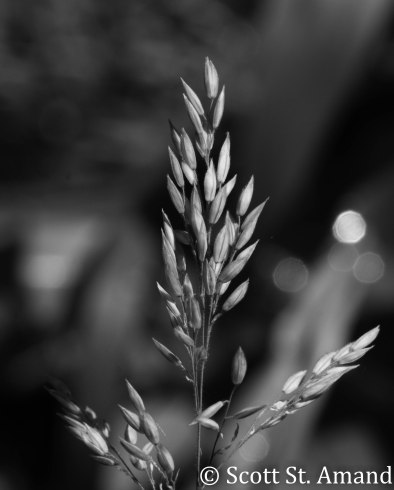
This photograph of a seedhead of tall ryegrass was taken on a high in Panthertown Creek, outside of Cashiers, North Carolina.  It is a simple photograph, and one which I would normally have skipped right over when I was sifting through the hundreds I took that day.  Nevertheless, something caught my eye in the simple elegance of the seeds and the blur and bokeh of the background.  Although not actual wheat, this native grass reminded me of the old aphorism “to separate the wheat from the chaff,” which is exactly what I do when I cull through the photographs to find the “keepers.”  The irony is not lost on me that the “chaff” nearly included this photograph.

Click here for a larger version.


Invasive Beauty

SSA Photography (179 of 400)

This post was originally titled “Native Beauty,” as I had seen these beautiful purple flowers up and down the coast near Carmel, California.  With a bit of research, however, I found that these stunning flowers are an invasive species known as Pride of Madeira (Echium candicans).  In fact, forestry officials are removing them from native plant communities as part of habitat restoration efforts in coastal parks such as the Golden Gate National Recreation Area.  The genus name is from an ancient Greek word for the plant. It is derived from “echion,” with the root word “echis” meaning “viper.”  There are conflicting etymological justifications for the name, including that the shape of the seed resembles that of a viper’s head, and  that Echium Vulgare, a related plant, was a historically thought to be a remedy for the adder’s bite.  Candicans or “shining white” refers to one of the more famous varietals in Madeira, Portugal, where the plants originate.  It was originally referred to as Echium Fatuosum, which is where the “pride” in the name originated.  In California, however, the purple E. Candicans varietal shown in the photograph is the most common.

Click here for a larger version.
Bee and Balm

SSA Photography (164 of 400)

This photograph is a companion to Anna’s Hummingbird, which I posted on Wednesday.  This photograph shows a bee and its balm, specifically a Halictus Poeyi (sweat “furrow” bee) about to collect pollen from a Monarda Clinopodia (white “bergamot” bee balm).  The sweat bee and bee balm are native to North Carolina, where this photograph was taken.  I was busy taking macro photographs of the native flowers in the beautiful gardens of a family friend, and I hardly noticed this little bee hovering near the dew-kissed bee balm.  I was looking at my camera screen to see whether I had captured a focused shot of the flower when he drew closer, and I was able to catch him mid-flight.  I would have loved to increase the shutter speed to catch his wings, as I did with Anna’s Hummingbird, but the lighting under the the dense rhododendrons was not conducive to such a shot.

Click here for a larger version.

Wabi-Sabi

SSA Photography (106 of 400)

“Nothing lasts, nothing is finished, and nothing is perfect.”

This quote sums up the Japanese philosophy of wabi-sabi, which has no direct translation in English. “Wabi” is said to be defined as “rustic simplicity” or “understated elegance.” “Sabi” is translated to “taking pleasure in the imperfect.”  This photograph of an abandoned toy truck captures the principle beautifully.  The imperfection of the truck (and even the photograph thereof) is evident.  Although the truck lost its wheels long before I took this photograph, its purpose has not yet been fulfilled – not completely.  It is now immortalized in this photograph, which has subsequently become the subject of this post.  Nothing is finished, really.  This post will be replaced tomorrow by a less melancholy subject, and slowly it will fade from memory.  Nothing lasts.  The Romantic poets were students of the ephemeral, finding beauty in the brief life of all things.  Even the Augustan poet Horace, famous for his introduction of the phrase “carpe diem,” was fascinated with fleeting time.  There is a beauty to this photograph, though; however, I could not put my finger on it before I connected it with wabi-sabi.  Now it has become clear why its perfectly imperfect composition and subject evoked such strong feelings of melancholy on the one hand, and pleasant nostalgia on the other.  The Japanese phrase captures in two words, what it has taken me a lifetime to understand.

Nothing lasts.  Nothing is finished.  Nothing is perfect.

Click here for a larger version.

Cypress Bluff

SSA Photography (204 of 400)

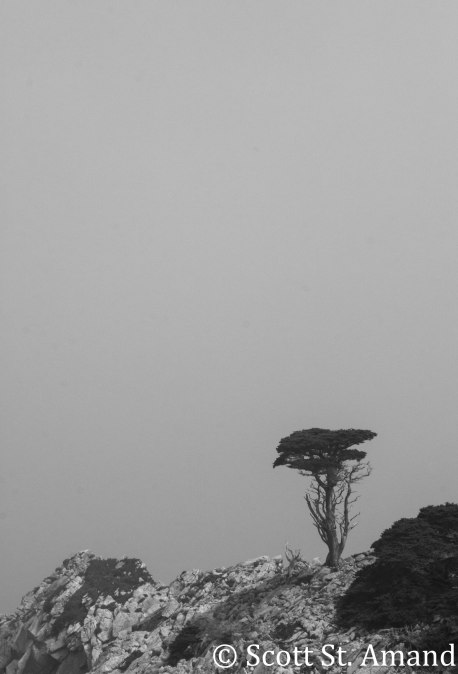
This photograph of a solitary Monterey Cypress (Hesperocyparis Macrocarpa) was taken at Point Lobos in Carmel, California. The species is native to the central coast of California, but now is confined to two small relict populations – Cypress Point in Pebble Beach and Point Lobos.  The most famous of the trees is the Lone Cypress, which is found along Seventeen Mile Drive in Pebble Beach.  Though the trees can grow to over forty feet, they are generally stunted by the strong winds that blow from the Pacific, which gives them their iconic flat-topped appearance.  Although it has long been held that some of the cypresses are two millennia old, this is a romantic conception of seaside literature, and the oldest of the cypresses are likely closer to 300 years old than 2,000.  Although only two native groves remain, the trees have been widely planted outside its native range, particularly along the coasts of California and Oregon.  Indeed, some intrepid seeds have even made it to Great Britain (including the Isle of Man and the Channel Islands), France, Ireland, Greece, Italy, Portugal, and Sicily.

Click here for a larger version.