Kemper

SSA Photography (187 of 400)

How my son has changed in the brief time since I took this candid portrait of him sitting on the parapets of his appropriated, improvised stone castle on the beach in Carmel-by-the-Sea, California…  This is my favorite picture of him at this age, then just four, and now about to turn six at the end of January.  I took a number of shots with him looking the camera dead to rights, but something, perhaps a wanton setter or retriever frolicking in the surf, caught his eye, and the shutter released at just the right moment to capture him as I see him often, wondering at the world, a younger version of me–for better or worse.

I have a distinct sense that he will eclipse me with photography.  His sensibilities and sensitivities are beyond his years, and he is patient and kind.  He is gregarious, unlike me, and perhaps he will be more comfortable approaching a stranger for a portrait.  Above all, he is curious.  He has not yet ceased to find awe in the smallest things, which it took me years and a good macro lens to rediscover from the bowers of my childhood.  We are going to North Carolina just after Christmas and for the New Year, and I will bring my old camera and kit lenses to see what he will be able to find through them.  His attention span is limited, but his wonder of nature will, I think, balance the scales appropriately…or it could be a quick introduction to a skill for which his maturity is not yet prepared.

Like the rock in this photograph, which he gravitated towards as if he were a satellite, he has a favorite stone perch in North Carolina, though it is not a castle there, but the great jutting precipice in the Lion King movie from which Simba was introduced to the kingdom.  The Lion King rock is on the property of a family friend where we stay, along the drive to the upper cabin, and scarcely will the wheels have stopped their revolutions before he is unbuckled and hastening towards it.  Perhaps this year he will be able to climb it by himself, a feat he has yet to master.  If so, I fear we will see little of him that first day.  I was like him as a child, happy to be within myself amongst nature and my own thoughts on any manner of subjects.  Perhaps this year, I will send him out with a camera in hand to find what he finds interesting or beautiful.  Photography has been a window into my psyche, and perhaps it will give me an even better view into his.

Click here for a larger version.

The Lone Cypress

SSA Photography (238 of 400)

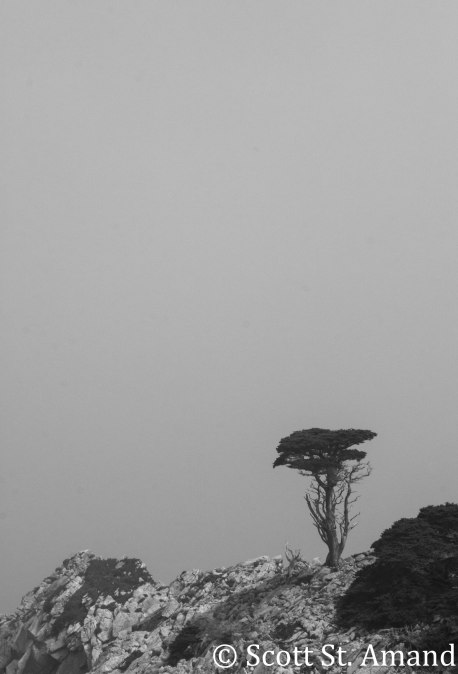
I often wonder how this iconic tree took root.  For those who don’t immediately recognize the scene, this is the “Lone Cypress” off the coast of Monterey, California.  This photograph was taken during the height of the Soberanes Fire southwest of here in the valleys just off the coast of Carmel and Big Sur.  Although likely surpassed by the recent Woolsey Fire, the Soberanes was the costliest wildfire in the history of California.  It coated everything in a thin layer of ash, and the smoke that hung thickly, almost unctuously in the air made shots of the coastline nigh impossible.  This photograph was taken towards the tail end of the trip, as the fire was winding down, and still the haze bled the details from the shot.

When the sun managed to pour through the thick air, the sky took on a burnt, sepia tone, which made every picture I took look like I had applied a strong filter to it.  The tree is at least 250 years old, and for the last 65 or so has been held in place by strong metal cables.  When I saw the cables in person, I thought that it was a supremely arrogant act by man to forestall the inevitable cycle of nature for the sake of Japanese tourists (and me) making a pilgrimage to gaze through chain-linked fence to snap an awkward photograph of the icon sitting on its outcropping, engirded as it is by a brick and mortar parapet.  But still, we come en masse, ogling the tree with a misplaced reverence.  When this one dies, as it will, it will be replaced with a fellow that I am certain is already being grown for its stead, like a Cardinal waiting in quiet for the Pope to abdicate.

Click here for a larger version.

Silhouette

calnov2016-9

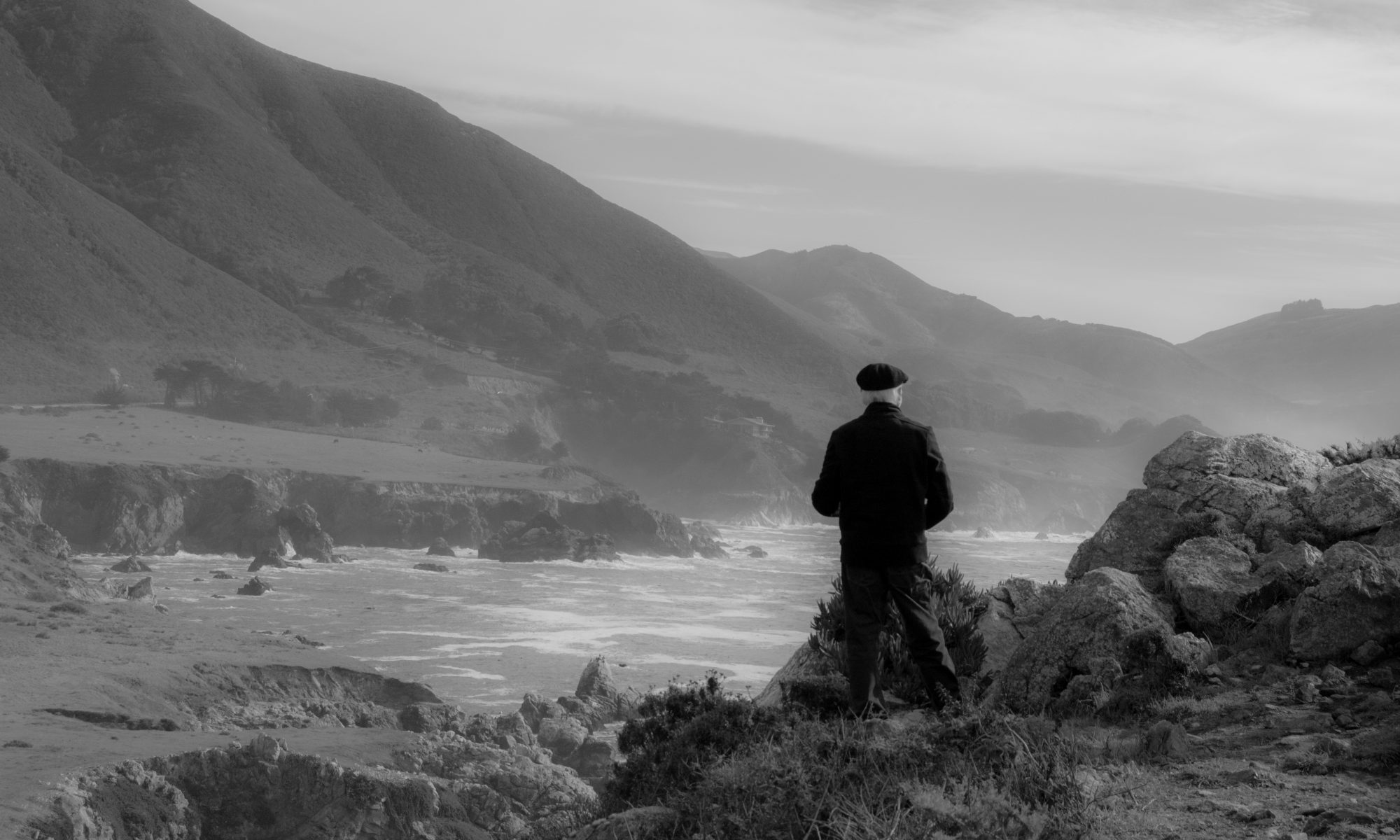
The word silhouette is derived from the name of Étienne de Silhouette, a French finance minister who, in the mid eighteenth century, was forced by France’s credit crisis during the Seven Years’ War to impose severe economic demands upon the French people, particularly the wealthy.  Because of de Silhouette’s austere economies, his name became synonymous with anything done or made cheaply.  Prior to the advent of photography, silhouette profiles cut from black card were the cheapest way of recording a person’s appearance.  I think that this silhouette of the female photographer on the rock is one of my best black and white compositions.  The mist and morning layer in the background contrasts sharply with the wet stone in the foreground, with the tiniest break in the line of the outcropping (in perfect thirds, I might add) made by the photographer.  I cannot say that my eye was drawn to her initially, but once it caught her, my eye became curious and could not look away – and if I did, I was always drawn back.

Click here for a larger version.

Hokusai

SSA Photography (242 of 400)

I took hundreds of photographs, waiting for the waves to crash on the rocks at just the right angle, with just the right force.  This photograph evoked feelings of “The Great Wave” the famous woodblock print by by the Japanese ukiyo-e artist Hokusai in his series Thirty-Six Views of Mt. Fuji.  It also made me think of the creation myth of Aphrodite, which unlike Botticelli’s Birth of Venus, was, by all accounts, a violent affair.  Although Aphrodite can be broken down into “aphros” (foam) and “ditos” (risen), there is no direct etymological derivation.  This did not stop the Greeks (Hesiod, specifically) from crafting a story of Aphrodite rising from the foam after a great battle between Cronus and Uranus, which would foreshadow the same father-son battle between Zeus and Cronus.  In the whitewash, I can almost see Aphrodite throwing her hair back, casting off the spray as she nears the coastline.  But then, I suppose that’s what you get when your two favorite subjects in school were Latin and Art History…

Click here for a larger version, as well as a more stylized version.

As They Saw It

SSA Photography (249 of 400)

I have published many posts taken at Point Lobos, but none yet of the point itself.  Point Lobos is located a few miles south down the coast from Carmel-by-the-Sea, California, and it is one of our favorite destinations when we visit Carmel.  When I took this picture, I wanted to capture the ruggedness of the point as well as the grove of Monterey Cypresses, which as I mentioned in a previous post, is one of two groves left in the world where the cypresses grow naturally.  When I went to “develop” or post-process the photograph, and I decided to go monochromatic, I was struck by the similarities to postcards I had seen in town from the 1930s and 1940s.  The coastline remained the same, albeit a bit more worn by the waves.  They cypresses were just as withered and topped by the constant winds.  The great Californian poet Robinson Jeffers wrote extensively about the coastline in his verses, and as I gazed at the photograph, I thought to myself, this is as he would have seen it – hence the genesis of the title of the post.

Click here for a larger version (and a color version).

Cypress Bluff

SSA Photography (204 of 400)

This photograph of a solitary Monterey Cypress (Hesperocyparis Macrocarpa) was taken at Point Lobos in Carmel, California. The species is native to the central coast of California, but now is confined to two small relict populations – Cypress Point in Pebble Beach and Point Lobos.  The most famous of the trees is the Lone Cypress, which is found along Seventeen Mile Drive in Pebble Beach.  Though the trees can grow to over forty feet, they are generally stunted by the strong winds that blow from the Pacific, which gives them their iconic flat-topped appearance.  Although it has long been held that some of the cypresses are two millennia old, this is a romantic conception of seaside literature, and the oldest of the cypresses are likely closer to 300 years old than 2,000.  Although only two native groves remain, the trees have been widely planted outside its native range, particularly along the coasts of California and Oregon.  Indeed, some intrepid seeds have even made it to Great Britain (including the Isle of Man and the Channel Islands), France, Ireland, Greece, Italy, Portugal, and Sicily.

Click here for a larger version.


Pod

SSA Photography (212 of 400)

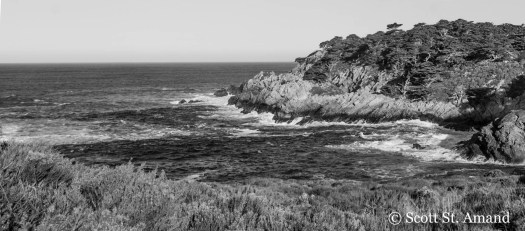
I took the photograph of this pod of pelicans off of Point Lobos, in Carmel, California.  This is only the front of a much longer line of pelicans that was flying down the coast, and I thought the panorama captured them nicely against the bay and the creeping marine layer.  I love how they are all in different stages of flight, some coasting and some flapping frenetically.

Click here for a larger version (and a color version).

Bixby Canyon Bridge

SSA Photography (174 of 400)

I descended a dusty gravel ridge
Beneath the Bixby Canyon Bridge
Until I eventually arrived
At the place where your soul had died
Barefoot in the shallow creek,
I grabbed some stones from underneath
And waited for you to speak to me
And the silence; it became so very clear
That you had long ago disappeared
I cursed myself for being surprised
That this didn’t play like it did in my mind
-Death Cab for Cutie
This photograph of the Bixby Canyon Bridge in Big Sur, California, just after dawn shows the marine layer lifting from the bay, slowly creeping up the mountains, only to burn off completely by the early afternoon.  The bridge spanning Bixby Creek is one of many on Route 1 down the coast of California south of Carmel, but it is probably the most famous.  The bridge has a rich history, opening in 1932 to connect the residents of Big Sur with Carmel and San Francisco further to the north.  When it was built, it was the longest concrete arch span the west coast.  It remains one of the tallest single-span concrete bridges in the world.  It is narrower (by eight feet) than the required width of modern bridges, but due to its historic relevance, expansion is unlikely.
Click here for a larger version.

Roil

SSA Photography (262 of 400)

This photograph was taken on a blustery morning in Carmel-by-the-Sea, California.  The winds were coming through the bay at a fierce clip, and the waves were the largest I had ever seen.  We went on a hike to Point Lobos, and I captured this scene after one of the larger waves had crashed across the rocks – completely covering them in a mix of foam and roil.  One of the apocryphal origins to the name Aphrodite is “risen from the foam,” but I cannot imagine that this was the type of scene the ancients envisioned of her birth.  I think Botticelli got it right.  The violence of the waves made me marvel at the strength of the stone, which has invariably been battered for eons.  Love is like that in many ways, often beaten but never broken…so perhaps the ancients were onto something…

Click here for a larger version.