Skagway Mist

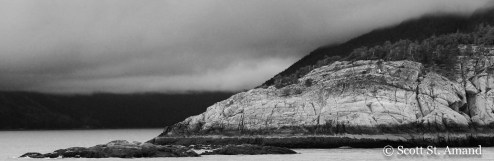
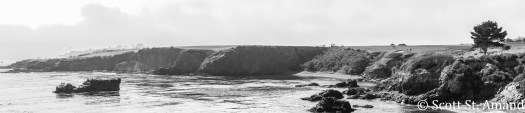
This small panorama was taken from the bow of a ship in the Inside Passage in Alaska, near Skagway. To call the nature in Alaska untamed would be an understatement. The glaciers are so plentiful that some have no names, and the fjords stretch for days. All of the stones have stories, variegated and striated like this one from eons of ebbing and flowing tides. The morning mist was a beautiful phenomenon, which I attempted to capture in this photograph. It blanketed everything in a soft, dense fog, which sometimes did not burn off until well into the afternoon, when the blue skies brought out the deep cerulean of the glaciers. Although beautiful in full color, I felt that the black and white of this photograph worked ever so well with the natural contrasts of the subject.
Click here for a larger version.
Awash

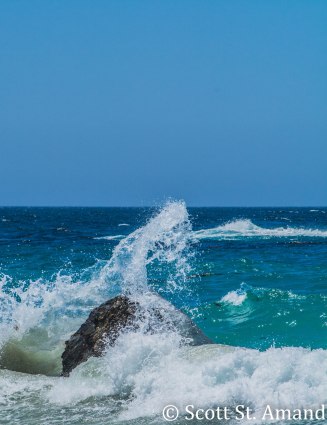
I have lived near the ocean my whole life, and yet it took my first trip to the California coast to truly admire the beauty of the sea. The rocks and the waves are gorgeous in and of themselves, but together they are magical. This photograph captures the instant when the two come together to produce an ephemeral wisp of beauty. But for my camera capturing the fleeting moment, this little crash would have been forgotten, lost beneath the weight of the others that have come after it. My fascination with the waves and the rocks can be seen in my collection California Waves. I hope you enjoy this instant as much as I have. The Romantics–Blake, Wordsworth, Coleridge, Keats, and Shelley–all tried to capture that one infinite moment in words. I will never have the words to capture it like they did; but then, they didn’t have a lens…
Click here for a larger version.
Rivulets

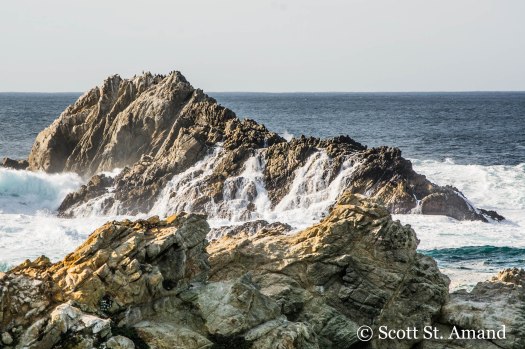
The beauty of the coastline of California is undeniable. The Pacific is magnetic, and I am drawn back to the West Coast when I am away for any length of time. This outcropping, just off the coast of Carmel-by-the-Sea, fascinates me, and I spent quite a while trying to capture a photograph to do it justice. I wanted to take one of the august waves crashing over the top, but ultimately I was struck by the hidden power of the little silent rivers that have carved away the stone over the millennia. There is no great force to the rivulets; they work by sheer repetition and determination. The streams of water cascade over the outcropping each time even a moderately sized wave crashes upon the rock, carrying a grain of sand or two, and slowly they peel away the layers of the hard stone – a testament to the often-hidden power of nature.
Click here for a larger version.
Chip off the Old Block

This photograph was taken from the shore of the bay, in Bar Harbor, Maine. As I mentioned in an earlier post, my father is from southeastern Maine, and the place has always held great memories for me. The weathered geometry of the rocks on the beaches struck me more during this trip than as a kid, when I was wont to be found between and betwixt the ocean-side boulders with knees perpetually skinned by the barnacles. Though not taken at Goose Rocks or Old Orchard Beach, where my dad would have been found in the summers, Maine is synonymous with him, and I am nothing, if not a chip off the old block.
Click here for a larger version.
Aesacus

This panorama was taken near Carmel Point, the southernmost point of the coastline in Carmel-by-the-Sea, California. The title, Aesacus, alludes to the myth memorialized in Chapter 11 of Ovid’s Metamorphoses. The youth Aesacus fell in love with Hesperia. As he pursued her, she was bitten by a snake and died. Aesacus gives a brief soliloquy lamenting her death, which he says was caused by him and the snake equally. The sentence after his speech contains one of my favorite images in Augustan-era poetry: “Dixit et e scopulo, quem rauca subederat unda, se dedit in pontum.” (“So he spoke, and from the cliff, which the rough waves had eaten away below, he gave himself to the sea.”) As Aesacus fell, the ocean goddess Tethys took pity on him and changed him into a diving bird. Watching the five diving birds in the photograph flying between rocks (eaten away by the sea) made me think at once of the Aesacus myth, which gave the scene such a mournful subtext.
Click here for a larger version.
Down East

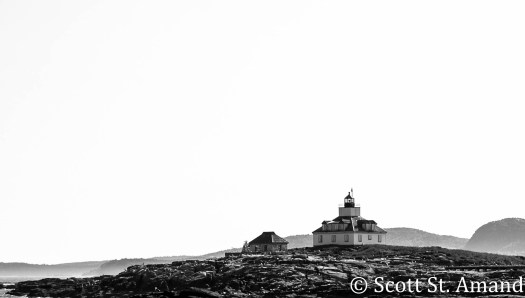
This photograph of a squat lighthouse was taken in southeastern Maine, where my dad was born and raised. Hundreds of these lighthouses dot the rocky coast, and each one of them is unique and picturesque in its own right.
Click here for a larger version.
Pebble Hill Cypress

This photograph is a morning panorama of the Pebble Hill golf course just outside of Carmel, California. In fact, the photograph was taken on the beach of Carmel Bay. Beyond the point at the far left of the photograph is Spyglass Cove, where I have sat a number of times and just watched the sea otters and harbor seals bob between the long, whip-like strands of bull kelp.
Click here for a larger version.
Twa Corbies

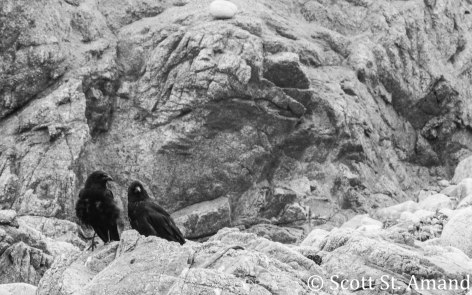
This photograph was taken on Spanish Beach, just off of Seventeen Mile Drive in Monterey, California during the Sobersanes wild fire. The sky was sepia, and the general mood was foreboding. When I saw these two crows (twa corbies) seemingly conspiring with one another, my mind turned back to the macabre Middle English folk song, “The Twa Corbies.”
Click here for a larger version.
Gargoyle

Taken in the Pisgah National Forest near Asheville, North Carolina, this close-up of a small waterfall along the Daniel Ridge Trail evoked in me the image of a medieval gargoyle, like those on the Notre Dame de Paris, featured in Victor Hugo’s The Hunchback of Notre Dame. This little gargoyle is a perfect example of life imitating art.
Click here for a larger version.