Posted

SSA Photography (105 of 400)

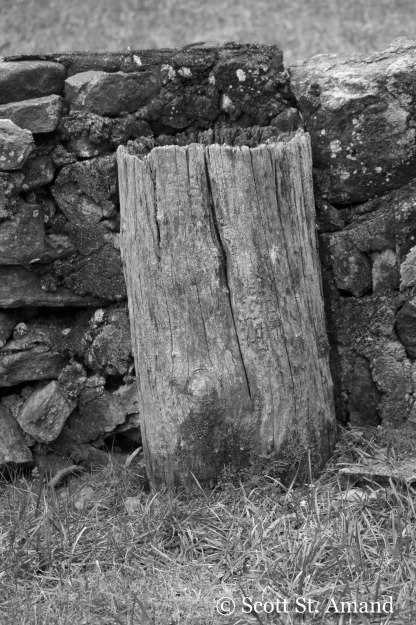
The provenance of this post is unknown.  I took the photograph right as I began to become serious about my photography.  The post is within the ruins of what used to be a gym for a boys camp in North Carolina, but the property was also a hippie commune, which the likes of Pete Seeger and Woody Guthrie graced with their presence.   The photograph is a simple composition, and if I would have taken it now, this one would likely have found itself on the cutting room floor.  Nevertheless, the photograph is nostalgic, and as my posts have shown, this is a flaw of mine.

Click here for a larger version.

Worth

MoorWalk-8.jpg

How I arrived at the top of this particular moor, I don’t really care to recount.  It suffices to say, that in a land of paths cut by more intrepid travelers over the centuries, there were no paths at the top of this moor, as we were, apparently, four of the only masochists to decide that it was prudent to visit the rock in the left foreground of the photograph.  I would have grumbled the entire way, as I am wont to do, but I had no breath.  Thus, the grumbling was internal–albeit vociferous.  Nevertheless, when we reached the apex of this last moor (we had already traversed at least four), my grumbling ceased.  I even managed to catch my breath, and yet I did not utter a discouraging word.  How could I at such a magnificent sight.  The purple heather that I disregarded with certain animosity as I trapsed through it was gorgeous, and gave the moors on the horizon an almost surreal violet hue in patches.

Three miles or so down in the Worth Valley is where Anna’s grandfather build their house, stone by stone, from the ruins of an ostler barn.  It is where Anna’s mother grew up, and where I proposed to her in a field across the valley from the house–but in a line of sight from the kitchen window, so that we could always look over to the field when we were at the house.  Looking further into the horizon, you can make out a pinpoint landmark, which is the rock outcropping that we came to mount.  This is where the Brontë sisters wrote their novels, and in fact Top Withens, the inspiration for Heathcliff’s home in Wuthering Heights, sat only minutes away atop an adjacent moor.  A steam train runs through the middle of the valley, on which tracks Anna’s great-great-grandfather was an engineer.  The valley is of another time, and it affects me like no other place I have visited in the world.

Click here for a larger version.

Climbing

LittleTalbot-4

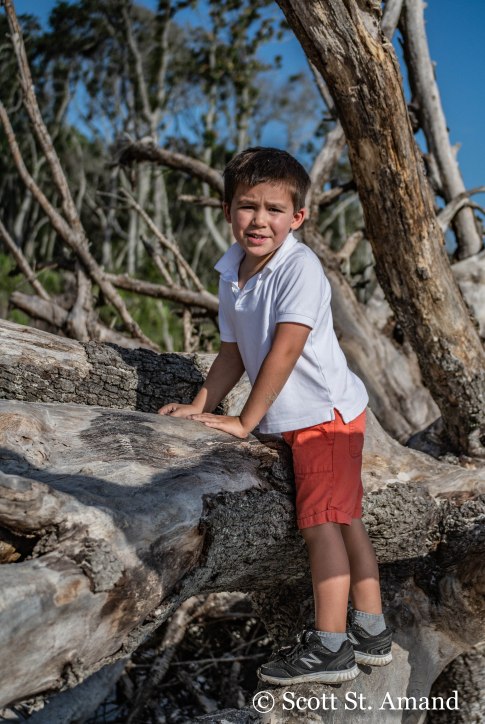
My parents have identical photographs of me at Kemper’s age climbing amongst the rocky shores of Maine and up to the narrowest branches in the trees in our yard, which in hindsight (now as a parent) was a terrible, horrible, no good, very bad practice.  Kemper is a bit more grounded than me, less of a risk-taker, which is why in his almost six years, he has not yet broken a bone.  By his age I had already broken both of my wrists (at the same time), a few ribs, and a number of toes.  I look back at this period of my life and laugh, though as a parent, I cannot imagine what I put my own through.

Kemper found the supine trees on Boneyard Beach at Big Talbot Island, which have been the subject of many posts in the past, and though they were only feet off the ground, he was still tentative in climbing them.  I urged him, almost begged him, to overcome his fears and climb.  As you can see by the wry smile on his face, it was a worthwhile pursuit.  Of course, once I got him to climb one without incident, every new one we came upon needed to be ascended, which made for a fitful photography session of the trees, but was great fodder for capturing him candidly enjoying his boyhood.  When we were in North Carolina last week, he had shed his fear of climbing somewhat, and mounted the rocks on the property with great aplomb.  Still, he was more keen to slosh in the creeks and melted snow puddles with his wellingtons.  He is grounded, and this will undoubtedly bode well for him in the future.  Breaks are a part of childhood, a part of life, but his caution may let him escape the many breaks of bone and heart that I experienced.  This is my hope, perhaps a naive one, but my hope no less.

Click here for a larger version.

Quarry

NCWinter2018-24

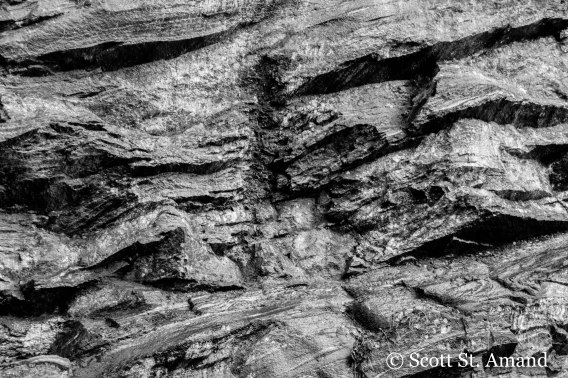
As I stared at the tall, sheer rock face of the long-abandoned quarry, in the middle of the Pisgah National Forest, my dad reminded me that one of my relatives had been a dynamite man for a quarry back in Maine many years ago.  Whether he was deaf from the work, or simply unsocial, my father never knew.  The long drills would bore vertically into the solid stone, and then he would carefully lower the dynamite into the channel to blast thousands of tons of rock and rubble from the mountainside.  Most of the bores in the Pisgah quarry were high on the stone face at least ten feet long, irregularly spaced, but distinctively smooth interstices in the jagged profile of the mountain.  The small paper birch trees were deceptively omnipresent in all of the photographs I attempted, and I was not satisfied with any of them–even as I took them.

As we began to walk on, however, I saw this remnant of a small bore, and I snapped a quick photograph of it, not thinking too much about it at the time.  This hole was unique from the others.  It was only a foot or so long, and its edges were not smooth like the channels higher up.  The crevasses and splintered stone that surrounds the bore suggests that it was an afterthought, and the jagged striations within the shallow channel evidence a blast that wrought the uniformity from it.

This photograph is a microcosm of the quarry, but far more representative than a wide-angle shot of the sheared-off face of the mountain with its uniform bores.  It is evocative and telling that the work was violent and loud and dangerous, but the quarry no doubt was necessary in supplying building materials for the early denizens of Brevard.  Though Robinson Jeffers noted, as I have quoted before, “Not everything beautiful is pleasant,” I have to believe that the opposite might be true.  The violence of a volcano or a blast-torn bore can be beautiful if the time is taken to appreciate it.

Click here for a larger version.

Panthertown Skies

Panthertown Valley-6

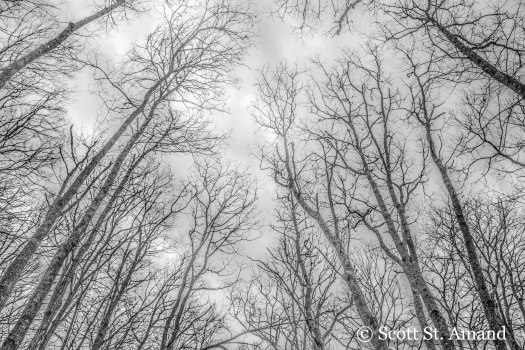
North Carolina in the winter is breathtaking.  I haven’t spent a full winter there in over ten years, since Anna and I graduated from Wake Forest.  The little time I do spend there is with family over the holidays, and the less than frequent trip back to our Alma Mater.  So often now, I find myself looking down, whether it be watching the footfalls of Kemper and Nora, or searching out the low-lying objects that I neglected for so many years as I grew taller and less aware of the beauty that only years before had been at eye level.  As a child, though, I often looked towards the sky.  It was a predilection of mine, and was lost through high school, college, law school, and then my post-graduate work.  As a litigator, I have been trained to look ahead and anticipate the roadblocks before me, and  I have, along the way, lost the penchant for gazing into the clouds above the treetops.  Photography, though in many ways a mature art, has brought me back to my childhood wonder of nature, and as we hiked through Panthertown Valley over the New Year, I caught myself looking upwards once again.

This photograph, though a simple composition, captures some of the innocent wonder.  The clouds of the late morning were beginning to roll in, heavy with precipitation, and we laconically raced to avoid the rain that settled in as we reached the trailhead.  The fingers of the maples and sweet gums and oaks looked like arteries against the pale sky, and in many ways this is a fitting simile.  Nature is a lifeblood–one that I am reconnecting with after years of the wonder of it lied fallow.  Even though I am at my desk from the darkness of the morning through to the early darkness of the winter evenings, I catch myself looking often to the sky, especially as the sun rises and sets.  Jacksonville, to its credit, is beautiful at these times of day.  The rich colors wrought by the low sun are no match to a North Carolina dawn, but then I am biased and nostalgic for the old days, when I could skip my morning lectures and find myself in an hour at the base of Pilot Mountain as the leaves were beginning to redden at the first breath of winter.  Until we return, I will always long for those days, simpler by measure and winsome.  For now, I will console myself with the memories and the short trips when I will fill my camera with shots such as this of the mountain skies on a chilled winter day.

Click here for a larger version

Crash

SSA Photography (266 of 400)

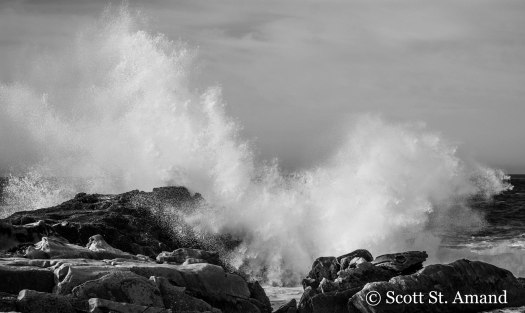
The Pacific intrigues me like no other body of water.  Having grown up minutes from the Atlantic Ocean, I am accustomed to what I always considered crashing waves.  I remember the muscle memory as a child of being tossed and rolled in the waves after a visit to the beach lasting for hours after we arrived back home.  The sheer strength of the Pacific dulls these memories somewhat, and forces me to reconsider the awe of my childhood fascination with the placid Atlantic.

This photograph was taken amongst the rocks in Carmel Bay.  Although the crash of the waves in this photograph is impressive, the highest swells and tallest sprays seemed to come the moment I turned my camera off after waiting for the next great wave to roll in.  Kemper joined me on this trek down to the water’s edge, but he was more interested in throwing pebbles to the tide pools than the august waves and cacophony of them extinguishing themselves on the rocks.  Perhaps he is jaded, having grown up with the Pacific, or perhaps he is simply a child, whose attention is drawn more by his controlling of nature than nature’s control over the elements.

The morning layer was thick when I dragged him from bed to amble down to the coastline, and the colors were muted.  The deep dark shades of the wet rocks and the brilliant white of the salt spray were perfect contrasts, and so my inclination to monochrome most of my photographs was well founded in this one.   Although I am taking more photographs with Kemper in them, which capture his growth and my fondness of him journeying with me as I did with my father, I had not yet begun this practice when I captured this wave against the rocks of Carmel Bay.  When we return, hopefully soon, to California, I will rectify this shortcoming.  Perhaps he is old enough now to appreciate the power of the Pacific, but more likely, he will return to his old pursuits of watching his ripples in the tide pools as I wait for the great wave.

Click here for a larger version.

Fire in the Highlands / Smoke on the Water

SSA Photography (237 of 400)

In classical mythology, Eurus and Apeliotes, interchangeably, were the gods of the easterly winds, though Eurus was favored by the poets such as Homer and later Ovid.  Homer, in naming the Anemoi (the winds) noted that Poseidon was the master of the winds, and after the blinding of his son Polyphemus (and Odysseus’ subsequent boasting), “Poseidon massed the clouds, clutched his trident and churned the ocean up; he roused all the blasts of all the Anemoi and swathed earth and sea alike in clouds; down from the sky rushed the dark.  Eurus, the east wind, and Notus, the south wind, clashed together, stormy Zephyrus, the west wind, and sky-born billow-driving Boreas, the north wind.”  Ovid, placing the Anemoi’s parent Aeolus at their charge, noted that “Fierce as Aeolus is, far harsher than his own sons, surely, something comes from a life with savage winds; his temper is like that of his subjects.  It is Notus and Zephyrus, and Sithonian Boreas, over whom he rules, and over the pinions, wanton Eurus.  He rules the winds.”

This photograph was taken on Spanish Beach just off of  17 Mile Drive in Monterey, California, near Pebble Beach.  The natural sepia tone of the photograph is derived not through the use of any filters or post-processing, but from the thick, cloying smoke that hung in the air from the raging Soberanes Fire then burning through the highlands south of Carmel, California.  As I mentioned in my post of the Lone Cypress, taken at the same time as this, I was off-put at first by the way the photograph turned out.  I have numerous panoramas of the coastline of Carmel, strewn with stones and shattered boulders, and this photograph offered nothing new.  Further, the smoke bled any detail from the scene.  I boosted the detail with post-processing software, but eventually I came back to the unedited version, finding a certain nostalgia with the memory of the smoke, poured out to sea by Zephryus, the west wind, and then wafted back to shore laconically by Eurus, the wanton east wind.  What is not captured in the photograph is the utter, lifeless silence of the coastline, aside from the ever-present sluice of the capped waves on the rocks.  The shore, always buoyed to life by crows and sparrows of every type, was abandoned in the smoke.  Perhaps the birds knew better to seek higher ground to the west, where the smoke had not yet permeated.

Click here for a larger version.


Behind the Falls

Panthertown Valley-57

This photograph of my dad standing behind a waterfall was taken in Panthertown Creek near Brevard, North Carolina.  We hiked about three miles and were prepared to turn around, when we ran into a sweet older lady who said, “The falls are really running today.”  We asked for directions, and she pointed us down a side path, which we traversed for about ten minutes until we heard the roaring of the waterfall.  I took many photographs and wanted to get closer.  I found a not so well-worn path, and my dad and I followed it until we found ourselves behind the waterfall.  He remarked that although walking behind a waterfall had not been on his bucket list, it should have been.  It was truly remarkable.  The hike behind the falls had been tough, but it was so very worth it.

Click here for a larger version.

Morning through the Maples

NCWinter2018-85

Dawn is often a foggy affair in the mountains.  This photograph was taken off of the front porch of our cabin in Brevard, North Carolina.  We have come up for a week, and though we have been up for only two days, I am reinvigorated after a long year at work.  Foggy beginnings seem familiar and yet foreign.  Though I am nostalgic for many things, living in a metaphorical fog is not amongst them.  Waking up, walking outside with a hot cup of tea, and watching as the low clouds creep through the maples is something different entirely.  Being here with my family, who walked through the fog with me, and seeing my son slushing through the creeks on the property like I did when I was his age is inspiring.  Even though the dawn is foggy, the sunlight burns through in the end.

Click here for a larger version.

Dreamcatchers

SSA Photography (126 of 400)

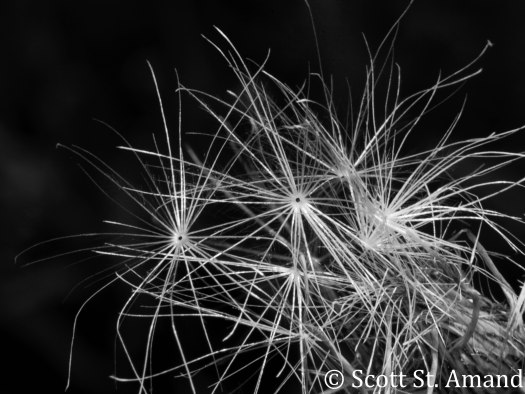
This photograph of the achenes or diaspores of a “horrible” thistle (Cirsium Horridulum) was captured two summers ago with my macro lens.  The diaspores have evolved over millions of years to to be light and airy, with tendrils that catch the air for dispersal far afield of their mother plant.  Though not the best composition, I was struck by the symmetry of the achenes and their simple utility.  The swampy path I was walking when I came upon them during the summer was littered with thistles for miles.  The evolution, though perhaps not complete, had certainly served its purpose well.  The most recognizable achenes are those of the dandelion clock, which children gather up with some eagerness only to blow the diaspores unwittingly throughout their parents’ front yard.

I wish Kemper had been old enough to accompany me when I took this photograph.  He finds great sport in blowing the silky white seeds from their presently denuded and spent host.  He was three then, and not quite up to a long jaunt in the summer heat.  The mosquitoes were particularly bad this day, and to be honest, I am surprised that I did not capture one in this photograph–they were so thick.  But this is Florida, and the beauty of nature invariably carries with it some danger, whether an alligator lurking silently beneath the surface of a calm fishing pond, or a rattlesnake blending in with the underbrush.  Having grown up here, these are calculated risks, and readily mitigated.  For the uninitiated, however, Florida is as wild as the outback of Australia.  This results, I think, in a fair bit of pride for us native Floridians who would as soon approach a four foot long gator, knowing full well it will quickly shy away, as a New Yorker would cross a busy intersection at the height of the noon-day traffic.  I do not begrudge the out-of-towners the novelty of seeing an alligator in the wild for the first time, but to us they are quotidian and predictable.  Yet, as this photograph shows, even the most commonplace native objects, when viewed with a different perspective, yield beauty.

Click here for a larger version.