Atop the Moors

MoorWalk-5.jpg

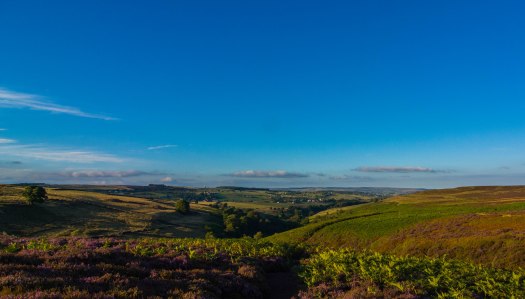
I often muse that I was born on the wrong continent at the wrong time.

This is not to say that I am not well pleased with my life, only that I feel a kinship to England that reaches beyond a penchant for visiting.  When I am there, it feels like home.  It helps to be surrounded by scores of my wife’s family, but there is something natural, intrinsic about the moors that makes me feel like throwing on a flat cap and taking a stroll down a back lane in the afternoon.

In Florida I am loath to take strolls in the afternoon, mostly because it is as hot as the seventh circle of hell for 80% of the year, and its raining or threatening to rain for another 15%.  The final 5% of the year is pleasant, and I would not want to be anywhere else – except England, or Carmel, or North Carolina.  I have left pieces of my heart in all of these places.  I met Anna in North Carolina, and I proposed to her in England – on the moors.  We have spent many beautiful days on the coastline in Carmel, and I feel a certain creativity out there that I do not feel anywhere else.

Florida is our home, though.  I was born here, and I have set down deep roots since we moved back from Virginia nine years ago.  My job is here, and I am finally happy.  That is not to say if we won the lottery, I would not spend more time in England and Carmel and North Carolina, but I am content.

Contentment is a far cry from the anhedonia I once thought was just a part of who I was, and who I would always be.  I had a wonderful wife, a young child, and yet I was desperate for something more, something tangible that I could take hold of and claim as my own.  I felt out of control, and I did little constructively to find my way back to center.  Yeats captured this in his poem The Second Coming:  “Turning and turning in the widening gyre / the falcon cannot hear the falconer / things fall apart; the centre cannot hold / mere anarchy is loosed upon the world…”

It has been over three years since I felt lost, at once like the falcon and the falconer.  I was a paralyzed man learning how to walk again, and in many ways I am still learning – learning how to smile, learning how to appreciate the simple joys, and learning how to hold the center.  I miss England, but I do not pine for it as I once did.  When I return, and I will, I know that I can appreciate it for what it is, and not what I long for it to be.

I may very well have been born in the wrong time and on the wrong continent, but I have an English spirit about me, a spirit of humored resilience…and that, for now, is enough.

Click here for a larger version.

Turkey Tails

AngelColor-14

This photograph of the “turkey tail” mushroom (Trametes Versicolor) was taken in the Nocatee Preserve on Christmas morning with Kemper as my photographer’s assistant.  I gave him my old Nikon D40, which was the first DSLR that I ever had.  It has seen Alaska and many other beautiful places, and it served me well until I upgraded to my current D7100.  Kemper took to photography like a duckling to water.  As I am drawn to paths and mushrooms and other natural wonders, he is drawn to sticks and mosses and the sky.

A number of his photographs turned out, though we need to work on focusing a bit more.  His hands are a bit small yet for back-button focusing, and so I reset the camera to focus on depressing the shutter button by half.  I think he gets so excited when he is ready to take a shot (as evidenced by The Pose).

I love taking photographs of mushroom, because they have some of the most beautiful variety of any natural phenomenon.  Some are medicinal, while others are deathly poisonous.  Some are edible, while some are deathly poisonous.  Some are beautiful, and some are beautiful and deathly poisonous.  The turkey tail has gorgeous growth rings that show up especially well in black and white.  Like many woodear mushrooms, they are harbingers of doom for the tree that they grow on, but even as such, they are beautiful to look at and to photograph.

Click here for a larger version.

York Minster Windows

SSA Photography (344 of 400)

I am indebted to many of my past teachers and professors, but there are those who leave a more lasting impression than others.  My Latin teacher, for instance, was one of the most influential teachers I had in high school, and she prepared me so well that my Latin major at Wake Forest was all but a foregone conclusion.  We all use Latin daily, whether we are aware of it or not.  Us Latin geeks are more tuned in to the derivatives, and we make conscious decisions to use Latinate words wherever possible (in lieu of that vulgar German stock).

As a lawyer, I am a writer first and foremost.  It is my craft.  As a photographer, too, I view the world differently than most attorneys.  Indeed, I perceive the world aesthetically through an artistic lens, whether or not I am behind my camera.  This appreciation for art is due in large part to my AP Art History teacher.  When I was 20, I saw my first cathedral outside of my art history books.  It was on a trip with my wife and her family to Europe.  We stopped for a day in Mallorca, and I made a pilgrimage to La Seu (Palma Cathedral).

I stood before the great vaulted entrance for a terribly long time, for the first time in my life appreciating the magnitude of what Judy taught me.  I took in the carvings and the arches, and then once inside, I looked with a child-like wonder at the rose window.  I walked down the central aisle in the nave (knowing, of course, what this part of the cathedral was called), and for the first time it struck me that although I had memorized the frescoes on the ceiling of the Sistine Chapel, I had never known what it felt like to physically stand under Michelangelo’s handiwork.  I couldn’t tell you how the chapel smelled, or what sensation I had when I first walked inside.  But now, standing in the dimly lit chapels of La Seu, I knew what it was to be inside a gothic cathedral.

Last summer, I visited Anna’s family in England.  Her cousin/godmother lives in York, and we went for a short day trip to visit Alice.  Alice had inherited a tortoise from the previous owner of her home, and he was nearly one hundred years old.  Kemper still asks about the tortoise, and this will be his memory of York (for now).  For me, however, I will remember York through the photographs I took of York Minster, the grand cathedral of York.  I will remember it, because I understood it.  I will remember York Minster, not just because of its august presence, but because I was taught to appreciate the buttresses and the vaulted ceilings by an uncommonly wonderful teacher.

In many ways, I think I missed my calling.  I am always mildly jealous of my best friend (Nora’s godfather) who is a professor in North Carolina.  I was helping proof a paper for which he allowed me to contribute some research, and I was overcome with a modest pang of regret (made all the more acute when I had to turn back to the Response to Petitioner’s Motion to Dismiss that I should have been working on instead of immersing myself in the effect of language policy on the colonialization and Americanization of Puerto Rico at the turn of the 20th Century).  But I am happy where I am in life.  I have a job I enjoy at a firm I adore, and I will always have my photography and my writing.  I owe all of these things to my teachers and professors, especially those select few whose lessons continue to teach me to this very day.

Click here for a larger version.
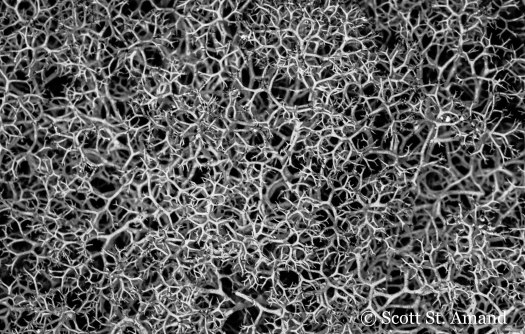
Deer Moss

NCWinter2018-40

This lichen (Cladonia Evansii) is a familiar one.  Known mistakenly as “deer moss” this fungus is a lichen, not moss.  As the name suggests, this fruiticose lichen is important forage for whitetail deer in the eastern states.  Though not as plentiful amongst the trees as the usnea lichen that seems to attache to the branches and trunks of even the youngest saplings, among the rocky hills, the light ash-gray clumps of lichen are visible from long distances, interspersed between the darker slate-gray stones.   The lichen grows extremely slowly, only three to ten millimeters per year.

The patch that Kemper and I found on our walk down the driveway was decades old and thick with a radius of lichen stretching out ten feet from the center in all directions.  The thalli (branches) are interwoven, and the result is a springy, spongy mass.   This type of lichen (Cladonia) can be found all over the world, and its name varies as the animals that forage on it change.  In the northernmost reaches, it is known as reindeer moss, and further south it is known as caribou moss.  Kemper and I even found some in a Jacksonville swamp during a hike, and sure enough, cast in the mud was a hoof print of a small whitetail deer.

Click here for a larger version and a color version.

North Carolina Nights

twigs-stars

I have seen successful astral photography.  The shots are generally taken in the middle of a deserted stretch of Earth, such as the desert, on a moonless night with the tails of the Milky Way visible.  Aside from shots of the moon, I have only dabbled in astral photography.  I could not resist this night, a couple of winters ago in Brevard, North Carolina.

The rich cerulean sky was dotted with an incomprehensible number of stars, and the moon was nowhere to be seen.  I set up my tripod in the middle of a large field, where the light pollution from the cabin we were staying in could not reach.  Although the focus is a bit off, this shot, and others from that night, manage to capture the beauty of the scene, though not quite capturing the awesomeness of the uninhibited night sky.  Last winter, it rained most evenings, and on the evenings it did not, the kids were already in bed, and it was hard for me to tear myself away to trek up to the field.  I regret not going.  Next time…

Click here for a larger version.

Kemp & Brynn

NCWinter2018-82

My sister and I were close as kids.  We lived across the river (literally) from our school friends, and we were often the only playmates the other had.  Nevertheless, I knew which buttons to push to get a rise from her, and I was like a churlish child on an elevator for the first time pressing all of them at once, at times, just to see them light up.  To my memory, she only paid me back once, when I was six or seven and learning to rollerblade.  I fell, and she tried to help me up with her foot…on my back…twice…  If this is the worst that I can remember, then I suppose we had a pretty good relationship.

Since we had kids (Claire’s daughter, Brynn on the left, and my son, Kemper on the right), however, we have grown much closer.  It may be the newfound maturity on both our parts, but I would like to think that we are just in a better place to be even closer than we were growing up.  She is a single parent, and a damn fine one.  My dad and I have both taken on the male figure in Brynn’s life, and in many ways I think that this has made me grow up even faster than just having two kids of my own.

I love seeing Kemp, Brynn, and now my daughter Nora, all playing together.  Kemp is gentle and kind with both girls, and very protective.  Brynn mothers Nora, and Nora adores them both.  We had the chance to spend a good chunk of time together in North Carolina over the New Year, and it is the best family vacation that I can remember.  Everyone was on their best behavior – even me – and the kids played constantly together.  This photograph was taken on a short hike on the property to an amphitheatre that was built for the boys’ camp that existed on the property in its earlier life.

Although I was trying to get Kemp and Brynn to pose for a shot, this one is candid.  It perfectly captures Brynn’s childish pleasure at being with the whole family (especially Kemper), and Kemper’s sly amusement at the world itself.  I love this shot, and I smile every time it comes up on my photo album that I have playing in my office at all times.  Claire and I were close, but I know that we want our kids to be even closer.  I think that is, ultimately, what we worked towards growing up without even knowing it.

Click here for a larger version.

Beneath the Rhododendrons

Panthertown Valley-10

The great rhododendrons (Rhododendron Maximum) are thick throughout western North Carolina, no less so in Panthertown Valley.  We hiked through the valley, and though the leaves had fallen from all but the paper birches, even the huge snowstorm the weeks before had not tempered the deep, rich green of the underbrush.

I don’t particularly care for the bare bushes, though in the summer when they are flowering, they can be quite lovely.  To me, they are glorified giant azaleas, which again, are beautiful only when they are in bloom.  Nevertheless, I respect them.  They are a native species, and they have retained their ground (with great aplomb) even where invasive species would have otherwise taken over.  Even the leaves of the rhododendron are persistent, lasting up to eight years on the plant itself, and then they are incredibly slow to decompose.  There is even some believe that the rhododendron is allelopathic (a biological phenomenon by which an organism produces chemicals that inhibit the growth or germination of other plants), which means it quite literally fights for its place in the forests through biochemical warfare.

There is, I admit, something to be admired about the lowly “great rhododendron” and the wide swath it has cut through Appalachia.  I count myself among a group of survivors, whose roots were set down deep by my parents, else I would have washed away long ago.  I feel a sort of kindred with them, and perhaps I did not care for them in the past because I saw a bit too much of myself in them.

Click here for a larger version.

Framed

SSA Photography (86 of 400)

Life is a kaleidoscope of perspectives.

I have had many perspectives in my relatively short life.  I have seen the world from the top and from about as low a bottom as anyone could imagine.  I have begged for forgiveness, often undeserved, and I have forgiven.  I have now even seen the world through my own children’s eyes.

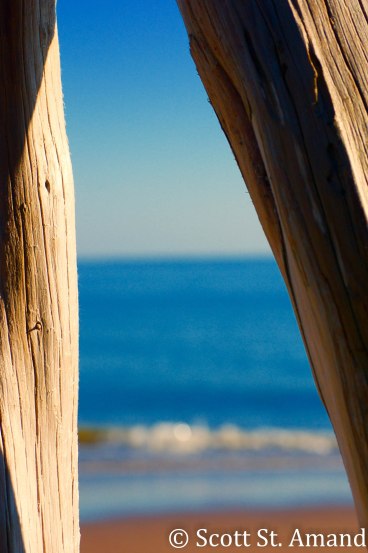
Photography allows me to manipulate perspectives, to frame them in ways that you may have never thought to look at a particular scene.  This photograph was taken at Big Talbot Island State Park, just north of Jacksonville, Florida.  It was a hot summer day, and in my infinite foresight, I arrived around noon, just as the sun was reaching its apex in the sky.  The shadows played on the driftwood as it began its slow descent to the West.  I came upon a particularly large live oak (Quercus Virginiana), which had two large branches reaching towards the sky.  One was perfectly vertical, and the other was at about thirty degrees.  I took a number of photographs of the geometry of the branches, but none were particularly aesthetically pleasing.  Although mathematics often make photographs interesting, when it is particularly complex like a fractal in a snail’s shell, when the shapes are so simple, they sometimes do not lend themselves to a pleasing composition.

Determined to use them for a shot, I evaluated what struck me about them.  I zoomed into one of the closer shots I took, which approximately resembled this final photograph, and I loved the contrast between the dark, shadowed wood, and the brightly lit ocean and clear blue sky.  I reframed the photograph, itself a frame, and captured this scene.  The fact that the wave rolled in at the exact right time with a sandy color to complete the triangle was a bonus that I only realized when I was touching the photo up later that day.

Click here for a larger version.

Quest

LittleTalbot-9

In the end, we are all searching for something.

The quote I chose for my yearbook junior year of high school was “Life’s a journey, not a destination, and I just can’t tell just what tomorrow will bring.”  This was from Aerosmith’s Amazing, which hit so many chords with me even then.  The quote is hackneyed and attributable to dozens of people, most commonly Ralph Waldo Emerson (though he does not appear to have written the exact quote, just the sentiment).  Some days I regret choosing it instead of Faulker’s quote from the Unvanquished: “I realized then the immitigable chasm between life and print – that those who can do, and those who cannot, and suffer enough because they cannot, write about it.”  That, I think, would have been more appropriate for that time in my life.

Kemper has inherited many things from me, but at his core he does not know what it is to deceive.  We often joke that he acts the same for Anna and me as he does for his teachers, and as he would for a stranger; what you see is what you get.  It is a brilliant, albeit foreign, trait to me.  As he has matured, I have waited for the introversion to take over, but he must have received a recessive gene from Anna.  Though he cedes to quietness after a long day of entertaining people – and not as a defense mechanism – he is not like me, like who I was.

In my earlier years, if you saw me, casually, on the street, to you I looked happy.  I was the greatest liar that ever lived.  That did not seem like hyperbole at the time, and when I look back on the years between college and where I am today, I can still say that without any reservation or apprehension (which, perhaps, is a testament to how often I convinced myself of my own deception).  But then I recovered.

I am different now, too.   I remain introverted, but the life I lead is no longer a duality of darkness and feigned brightness.  Hawthorne once wrote “No man, for any considerable period, can wear one face to himself and another to the multitude, without finally getting bewildered as to which may be the true.”  I read this quote (from The Scarlett Letter) in high school, and I still remember it to this day.  I lived the quote, not as much then as in my later years, but even at sixteen, I recognized my ability to con and fool others (and even myself) into believing I was capable of feeling joy.  But then I recovered.

I have found that capability, and I experience joy every day.  I am cautious though.  The joy is always tinged at the corners with a fear of free-falling back to a time and place I can now barely remember.  I do not regret my past, nor do I wish to shut the door on it.  Instead, it has made me who I am at this moment, and this moment is all I have until the next one passes.  For now, I have joy and contentment and knowledge and peace that there are things both within and without my control.  Honestly.  Because I recovered.

Click here for a larger version.

Path to Pebble Beach

SSA Photography (219 of 400)

The Pebble Beach ProAm golf tournament was played last weekend, and as I watched the scenes of the course from the sky, and the ubiquitous shots of Stillwater Cove, I thought about how absolutely lucky I am to personally know and to personally be connected with this magnificent place.

My in-laws have a house in Carmel-by-the-Sea, three blocks from the ocean, and about as many from the beach access to this rocky path which leads onto the Pebble Beach Golf Links.  Specifically, this path leads to the fairway of the sixth hole, and you can just make out the trees on the horizon to the left of the path that mark the seventeenth green.  The scenery is rugged and stunning.  This path is about five miles from the Lone Cypress, and about a mile from the center of Carmel-by-the-Sea.

I came to California when I was ten, but the California I knew was the Kemper Campbell Ranch in the highlands of the Mojave Desert (Victorville, to be specific).  My great-aunt and her family had a ranch in the middle of the desert, through which the Mojave River flowed and gave startling contrast between the lush fields where the cows roamed and the hot, sun-baked sand and ancient petroglyph-covered rock outcroppings that I characteristically climbed with great zeal (and moderate aplomb).  My mom’s cousin, Scott, for whom I was named lived out there, as did her cousin, the famous historical romance writer Celeste De Blasis.

Even at ten, I knew I wanted to write, and so meeting Celeste was incredible for a young, naive boy, who had only written a couple of short stories at the time, but who knew he wanted to write more once he had a command of the language.  (Yes, I did think in these terms at that time.  I have never claimed to be a normal kid.)  Celeste passed away in 2001, just before I graduated high school, and just as I was beginning my first novel.  I wish that I had gotten to know her better and to have been able to trade war stories about writer’s block or overcoming the crippling fear of the blank page.  (To me, as a writer, there is nothing more intimidating than a crisp, empty journal.)

So the Californias I know are as unique as can be.  One is dominated by water, and one is defined by the lack thereof.  I have not been back to the Kemper Campbell Ranch in twenty years, but I have my own Kemper now, and perhaps someday when we travel out to Carmel, we’ll make a sojourn into the desert so that he can climb the rocks that grow ever taller in my memory to this day.

Click here for a larger version.