Outcropping

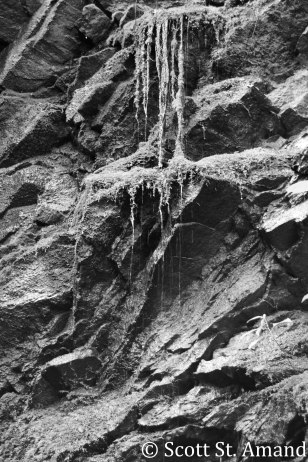
SSA Photography (138 of 400) This photograph was taken a few summers ago in North Carolina.  The afternoon presented a small break in the rain that had been falling consistently for nearly a week, and so we put on our boots and braved the trails that were muddy in parts and wholly impassable in others.  The green of the forest was indescribable.  Everything glowed with a vibrant verdigris, especially the moss that grew on the rocks and the fallen trees.

This patch of moss was unique, insofar as it hung from the rocks instead of clinging to them.  Perhaps the moss just followed the water that always trickled down from the mountaintops during the summer rains.  Certainly the water had enough nutrients for any living thing to subsist.  The bright, almost neon, chartreuse was stunning.  When I got back to the cabin, the rain having begun to fall again, I was somewhat morose.  I am not sure if it was because our hike was cut short, or because I was stuck inside once again, when all I wanted to do was walk around with my camera and capture the beauty of Western North Carolina.

Whatever the reason, my displeasure at the situation made this photograph monochrome.  I am sure that I have the original on a hard drive somewhere, but I have come to know this photograph as black and white.  When it cycles through the slideshow in my office, it is monochrome, and it reminds me of my grumpiness that day.

Photographs are queer like that, I suppose.  They capture a moment, but the moment is so much greater than what actually registers on the sensor as a photograph.  For me, the act of taking a photograph is a holistic experience.  When I look at a shot I took, I remember where I was and how I felt about the shot when I took it and when I edited it.  Some memories have been lost along the way, but the important ones persist.  Even the thought of that rainy July day four years ago has stayed with me.  If I ever begin to lose my memory, my photography will become all that much more important.

My photography is a record of my journey through the last ten years of my life, a journey that was filled with tempest and the afterglow of a rainy afternoon, when everything appears that much more green after the rain has passed.

Click here for a larger version.


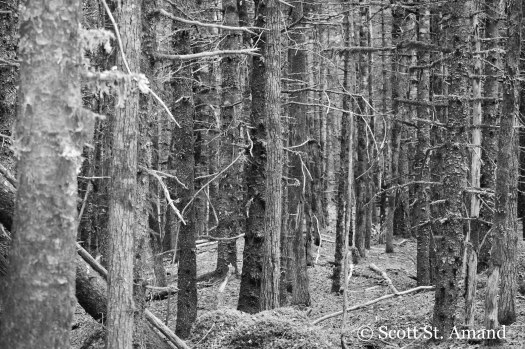
Alaskan Rainforest

SSA Photography (24 of 400)

Few places in America have resonated with me as much as Alaska.

To me it is otherworldly, which is, perhaps, because I was born and raised in the flat scrub-filled swamps of northern Florida.  Still, the glaciers and fjords seemed so foreign to me when I first saw them.  This photograph was taken in Glacier Bay National Park, along the inside passage of Alaska.  Amongst the ice features that dominate the state, there is a temperate rainforest (as opposed to the tropical ones we are wont to think of).

The paths that cut through the forest were each uniquely beautiful, and I wish that I had truly hit my photographic stride when I was there.  Unfortunately, I have been there just once, and it was my inspiration to become a better photographer, rather than coming out party as a well-meaning, somewhat skilled amateur photographer, whose eye for photographs is punctuated by luck and somewhat more advanced post-processing skills.

Someday we will return, and I will be prepared.  I will bring my arsenal of lenses, but I hope that I give enough time to simply taking in the majesty of my surroundings.  It is easy for me to slink behind the lens and capture the beauty of nature without being engaged with it until days or weeks later when I can appreciate it through the photographs.  Still, they are a memento of the voyage to a place so unlike my home, and I treasure them.

Click here for a larger version.

Path to Pebble Beach

SSA Photography (219 of 400)

The Pebble Beach ProAm golf tournament was played last weekend, and as I watched the scenes of the course from the sky, and the ubiquitous shots of Stillwater Cove, I thought about how absolutely lucky I am to personally know and to personally be connected with this magnificent place.

My in-laws have a house in Carmel-by-the-Sea, three blocks from the ocean, and about as many from the beach access to this rocky path which leads onto the Pebble Beach Golf Links.  Specifically, this path leads to the fairway of the sixth hole, and you can just make out the trees on the horizon to the left of the path that mark the seventeenth green.  The scenery is rugged and stunning.  This path is about five miles from the Lone Cypress, and about a mile from the center of Carmel-by-the-Sea.

I came to California when I was ten, but the California I knew was the Kemper Campbell Ranch in the highlands of the Mojave Desert (Victorville, to be specific).  My great-aunt and her family had a ranch in the middle of the desert, through which the Mojave River flowed and gave startling contrast between the lush fields where the cows roamed and the hot, sun-baked sand and ancient petroglyph-covered rock outcroppings that I characteristically climbed with great zeal (and moderate aplomb).  My mom’s cousin, Scott, for whom I was named lived out there, as did her cousin, the famous historical romance writer Celeste De Blasis.

Even at ten, I knew I wanted to write, and so meeting Celeste was incredible for a young, naive boy, who had only written a couple of short stories at the time, but who knew he wanted to write more once he had a command of the language.  (Yes, I did think in these terms at that time.  I have never claimed to be a normal kid.)  Celeste passed away in 2001, just before I graduated high school, and just as I was beginning my first novel.  I wish that I had gotten to know her better and to have been able to trade war stories about writer’s block or overcoming the crippling fear of the blank page.  (To me, as a writer, there is nothing more intimidating than a crisp, empty journal.)

So the Californias I know are as unique as can be.  One is dominated by water, and one is defined by the lack thereof.  I have not been back to the Kemper Campbell Ranch in twenty years, but I have my own Kemper now, and perhaps someday when we travel out to Carmel, we’ll make a sojourn into the desert so that he can climb the rocks that grow ever taller in my memory to this day.

Click here for a larger version.

Lion’s Teeth

SSA Photography (125 of 400)

I am a philologist, a lover of words.  As an English and Latin double major in college, I pursued my love of language (even through the trials of reading Beowulf in its original Old English).  As you have seen in many of my previous posts on nature, I like to include the taxonomic name of the plants, not because I want to show off my knowledge of nature – it’s a notch above rudimentary, at best – but because I love the Latin names.  A white oak is so much more august as a Quercus Alba, or the sweet-gum tree as Liquidambar Styraciflua, which literally means a tree flowing with amber liquid (referring to the gum that exudes from the tree when it is cut).

In this vein, I give you a (false) dent de lion, a lion’s-tooth flower, better known as a dandelion.  Although the appellation refers to the coarsely toothed leaves, this photograph – one of my early macro lens experiments – focuses on the petals and the pseudanthium, or false flower head in the middle, which is actually a small cluster of tiny flowers grouped together.  The pictured flower is actually a false dandelion, or a Carolina desert chicory flower (Pyrrhopappus Carolinianus).

The simplicity of the composition is appealing to me on the one hand, and on the other, I have always been troubled by the dead center focus on the flower.  Unfortunately, when I was first taking my macro shots, I was more concerned with aperture and focus than I was with composition.  I have sincerely amended my ways.  Nevertheless, the clarity and the stark contrast of the petals and the void behind them have always been pleasing to me.

Click here for a larger version.
 

Fjords

SSA Photography (27 of 400)

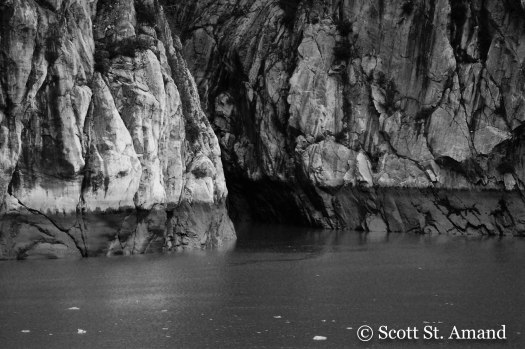
This photograph was taken on the journey to Skagway, Alaska up the Inner Passage from Juneau.  I must admit that I was unaware that there were fjords in Alaska, as in Norway and Iceland.  A fjord is simply a long waterway cut by glaciers into the bedrock.  The stone walls of the fjords were incredible, as were the markings on them.  You can see in this photograph the dark tide lines on the stones which lead into a deep chasm in the rock.  Alaska was mysterious to me.  It was true wilderness, which fascinates me.  Even in the wilds of North Carolina, I am still mindful that I was not the first person to trod upon the dirt.  There is a distinct possibility that if you stray to far afield of the paths in Alaska, you may be the first human to do so.  I long to go back to Alaska.

Click here for a larger version.

Cored

SSA Photography (144 of 400)

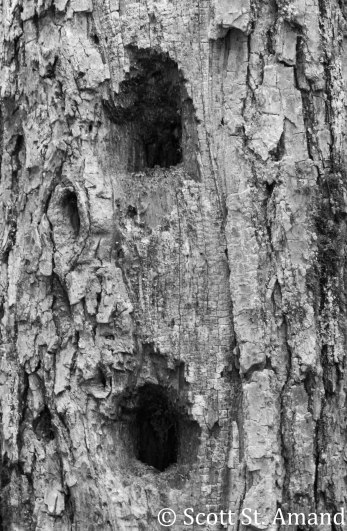
This old pignut hickory (Carya Glabra) has seen better seasons, but the beak of a red-cockaded woodpecker (Picoides Borealis) has extensively excavated the trunk, reaching through the growth rings of those seasons for the tunneling larvae of hickory bark beetles (Scolytus Quadrispinosus).  Although I only captured two of the woodpecker’s cavities in this photograph, the length of the trunk of the dead pignut hickory was pocked with them on every side.  I had hoped to capture the guilty woodpeckers in flagrante delicto, but I was only able to capture the evidence of their tenacious, voracious nature.

The black and white captures the deep shadows of the holes, and gives the bark an almost tessellated appearance, which is true to form.  The gray lichen on the bark just to the right of the lower cavity is almost inconspicuous, but I would be remiss to not note the thin layer of crustose lichen, perhaps Pertusaria Epixantha, which gives a more complete vision of this small ecosystem with tree, and bird, and insect, and fungi within millimeters of each other–coexisting in harmony, even after the tree has lost its sap and vigor.  Nothing in the woods of North Carolina goes to waste.  Even the autumnal leaves that fall by the wayside eventually feed the very trees that shed them, not to mention the other fauna and flora that feast upon them.  Thus, even in the hollowed, cored trunk of this long dead tree, I saw embodied a brief arc of the circle of life.

Click here for a larger version.
Crescent

SSA Photography (99 of 400)

The whirls of the driftwood on Big Talbot Island, just north of Jacksonville, Florida, are peculiarly wonderful to me.  My father is a woodworker in his spare time, and throughout the years, we have made scores of pieces of furniture, boxes, and we have even turned a number of bowls on the lathe.  As such, I am a constant admirer of wood and its natural beauty.  I have turned beautifully featured bowls from a pecan log wrought with worm holes, and ambrosia maple, and spalted sweetgum, but the oak bowls I have turned are lovely, but plain, almost like Shaker furniture.  They have a very ordinary grain, and little about them is exceptional.  The fallen oaks on Big Talbot Island, however, have fantastic patterns, some like the ornamentation of a medieval Celtic manuscript.

I do not know how these patterns came to be, though I speculate that it has something to do with the effect of the sea air on the tree’s formation, both nurturing and stunting the growth at the same time.  Some of the trees must have been tall and vast when they stood decades, or perhaps centuries, ago, but it is the smaller ones that have the more intricate patterns like this one.  To capture the perspective of this photograph, I set the aperture (depth of field) quite low, so that only a piece of the limb was in total tack focus.  The foreground and background are blurred, and the focused piece catches your attention, not only because of its placement in the composition (according to the rule of thirds), but also because of its contrasting sharpness.  I would have loved to turn a bowl from this tree, if only to see whether the patterns on the surface came through onto the finished product.  But now I have turned my artistic attention away from woodworking to photography, and so I must satisfy myself with capturing the beauty of the wood rather than pulling it from an unfinished block.  It is a different approach, but no less satisfying when the photographs turn out like this.

Click here for a larger version.

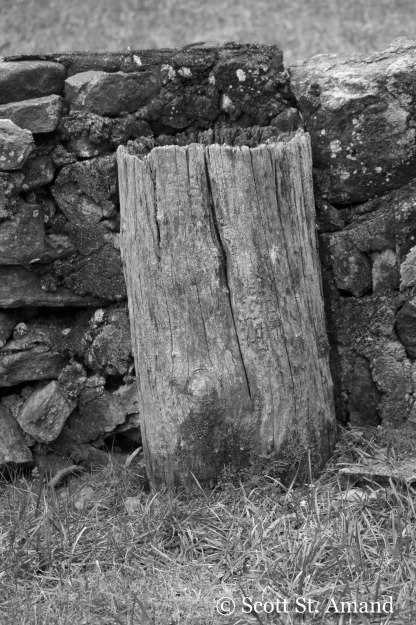
Posted

SSA Photography (105 of 400)

The provenance of this post is unknown.  I took the photograph right as I began to become serious about my photography.  The post is within the ruins of what used to be a gym for a boys camp in North Carolina, but the property was also a hippie commune, which the likes of Pete Seeger and Woody Guthrie graced with their presence.   The photograph is a simple composition, and if I would have taken it now, this one would likely have found itself on the cutting room floor.  Nevertheless, the photograph is nostalgic, and as my posts have shown, this is a flaw of mine.

Click here for a larger version.

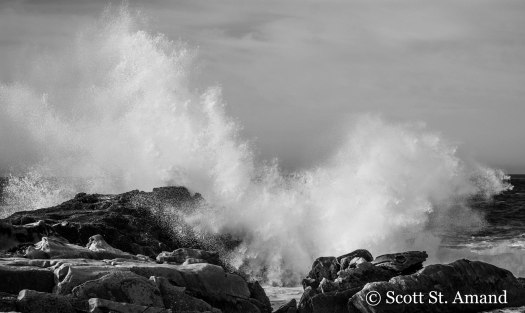
Crash

SSA Photography (266 of 400)

The Pacific intrigues me like no other body of water.  Having grown up minutes from the Atlantic Ocean, I am accustomed to what I always considered crashing waves.  I remember the muscle memory as a child of being tossed and rolled in the waves after a visit to the beach lasting for hours after we arrived back home.  The sheer strength of the Pacific dulls these memories somewhat, and forces me to reconsider the awe of my childhood fascination with the placid Atlantic.

This photograph was taken amongst the rocks in Carmel Bay.  Although the crash of the waves in this photograph is impressive, the highest swells and tallest sprays seemed to come the moment I turned my camera off after waiting for the next great wave to roll in.  Kemper joined me on this trek down to the water’s edge, but he was more interested in throwing pebbles to the tide pools than the august waves and cacophony of them extinguishing themselves on the rocks.  Perhaps he is jaded, having grown up with the Pacific, or perhaps he is simply a child, whose attention is drawn more by his controlling of nature than nature’s control over the elements.

The morning layer was thick when I dragged him from bed to amble down to the coastline, and the colors were muted.  The deep dark shades of the wet rocks and the brilliant white of the salt spray were perfect contrasts, and so my inclination to monochrome most of my photographs was well founded in this one.   Although I am taking more photographs with Kemper in them, which capture his growth and my fondness of him journeying with me as I did with my father, I had not yet begun this practice when I captured this wave against the rocks of Carmel Bay.  When we return, hopefully soon, to California, I will rectify this shortcoming.  Perhaps he is old enough now to appreciate the power of the Pacific, but more likely, he will return to his old pursuits of watching his ripples in the tide pools as I wait for the great wave.

Click here for a larger version.

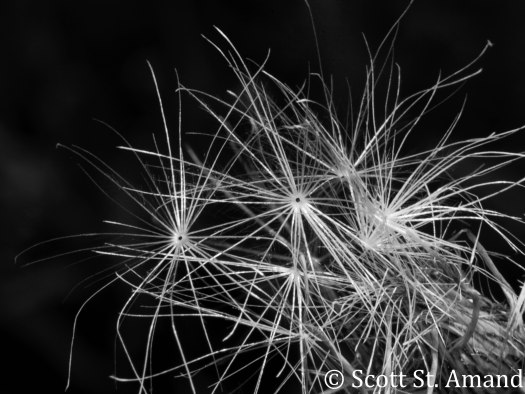
Dreamcatchers

SSA Photography (126 of 400)

This photograph of the achenes or diaspores of a “horrible” thistle (Cirsium Horridulum) was captured two summers ago with my macro lens.  The diaspores have evolved over millions of years to to be light and airy, with tendrils that catch the air for dispersal far afield of their mother plant.  Though not the best composition, I was struck by the symmetry of the achenes and their simple utility.  The swampy path I was walking when I came upon them during the summer was littered with thistles for miles.  The evolution, though perhaps not complete, had certainly served its purpose well.  The most recognizable achenes are those of the dandelion clock, which children gather up with some eagerness only to blow the diaspores unwittingly throughout their parents’ front yard.

I wish Kemper had been old enough to accompany me when I took this photograph.  He finds great sport in blowing the silky white seeds from their presently denuded and spent host.  He was three then, and not quite up to a long jaunt in the summer heat.  The mosquitoes were particularly bad this day, and to be honest, I am surprised that I did not capture one in this photograph–they were so thick.  But this is Florida, and the beauty of nature invariably carries with it some danger, whether an alligator lurking silently beneath the surface of a calm fishing pond, or a rattlesnake blending in with the underbrush.  Having grown up here, these are calculated risks, and readily mitigated.  For the uninitiated, however, Florida is as wild as the outback of Australia.  This results, I think, in a fair bit of pride for us native Floridians who would as soon approach a four foot long gator, knowing full well it will quickly shy away, as a New Yorker would cross a busy intersection at the height of the noon-day traffic.  I do not begrudge the out-of-towners the novelty of seeing an alligator in the wild for the first time, but to us they are quotidian and predictable.  Yet, as this photograph shows, even the most commonplace native objects, when viewed with a different perspective, yield beauty.

Click here for a larger version.