Paper Birch

NCWinter2018-64

The winter leaves had fallen on all of the trees on the property in Brevard, North Carolina, when we visited at the end of December.  The lone holdouts were the thin, wispy leaves of the white birch trees (Betula Papyrifera), which clung on despite the snowstorm that had toppled many larger trees.  The scientific name, Betula Papyrifera, literally means paper-bearer, and indeed the leaves were paper-thin and fluttered at even the slightest hint of wind.  (In truth, however, the “paper birch” is named due to the thin white bark which often peels in paper-like layers from the trunk.)

The paper-birch is a short lived species of the birch family, and in the climate of North Carolina will likely only live thirty to fifty years (though in colder, less humid climates it may live for a hundred years or more).  Despite the relatively short life of the tree, it is a survivor, as the leaves attest.  The paper birch is a “pioneer species,” meaning it is often one of the first trees to grow in an area after other trees are removed by some sort of disturbance. When it grows in these pioneer, or early successional woodlands, it often forms stands of trees where it is the only species.

What struck me the most, however, was that despite the relatively small stature of the trees (there were a number on the property easily recognizable due to its leaves), they were the only ones that held fast to their leaves, almost refusing to let them fall.  I admire this stubbornness, even in a tree.  What’s more, the leaves, though faded and whitened by the fall, were still beautiful, and decorated the tree admirably.  We can, perhaps, learn something from the paper birch about retaining beauty in the winters of our lives.

Click here for a larger version and a color version.

Cheeky

NCWinter2018-71

This photograph of Kemper, and my niece Brynn, was taken a few weeks ago in Brevard, North Carolina.  The two cheeky little gremlins had just been sloshing through the creek that was running higher than I had ever seen it on account of the torrential rain and snow melt.  Still, it was shallow enough in places to come just over their wellingtons, thereby defeating the boots’ entire purpose.  I think they had more fun splashing in their boots on dry land, listening to the sucking sounds that their feet made within the boots, than they did in the creek itself.

Living square in the suburbs, Kemper and Brynn play “outside” all of the time, meaning they play with chalk on the driveway, ride their bikes and trikes, but they do not have the chance to slosh through the creeks in Florida.  There are too many unseen dangers, the least of which are alligators and moccasins.  So, to be able to traipse through the mud and cold water in North Carolina was as much a release for the kids as it was to watch for the grownups – my sister, Claire, Anna and me.  We got to see the nature of our kids come out in the natural elements.  Though Kemper lamented the long hikes, he loved to play with the sticks and threw the rocks that he found along the way.  Give him a mud puddle, and he will have fun for longer than any sow or elephant might.  It was heartening to see them both having fun, and whats more, having fun together.

Click here for a larger version.

Quarry

NCWinter2018-24

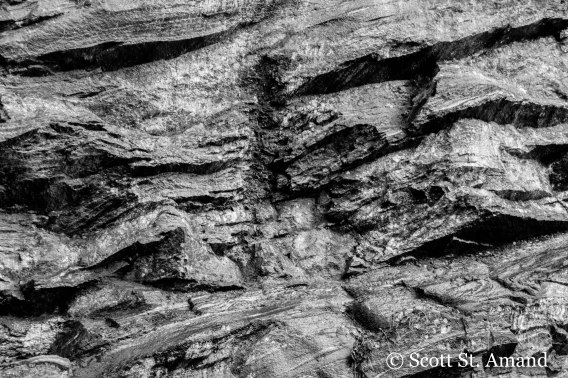
As I stared at the tall, sheer rock face of the long-abandoned quarry, in the middle of the Pisgah National Forest, my dad reminded me that one of my relatives had been a dynamite man for a quarry back in Maine many years ago.  Whether he was deaf from the work, or simply unsocial, my father never knew.  The long drills would bore vertically into the solid stone, and then he would carefully lower the dynamite into the channel to blast thousands of tons of rock and rubble from the mountainside.  Most of the bores in the Pisgah quarry were high on the stone face at least ten feet long, irregularly spaced, but distinctively smooth interstices in the jagged profile of the mountain.  The small paper birch trees were deceptively omnipresent in all of the photographs I attempted, and I was not satisfied with any of them–even as I took them.

As we began to walk on, however, I saw this remnant of a small bore, and I snapped a quick photograph of it, not thinking too much about it at the time.  This hole was unique from the others.  It was only a foot or so long, and its edges were not smooth like the channels higher up.  The crevasses and splintered stone that surrounds the bore suggests that it was an afterthought, and the jagged striations within the shallow channel evidence a blast that wrought the uniformity from it.

This photograph is a microcosm of the quarry, but far more representative than a wide-angle shot of the sheared-off face of the mountain with its uniform bores.  It is evocative and telling that the work was violent and loud and dangerous, but the quarry no doubt was necessary in supplying building materials for the early denizens of Brevard.  Though Robinson Jeffers noted, as I have quoted before, “Not everything beautiful is pleasant,” I have to believe that the opposite might be true.  The violence of a volcano or a blast-torn bore can be beautiful if the time is taken to appreciate it.

Click here for a larger version.

Panthertown Skies

Panthertown Valley-6

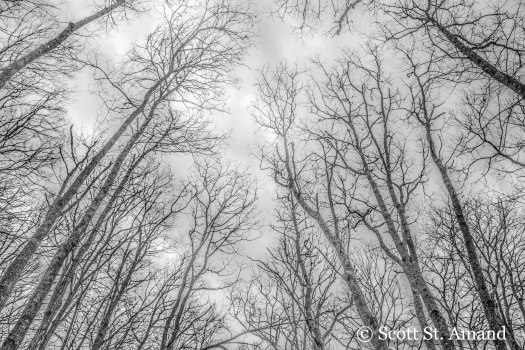
North Carolina in the winter is breathtaking.  I haven’t spent a full winter there in over ten years, since Anna and I graduated from Wake Forest.  The little time I do spend there is with family over the holidays, and the less than frequent trip back to our Alma Mater.  So often now, I find myself looking down, whether it be watching the footfalls of Kemper and Nora, or searching out the low-lying objects that I neglected for so many years as I grew taller and less aware of the beauty that only years before had been at eye level.  As a child, though, I often looked towards the sky.  It was a predilection of mine, and was lost through high school, college, law school, and then my post-graduate work.  As a litigator, I have been trained to look ahead and anticipate the roadblocks before me, and  I have, along the way, lost the penchant for gazing into the clouds above the treetops.  Photography, though in many ways a mature art, has brought me back to my childhood wonder of nature, and as we hiked through Panthertown Valley over the New Year, I caught myself looking upwards once again.

This photograph, though a simple composition, captures some of the innocent wonder.  The clouds of the late morning were beginning to roll in, heavy with precipitation, and we laconically raced to avoid the rain that settled in as we reached the trailhead.  The fingers of the maples and sweet gums and oaks looked like arteries against the pale sky, and in many ways this is a fitting simile.  Nature is a lifeblood–one that I am reconnecting with after years of the wonder of it lied fallow.  Even though I am at my desk from the darkness of the morning through to the early darkness of the winter evenings, I catch myself looking often to the sky, especially as the sun rises and sets.  Jacksonville, to its credit, is beautiful at these times of day.  The rich colors wrought by the low sun are no match to a North Carolina dawn, but then I am biased and nostalgic for the old days, when I could skip my morning lectures and find myself in an hour at the base of Pilot Mountain as the leaves were beginning to redden at the first breath of winter.  Until we return, I will always long for those days, simpler by measure and winsome.  For now, I will console myself with the memories and the short trips when I will fill my camera with shots such as this of the mountain skies on a chilled winter day.

Click here for a larger version

Behind the Falls

Panthertown Valley-57

This photograph of my dad standing behind a waterfall was taken in Panthertown Creek near Brevard, North Carolina.  We hiked about three miles and were prepared to turn around, when we ran into a sweet older lady who said, “The falls are really running today.”  We asked for directions, and she pointed us down a side path, which we traversed for about ten minutes until we heard the roaring of the waterfall.  I took many photographs and wanted to get closer.  I found a not so well-worn path, and my dad and I followed it until we found ourselves behind the waterfall.  He remarked that although walking behind a waterfall had not been on his bucket list, it should have been.  It was truly remarkable.  The hike behind the falls had been tough, but it was so very worth it.

Click here for a larger version.

Morning through the Maples

NCWinter2018-85

Dawn is often a foggy affair in the mountains.  This photograph was taken off of the front porch of our cabin in Brevard, North Carolina.  We have come up for a week, and though we have been up for only two days, I am reinvigorated after a long year at work.  Foggy beginnings seem familiar and yet foreign.  Though I am nostalgic for many things, living in a metaphorical fog is not amongst them.  Waking up, walking outside with a hot cup of tea, and watching as the low clouds creep through the maples is something different entirely.  Being here with my family, who walked through the fog with me, and seeing my son slushing through the creeks on the property like I did when I was his age is inspiring.  Even though the dawn is foggy, the sunlight burns through in the end.

Click here for a larger version.

Southern Needleleaf

AngelColor-2

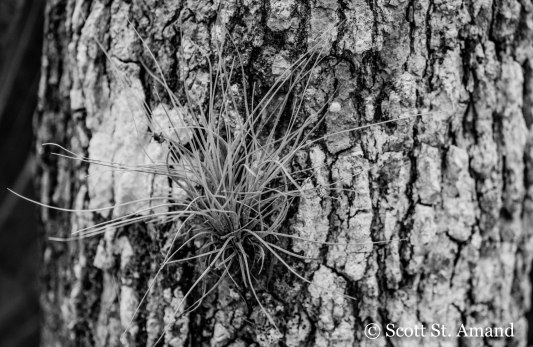
This photograph of a southern needleleaf air plant (Tillandsia Setecea) on a water oak (Quercus Nigra) was taken on a hike in Nocatee Preserve near my home in Ponte Vedra Beach, Florida.  The needleleaf is an epiphyte, an organism that grows on the surface of a plant and derives its moisture and nutrients from the air, rain, and debris accumulating around it. I am fascinated by epiphytes, like the resurrection fern in an earlier post.  In Florida, they are everywhere.  We had a few large crepe myrtles in our back yard, and the needleleafs practically covered the trunks and branches of the trees.  I have always been curious how they take hold on their host tree.  Many people have seen these members of the bromelaid family, but few have ever seen the beautiful and delicate purple flowers that bloom for an instant and are gone.  I have been lucky enough to see the blossoms, having grown up around them, and perhaps as the Romantic Poets believed, they are all the more beautiful because they are so evanescent and fleeting.

Click here for a larger version.

Nascent

AngelColor-3

I debated (at greater length than I care to admit) what to call this photograph, which typified to me the life cycle of the swamp near my home where I went hiking this weekend.  (In Florida, we hike in swamps, have snapping turtles as pets, and casually brush away alligators with nine-irons when they encroach on your golf ball to the horror of your father-in-law, who grew up in Maryland.)  This small laurel oak (Quercus Laurifolia) sprouted at the very base of the gigantic live oak (Quercus Virginiana), and I nearly passed by without paying it any heed.  I found myself gravitating towards the bright green moss that was overcoming the live oak’s hollowed trunk.  As I was musing on the etymology of the word phoenix (which bears its own post), and how, in the swamp, death feeds the living, I noticed this little laurel oak, no more than a year or two old, quite literally rising in the shadow of the live oak, which would have been more than three hundred years old, judging by its size.  The English word “nascent” has its origins in the deponent Latin verb, nascor, meaning to come into existence or to spring forth.  As I thought about calling this post “Ancient and Nascent,” I balked.  This photograph, though set against the old live oak, is, in truth, about the laurel coming into existence and its embryonic roots taking hold betwixt and between the taproots of the dead oak, which could stretch for hundreds of feet in all directions.

Click here for a larger version.


Looking Glass Falls

SSA Photography (147 of 400)

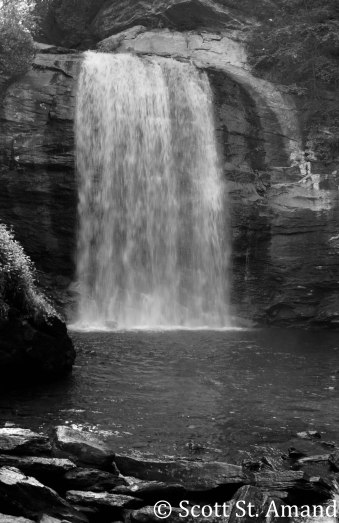
This photograph of Looking Glass Falls was taken in the Pisgah National Forest outside of Asheville, North Carolina.  The name “Looking Glass” comes from Looking Glass Rock, where water freezes on its sides in the winter and then glistens in the sunlight like a mirror or looking glass.  There had not been much rain during the summer I took this photograph, so the waterfall was tame in comparison to the rushing falls I remember from my youth.  Even today, miles removed, I can still hear the crashing water and recall the look of awe on Kemper’s face as we climbed down the steps to view the falls from water level.  You can see more of my fascination with falls in the gallery, ever so creatively named “Falls.”

Click here for a larger version.

Gargoyle

SSA Photography (149 of 400)

Taken in the Pisgah National Forest near Asheville, North Carolina, this close-up of a small waterfall along the Daniel Ridge Trail evoked in me the image of a medieval gargoyle, like those on the Notre Dame de Paris, featured in Victor Hugo’s The Hunchback of Notre Dame.   This little gargoyle is a perfect example of life imitating art.

Click here for a larger version.