Cheeky

NCWinter2018-71

This photograph of Kemper, and my niece Brynn, was taken a few weeks ago in Brevard, North Carolina.  The two cheeky little gremlins had just been sloshing through the creek that was running higher than I had ever seen it on account of the torrential rain and snow melt.  Still, it was shallow enough in places to come just over their wellingtons, thereby defeating the boots’ entire purpose.  I think they had more fun splashing in their boots on dry land, listening to the sucking sounds that their feet made within the boots, than they did in the creek itself.

Living square in the suburbs, Kemper and Brynn play “outside” all of the time, meaning they play with chalk on the driveway, ride their bikes and trikes, but they do not have the chance to slosh through the creeks in Florida.  There are too many unseen dangers, the least of which are alligators and moccasins.  So, to be able to traipse through the mud and cold water in North Carolina was as much a release for the kids as it was to watch for the grownups – my sister, Claire, Anna and me.  We got to see the nature of our kids come out in the natural elements.  Though Kemper lamented the long hikes, he loved to play with the sticks and threw the rocks that he found along the way.  Give him a mud puddle, and he will have fun for longer than any sow or elephant might.  It was heartening to see them both having fun, and whats more, having fun together.

Click here for a larger version.

Cored

SSA Photography (144 of 400)

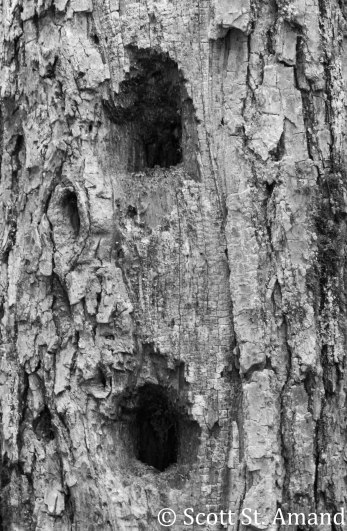
This old pignut hickory (Carya Glabra) has seen better seasons, but the beak of a red-cockaded woodpecker (Picoides Borealis) has extensively excavated the trunk, reaching through the growth rings of those seasons for the tunneling larvae of hickory bark beetles (Scolytus Quadrispinosus).  Although I only captured two of the woodpecker’s cavities in this photograph, the length of the trunk of the dead pignut hickory was pocked with them on every side.  I had hoped to capture the guilty woodpeckers in flagrante delicto, but I was only able to capture the evidence of their tenacious, voracious nature.

The black and white captures the deep shadows of the holes, and gives the bark an almost tessellated appearance, which is true to form.  The gray lichen on the bark just to the right of the lower cavity is almost inconspicuous, but I would be remiss to not note the thin layer of crustose lichen, perhaps Pertusaria Epixantha, which gives a more complete vision of this small ecosystem with tree, and bird, and insect, and fungi within millimeters of each other–coexisting in harmony, even after the tree has lost its sap and vigor.  Nothing in the woods of North Carolina goes to waste.  Even the autumnal leaves that fall by the wayside eventually feed the very trees that shed them, not to mention the other fauna and flora that feast upon them.  Thus, even in the hollowed, cored trunk of this long dead tree, I saw embodied a brief arc of the circle of life.

Click here for a larger version.

Posted

SSA Photography (105 of 400)

The provenance of this post is unknown.  I took the photograph right as I began to become serious about my photography.  The post is within the ruins of what used to be a gym for a boys camp in North Carolina, but the property was also a hippie commune, which the likes of Pete Seeger and Woody Guthrie graced with their presence.   The photograph is a simple composition, and if I would have taken it now, this one would likely have found itself on the cutting room floor.  Nevertheless, the photograph is nostalgic, and as my posts have shown, this is a flaw of mine.

Click here for a larger version.

Quarry

NCWinter2018-24

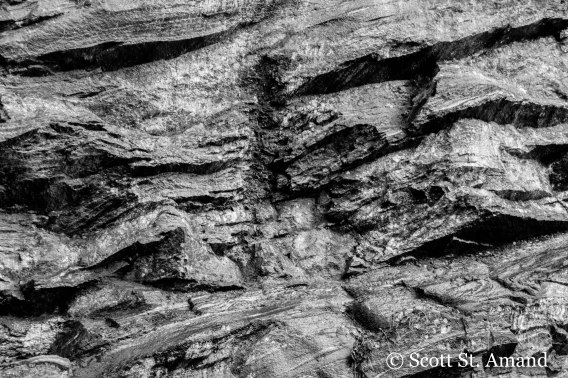
As I stared at the tall, sheer rock face of the long-abandoned quarry, in the middle of the Pisgah National Forest, my dad reminded me that one of my relatives had been a dynamite man for a quarry back in Maine many years ago.  Whether he was deaf from the work, or simply unsocial, my father never knew.  The long drills would bore vertically into the solid stone, and then he would carefully lower the dynamite into the channel to blast thousands of tons of rock and rubble from the mountainside.  Most of the bores in the Pisgah quarry were high on the stone face at least ten feet long, irregularly spaced, but distinctively smooth interstices in the jagged profile of the mountain.  The small paper birch trees were deceptively omnipresent in all of the photographs I attempted, and I was not satisfied with any of them–even as I took them.

As we began to walk on, however, I saw this remnant of a small bore, and I snapped a quick photograph of it, not thinking too much about it at the time.  This hole was unique from the others.  It was only a foot or so long, and its edges were not smooth like the channels higher up.  The crevasses and splintered stone that surrounds the bore suggests that it was an afterthought, and the jagged striations within the shallow channel evidence a blast that wrought the uniformity from it.

This photograph is a microcosm of the quarry, but far more representative than a wide-angle shot of the sheared-off face of the mountain with its uniform bores.  It is evocative and telling that the work was violent and loud and dangerous, but the quarry no doubt was necessary in supplying building materials for the early denizens of Brevard.  Though Robinson Jeffers noted, as I have quoted before, “Not everything beautiful is pleasant,” I have to believe that the opposite might be true.  The violence of a volcano or a blast-torn bore can be beautiful if the time is taken to appreciate it.

Click here for a larger version.

Panthertown Skies

Panthertown Valley-6

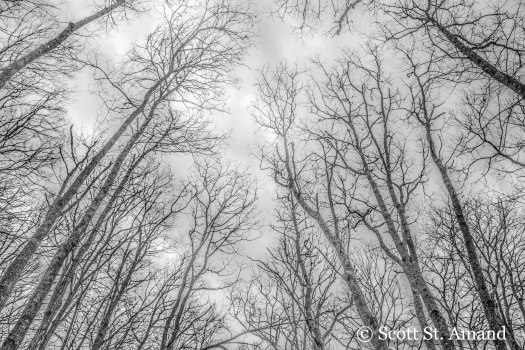
North Carolina in the winter is breathtaking.  I haven’t spent a full winter there in over ten years, since Anna and I graduated from Wake Forest.  The little time I do spend there is with family over the holidays, and the less than frequent trip back to our Alma Mater.  So often now, I find myself looking down, whether it be watching the footfalls of Kemper and Nora, or searching out the low-lying objects that I neglected for so many years as I grew taller and less aware of the beauty that only years before had been at eye level.  As a child, though, I often looked towards the sky.  It was a predilection of mine, and was lost through high school, college, law school, and then my post-graduate work.  As a litigator, I have been trained to look ahead and anticipate the roadblocks before me, and  I have, along the way, lost the penchant for gazing into the clouds above the treetops.  Photography, though in many ways a mature art, has brought me back to my childhood wonder of nature, and as we hiked through Panthertown Valley over the New Year, I caught myself looking upwards once again.

This photograph, though a simple composition, captures some of the innocent wonder.  The clouds of the late morning were beginning to roll in, heavy with precipitation, and we laconically raced to avoid the rain that settled in as we reached the trailhead.  The fingers of the maples and sweet gums and oaks looked like arteries against the pale sky, and in many ways this is a fitting simile.  Nature is a lifeblood–one that I am reconnecting with after years of the wonder of it lied fallow.  Even though I am at my desk from the darkness of the morning through to the early darkness of the winter evenings, I catch myself looking often to the sky, especially as the sun rises and sets.  Jacksonville, to its credit, is beautiful at these times of day.  The rich colors wrought by the low sun are no match to a North Carolina dawn, but then I am biased and nostalgic for the old days, when I could skip my morning lectures and find myself in an hour at the base of Pilot Mountain as the leaves were beginning to redden at the first breath of winter.  Until we return, I will always long for those days, simpler by measure and winsome.  For now, I will console myself with the memories and the short trips when I will fill my camera with shots such as this of the mountain skies on a chilled winter day.

Click here for a larger version

Behind the Falls

Panthertown Valley-57

This photograph of my dad standing behind a waterfall was taken in Panthertown Creek near Brevard, North Carolina.  We hiked about three miles and were prepared to turn around, when we ran into a sweet older lady who said, “The falls are really running today.”  We asked for directions, and she pointed us down a side path, which we traversed for about ten minutes until we heard the roaring of the waterfall.  I took many photographs and wanted to get closer.  I found a not so well-worn path, and my dad and I followed it until we found ourselves behind the waterfall.  He remarked that although walking behind a waterfall had not been on his bucket list, it should have been.  It was truly remarkable.  The hike behind the falls had been tough, but it was so very worth it.

Click here for a larger version.

Morning through the Maples

NCWinter2018-85

Dawn is often a foggy affair in the mountains.  This photograph was taken off of the front porch of our cabin in Brevard, North Carolina.  We have come up for a week, and though we have been up for only two days, I am reinvigorated after a long year at work.  Foggy beginnings seem familiar and yet foreign.  Though I am nostalgic for many things, living in a metaphorical fog is not amongst them.  Waking up, walking outside with a hot cup of tea, and watching as the low clouds creep through the maples is something different entirely.  Being here with my family, who walked through the fog with me, and seeing my son slushing through the creeks on the property like I did when I was his age is inspiring.  Even though the dawn is foggy, the sunlight burns through in the end.

Click here for a larger version.

Symptoms

SSA Photography (109 of 400)

These desiccated little smoky polypore mushrooms (Polyporus Adustus), like a resurrection fern, will spring back to life after a brief winter rain.  Unfortunately, for the hardwood trees that they are found on, the time for resurrection has long past.  The enzymes in the mushrooms help to speed the decay of dead and dying trees in forests all over the world, including this one in North Carolina, west of Asheville.  Interestingly, they also can eat away synthetic materials, such as synthetic dies in plastics, and research is being done to see what role these common little mushrooms can play in bioremediation.  This dwarf American Chestnut (Castanea Pumila) still bore leaves, and but for the polypores on its bark, the tree would have otherwise appeared healthy.  But alas, it is the beginning of the end for the august old tree.  The mushrooms are a symptom of death and disease, otherwise invisible until the tree succumbs.

I think of my favorite aunt on my dad’s side, Irene, who died of cancer when I was younger.  I had seen her soon before the cancer took over, and she appeared healthy on the outside — albeit crusty and sarcastic to the end.  I regret not knowing her better, as she was a huge influence on my dad’s life.  My dad and I went to Maine to visit her and my memere, who was in the throes of dementia, and I spent most of the time in the back of Irene’s house on the rocky outcroppings looking for moose and wild blueberries.  I told her that I would bring her a harvest of the blueberries, which grew low to the ground, rooted in the interstices of the rocks.  I failed in my mission, eating at least two-thirds of what would eventually make it into my small bucket.  I told her that I had not found as many as I had wanted (which, I suppose, was true), but my lips, stained a dark shade of purple, belied my foraging skills.  She laughed and smiled her ever present wry smile, and we had an understanding.  I was the chubby kid who was not to be trusted gathering fruit, and she was the understanding aunt, too kind to say anything cross.  Perhaps if there were outward signs, I would have stayed inside longer to hear her stories of my dad and uncle, Harvey, and perhaps I would have been more judicious with the blueberries I promised her.

Click here for a larger version.


Hollow

_DSC6019.jpg

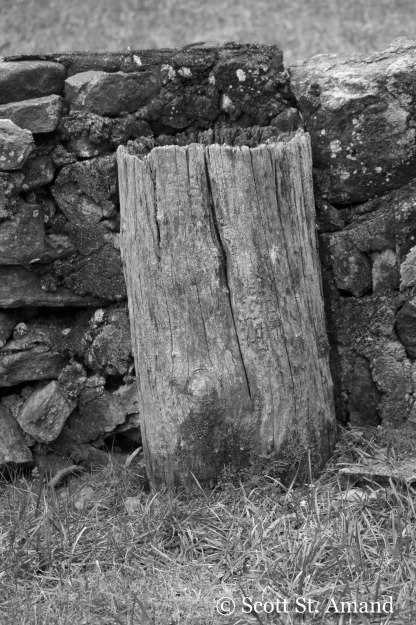
I have long since wondered what befell this little pignut hickory tree (Carya Glabra) that I found on a walk in the Pisgah National Forest, just outside Asheville, North Carolina.  Its brothers and sisters in the grove around it were healthy, but perhaps this one was hollow from an early age.  In my journey through the morass of my own personal demons, I met many individuals who were all but hollowed-out inside.  For some, their facade mirrored their inner emptiness, like this little hickory stump.  For many, however, they looked strong and confident and healthy on the surface, all the while roiling with anguish inside.  Even those of us who manage to come out the other side still have hollow pockets, places where the memories of the shadows still live, which catch us by surprise every so often.  Eventually, for the fortunate few, these shadows subside, but they remain–never to fade completely into the light, like scars that sometimes catch the sunlight at just the right angle to remind you that you were once injured, too.  And every once in a while, you may come upon a hollow stump, a not so subtle memento of the emptier days.  Maybe you walk by it, trying not to remember those times, but maybe, just maybe, you snap a photograph, a token to hold close to you, reminding you how insidious the hollowness can be.

Click here for a larger version and a color version.

Triple Falls

_DSC1835

Like many of my photographs of waterfalls, this one was taken in the Pisgah National Forest outside of Asheville, North Carolina.  Although I quickly shy away from the compliments and comparisons some have drawn between my black and white landscape shots and the photographs of the great Ansel Adams, this one does remind me of some of his shots of the falls in Yellowstone.  If I can be half of the photographer Adams was, I think that will be accomplishment enough.

Click here for a larger version.