Setting above the Sycamores

SSA Photography (397 of 400)

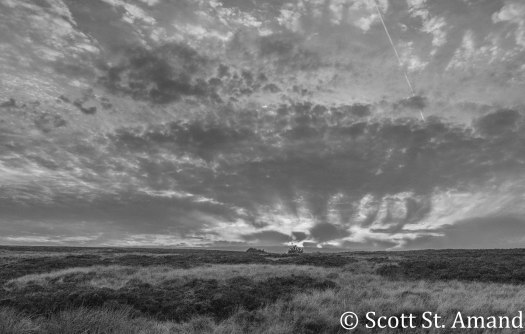
This was the last photograph I took on our trip to England in late August of this year.  I was tired, having climbed over moors, through the dales and back again at least four times over the course of the three hours or so.  The flatness of this picture belies the vertical bent of everything in England.  The sunset was magnificent because the clouds in the sky possessed such an impressionist character.  The patch of sycamores on the horizon grew closer and closer as we approached the setting sun, with Top Withens (the inspiration for Wuthering Heights) behind us.  There were no paths towards the top of the hike, which should have been an early harbinger of the difficulty of the climb.  For all I knew (and willingly shared with the rest of the hiking group), we were likely the only masochists to have made the hike for generations.  As we wended our way through the dense heather and tall wild grasses and bracken ferns, and I gasped for breath at manageable intervals, I thought back on that field twelve years prior where I proposed in a similar field across the valley from Anna’s grandparent’s house, amongst a small herd black and white Friesians.

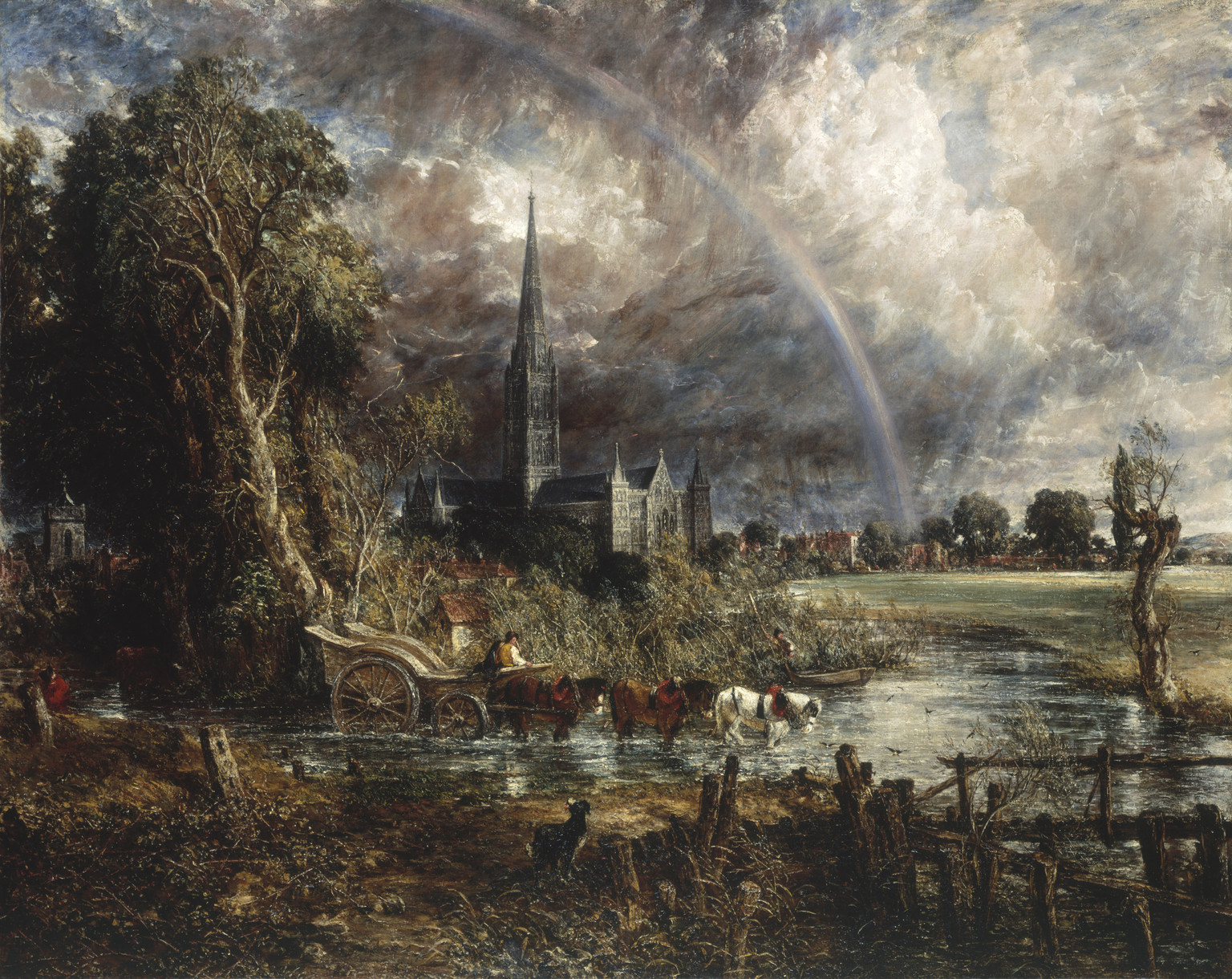
The beauty of Yorkshire has ceased to surprise me.  By this, I do not mean that it has become any less wondrous or awe inspiring, only that I have come to expect to look out on a field and see the beauty that inspired the Brontës and Wordsworth and John Constable and all of the other artists that have spent their lives’ work attempting to capture the magnificence of this landscape.  Indeed, the sky was something out of Constable’s painting of Salisbury Cathedral (sans the rainbow).  The beauty is almost laughably ubiquitous.  I have been to England three times now, and each time I am left with the distinct sensation that I was born on the wrong continent.  My archaic turns of phrases, my passion for history and ancient things, all find root in the mother country.  Anna’s grandmother, a strong Yorkshire woman, who still travels the world at 94, has adopted me as her “cloth” grandson, an appellation that I take very seriously, and I have been warmly embraced by the network of aunties and cousins — just the toe-holds I needed to claim a bit of Yorkshire as my own.

Click here for a larger version.

Post & Lintel

SSA Photography (95 of 400)

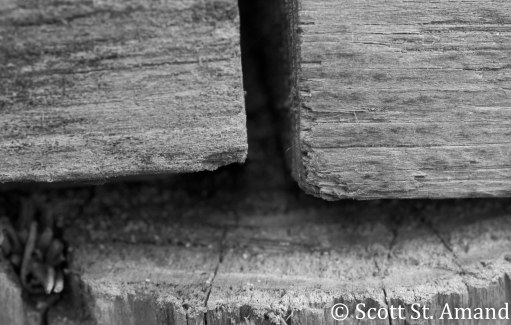
Though I do not take many abstract shots, this one came rather organically.  Taken at Big Talbot Island, just north of Jacksonville, Florida, I had fixed my macro lens on my camera halfway through the long walk down the driftwood-strewn beach.  I had already taken many photos of the fossil-like trees, languishing and bleaching in the hot sun, and so I set out to capture the little elements that required me to look closer and actually observe the microcosms of barnacles and tulip snails and patterns in the grains of the wood.  The day was cut short by the heat, which beaded down my forehead into my eyes, making the very act of photography an unpleasant task.

As I walked back the mile or so to my car, I left the lens cap off of my camera in case anything small, otherwise insignificant, caught my eyes, which burned with the sweat.  Near my car, there was a rickety old circular wooden handrail.  I cannot say why, but the way the rough-hewn logs stretched horizontally around, propped up by a glorified dock piling, reminded me of Stonehenge.  I’ve never been, though I did see a large stone circle in the Lake District years ago.  I scrunched up to where the post met the lintels, and manually focused my lens on the dark interstice between them.  I thought nothing of the photograph until I got home and began editing the photographs which I had taken that day.  There was something appealing about the abstract composition of the capture that pleased me, and, what’s more, intrigued me.

Photography has a way of elevating the mundane to art.  Whether that was achieved here, I leave up to you, but in this particular perspective, the photograph seems to create something far more significant than a fence and its post.  It is, itself, a simile without words.  By giving it a title, I was able to ascribe significance to it–it was no longer simply pressure treated lumber bolted together.  It was like Stonehenge.  This photograph taught me a lesson, which I carry with me to this day.  What may seem insignificant may be given artistic meaning, sometimes simply by capturing it with the camera, and other times simply by giving it a name, an identity.  In this way, photography is kin to poetry, revealing the beauty and grace within the quotidian.

Click here for a larger version.

Whirls

SSA Photography (101 of 400)

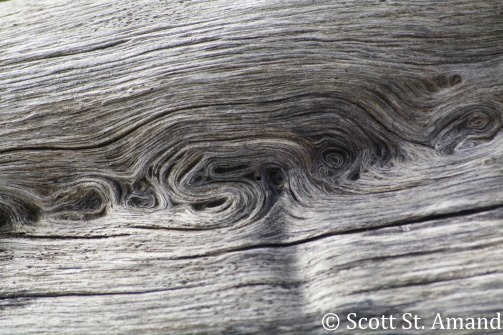
As I have mentioned before, the patterns of nature fascinate me.  The swirls and whirls on this driftwood tree, most likely a live oak (Quercus Virginiana), caught my eye immediately when I took to the beach with my macro lens.  I had passed the tree numerous times before, camera in hand, but I overlooked the fascinating, almost embryonic patterns along the large branch that reached towards the ocean.  I cannot believe that I missed it, but in hindsight, I was not looking for the little intricacies of nature when I first came to Boneyard Beach; instead, I was looking for patterns in the trees strewn about the sand, which I found in the hulking driftwood trees.

A certain bit of melancholy washed over me as I returned a few months ago, two years hence, and two hurricanes since.  The beach was not as I remembered it.  The huge live oaks were still there; not even a category three storm could have moved them.  Yet the smaller ones, like this one with the whirls, had been washed away.  Perhaps they will be rolled back to shore by the heavy waves of a nor’easter, or, perhaps, by another hurricane.  But for now, they were gone.  I brought my son to the beach when I returned, hoping that he would find the same beauty in his five year old eyes.  He, too, was enamored by the tulip snails, and he let go of his fears long enough to sidle up the trunk of one of the supine live oaks.  I let go of the melancholy, as well, and I ventured to find new patterns in the niches where limb meets branch or branch meets trunk.  Someday, Kemper will be old enough to mind the patterns, but for now, I will let him find the joy in the bigger picture.

Click here for a larger version.

Hollow

_DSC6019.jpg

I have long since wondered what befell this little pignut hickory tree (Carya Glabra) that I found on a walk in the Pisgah National Forest, just outside Asheville, North Carolina.  Its brothers and sisters in the grove around it were healthy, but perhaps this one was hollow from an early age.  In my journey through the morass of my own personal demons, I met many individuals who were all but hollowed-out inside.  For some, their facade mirrored their inner emptiness, like this little hickory stump.  For many, however, they looked strong and confident and healthy on the surface, all the while roiling with anguish inside.  Even those of us who manage to come out the other side still have hollow pockets, places where the memories of the shadows still live, which catch us by surprise every so often.  Eventually, for the fortunate few, these shadows subside, but they remain–never to fade completely into the light, like scars that sometimes catch the sunlight at just the right angle to remind you that you were once injured, too.  And every once in a while, you may come upon a hollow stump, a not so subtle memento of the emptier days.  Maybe you walk by it, trying not to remember those times, but maybe, just maybe, you snap a photograph, a token to hold close to you, reminding you how insidious the hollowness can be.

Click here for a larger version and a color version.

Boneyard Beach

SSA Photography (84 of 400)

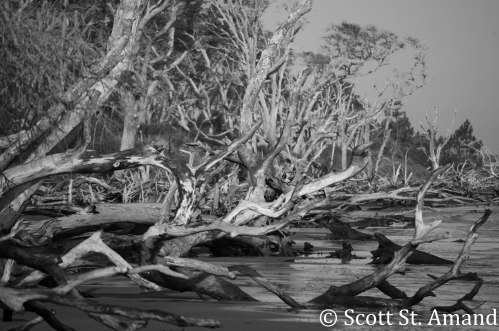
I do not know who settled on the name Boneyard Beach for this stretch of coastline on Big Talbot Island, just north of Jacksonville, Florida.  It is fitting, though, that the skeletons of the old live oaks (Quercus Virginiana) stretch towards the ocean like Tantalus stretched towards the water beneath his feet and fruit above his head.  This photograph was taken three years ago, before the northeast coast of Florida was battered by hurricanes Irma and Matthew.  Kemper and I went to Boneyard Beach earlier this year, in the height of summer, to take photographs.  I figured to get some photographs of him among the stripped, bleached bones.  To my great surprise, many of the trees that I had become accustomed to (which are featured in my gallery Driftwood), had vanished into the sea since I had been there last.  Kemper was disappointed for a moment, but then he caught sight of a ghost crab skittering around the base of a monolithic oak, unaffected by the reshaping of the coastline.  It would have taken a much stronger act of God, or His hand itself, to move that oak from its spot.  Innumerable hurricanes have battered the island over the centuries, and as the new oaks, themselves, fall to the beach, the skeletons will once again reappear–until, of course, another set of storms carries them off to the sea.

Click here for a larger version.

Among the Ferns

SSA Photography (390 of 400)

These bracken ferns on the moors in Yorkshire are substantially shorter than those in the lake district; nevertheless, they nearly engulfed my wife, Anna, as she tried to follow the path cut between the fiddleheads that popped out from the skeletons of heather, long since overcome by the dark green ferns.  This photograph was taken at dusk outside of Haworth, England, where the Brontë sisters lived and wrote.  Their stories were heavily   influenced by the moors and the hardy people who lived on them (especially Wuthering Heights).  Indeed, in this photograph, on the horizon to the left, there is a lone sycamore next to the barely perceptible ruins of a farmhouse (Top Withens), which is said to be the inspiration for Wuthering Heights.  My mother-in-law grew up among the ferns on the moors, and she is closer to nature than anyone I have ever met.  Yorkshire does something indelible to a person.  The first time you walk over the top of a moor and look down into the Worth Valley at the train steaming along the tracks towards Leeds, you realize that you are in a living snapshot of a much simpler time.

Click here for a larger version.
Needles

SSA Photography (143 of 400)

This macro photograph of a Pinus Echinata (short-leaf pine) was taken in North Carolina on the property of a dear family friend, a brother-from-another-mother, if you will.  I was experimenting with my macro lens, which I had purchased just weeks before, and I came upon this sapling with beautiful green needles.  It was not until I had framed the picture in my camera that I noticed the perfect symmetry of the needles radiating from the center.  Nature is beautiful on a macroscopic level, but upon closer inspection–the kind we did as kids, when we were closer to the ground, and the snails were within our range of vision–nature is simply breathtaking.  Whether it be the fractals found on pinecones or even broccoli, there is a divine order to these elements.  For me, there is no other explanation.

Click here for a larger version.

Through the Briar Patch

SSA Photography (115 of 400)

Nostalgia is a beautiful word.  It is a is learned formation of a Greek compound, consisting of the Homeric word νόστος (nóstos), meaning “homecoming” and ἄλγος (álgos), meaning “pain” or “ache”, and was coined by a 17th-century medical student to describe the anxieties displayed by Swiss mercenaries fighting away from home.  Nostalgia is a sentimentality for the past, typically for a period or place with happy personal associations.  For me, nothing evokes nostalgia like the mountains of North Carolina.  The earliest associations are of visiting the Smoky Mountains with my family when I was much younger, and later the mountains close to Winston-Salem, which were only a short drive away from Wake Forest.  For reasons I cannot explain, the feelings are strongest in the winter, when the wind has stripped away the leaves from the branches, and you can see through the skeletons of the trees through the valleys and to the peaks.  This photograph, taken outside of Brevard, North Carolina, evokes so many strong memories – all positive – which was not always the case in North Carolina.  Hindsight and nostalgia are curious like that, though.  No matter the number of disheartening days and nights, I still long to be back in the mountains.  We’re going up for a week after Christmas, and I know the feelings will rush back, satisfying the homesickness for a while.  Until then, in my mind, I’m going to Carolina…

Click here for a larger version.

Wheat & Chaff

SSA Photography (165 of 400)

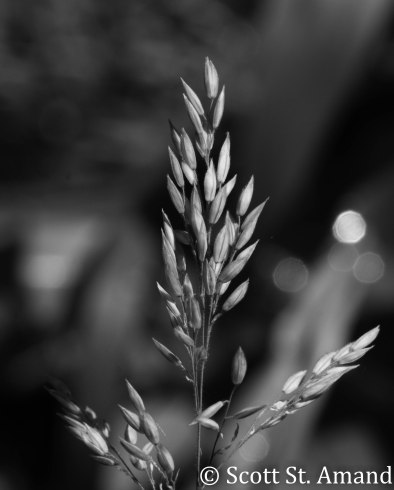
This photograph of a seedhead of tall ryegrass was taken on a high in Panthertown Creek, outside of Cashiers, North Carolina.  It is a simple photograph, and one which I would normally have skipped right over when I was sifting through the hundreds I took that day.  Nevertheless, something caught my eye in the simple elegance of the seeds and the blur and bokeh of the background.  Although not actual wheat, this native grass reminded me of the old aphorism “to separate the wheat from the chaff,” which is exactly what I do when I cull through the photographs to find the “keepers.”  The irony is not lost on me that the “chaff” nearly included this photograph.

Click here for a larger version.


Silhouette

calnov2016-9

The word silhouette is derived from the name of Étienne de Silhouette, a French finance minister who, in the mid eighteenth century, was forced by France’s credit crisis during the Seven Years’ War to impose severe economic demands upon the French people, particularly the wealthy.  Because of de Silhouette’s austere economies, his name became synonymous with anything done or made cheaply.  Prior to the advent of photography, silhouette profiles cut from black card were the cheapest way of recording a person’s appearance.  I think that this silhouette of the female photographer on the rock is one of my best black and white compositions.  The mist and morning layer in the background contrasts sharply with the wet stone in the foreground, with the tiniest break in the line of the outcropping (in perfect thirds, I might add) made by the photographer.  I cannot say that my eye was drawn to her initially, but once it caught her, my eye became curious and could not look away – and if I did, I was always drawn back.

Click here for a larger version.