Morning Dew

SSA Photography (83 of 400)

This photograph was taken just after dawn on Little Talbot Island, north of Jacksonville, Florida.  It was one of the first macro photographs I took, and it remains one of my favorites.  I love how it captures the pendant dewdrop and the weight of the driftwood branch and the water.  The little bubbles add an interesting depth of field.

Click here for a larger version.

Passerine

SSA Photography (281 of 400)

Lugete, o Veneres Cupidinesque,
et quantum est hominum venustiorum:
passer mortuus est meae puellae-
passer, deliciae meae puellae,
quem plus illa oculis suis amabat.”

Mourn, O Venuses and Cupids,
and whatever there is of pleasing me:
the sparrow of my girl is dead –
the sparrow, the delight of my girl,
whom she loved more than her own eyes.

Catullus, Carmen 3

As evidenced by this brief passage from the funeral dirge of the first century (BC) Roman poet Catullus, the sparrow has been a subject of art and admiration (even tongue-in-cheek adoration) for thousands of years.  I found this golden crowned sparrow perched in the chaparral along the path towards Whaler’s Cove in Point Lobos State Nature Reserve, Carmel, California.  I thought it was a lovely photograph of a beautifully marked bird, but upon closer inspection of the photograph as I was processing the photos at the end of the day, I noticed the rather doleful look on the sparrow.  For an animal that flits about, seemingly without care, this look struck me as rather queer.  Perhaps, like Catullus, I am importing more meaning to the life of a sparrow than reason would suggest appropriate.  Still, this remains my favorite photograph of the many sparrows I have photographed over the course of the last fifteen years or so.

Click here for a larger version (and a black and white version).

Zinger

SSA Photography (140 of 400)

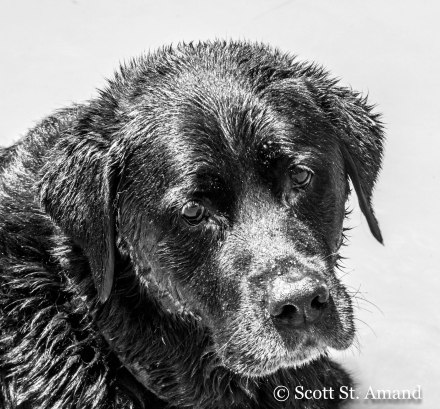
As I mentioned in a previous post, I am less comfortable taking portraits of anyone except my son, who is a willing subject.  This portrait, however, is one of my all time favorites.  Zinger was born just as the Red Sox clinched the 2004 World Series.  I was home from college, and I watched him being born to our sweet girl Hannah.  She nipped his umbilical cord too close to him, and he was left bleeding profusely.  My sister took him in her arms and staunched the blood for hours until he healed.  He was hers from that moment forward.  He loved the water, and he loved North Carolina – which is where I found him in this photograph.  We had to say goodbye to Zinger a few months ago, but he will always occupy a warm place in our hearts.

Click here for a larger version.

Moon Jelly

SSA Photography (232 of 400)

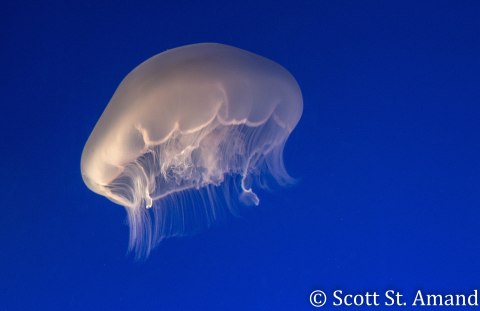
This photograph of a Aurelia Labiata or Moon Jellyfish was taken at the Monterey Aquarium.  Usually swimming in schools, this jellyfish had separated itself from the rest of its spineless (invertebrate) kin and was floating along just far enough away that I could get a shot of it by itself.  The beautiful wisps of stinger-rich tentacles fluttered in the current of the large tank, and I was mesmerized by them like the little children whose noses were plastered against the thick glass.  Kemper, who was three at the time, was enraptured by the sheer number of jellyfish that effortlessly floated by, and we had to explain that though beautiful, they were dangerous.  I could tell that he did not fully grasp Jeffers’ line, “Beauty is not always lovely.”  But when understanding washed over him, I was momentarily saddened that this lesson had to be learned at such a young age.  Soon, however, he was lost again in the schools of jellyfish not, perhaps, to give another thought to the lesson for a long time to come.

Click here for a larger version.

Iridescence

SSA Photography (129 of 400)

This photograph is a macro shot of an Augochlora Pura (Green Sweat Bee) on a Monarda Fistulosa (a wild bergamot or bee balm).  As the title of the post suggests, I was captivated (and I still am) by the iridescence of the sweat bee’s green head and thorax, and his purple wings that look like stained glass.  This photograph was taken in Brevard, North Carolina on the property of a family friend.  I had to be terribly patient to get this shot, but in the end it paid off with a beautiful capture.

Click here for a larger version.

Emergence

SSA Photography (169 of 400)

This photograph of an allium (a member of the garlic family) breaking out of its protective sheath has been one of my favorite photographs since I took it a couple years ago.  To me, this photograph is evocative on so many levels.  It was taken, like Herrick’s Bud in my in-laws’ garden in Carmel, California.  Although I thought that the emergence would be relatively slow, I came back the next day and the buds had fully emerged, with the sheath having shriveled up and hanging by the wayside.  The ephemera of nature is simply amazing to me.  I hope you enjoy this photograph as much as I do.

Click here for a larger version.

Shadow Play

SSA Photography (89 of 400)

Taken at Big Talbot Island, north of Jacksonville, Florida, the lines and shadows of this photograph of driftwood cobbled together on the beach draw the eye to the center of the mass of wood.  After the hurricane last year, this particular grouping of driftwood is no longer on the beach, so I was fortunate to capture it when I did.

Click here for a larger version.

Chip off the Old Block

SSA Photography (13 of 400)

This photograph was taken from the shore of the bay, in Bar Harbor, Maine.  As I mentioned in an earlier post, my father is from southeastern Maine, and the place has always held great memories for me.  The weathered geometry of the rocks on the beaches struck me more during this trip than as a kid, when I was wont to be found between and betwixt the ocean-side boulders with knees perpetually skinned by the barnacles.  Though not taken at Goose Rocks or Old Orchard Beach, where my dad would have been found in the summers, Maine is synonymous with him, and I am nothing, if not a chip off the old block.

Click here for a larger version.

Herrick’s Bud

SSA Photography (171 of 400)

It’s rare that I can combine both my Latin and English major in a photography post, so I apologize for the length up front.

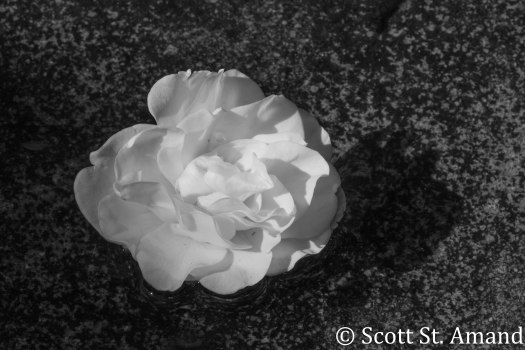
This photograph was taken in my in-laws’ garden in Carmel-by-the-Sea, California.  The title refers to the first line of the 1648 poem by Robert Herrick’s, “To the Virgins, Make Much of Time,” which even non-English majors will remember from the scene in Dead Poet’s Society.  As Robin Williams’ character notes, the theme of the poem is carpe diem – seize the day.  Carpe diem is one of those phrases that has stood the test of time and meandered its way into the modern lexicon both in its original Latin and in its widely accepted translation.  Unlike phrases such as et cetera or even cave canem (a common phrase, even written on a floor mosaic in Pompeii), carpe diem has a wonderfully beautiful, poetic history.

The ephemerality of life has long been a preoccupation of poets, and it should, therefore, be no surprise that the greatest poets of the greatest ages wrote about the transient nature of beautiful things.  One of the earliest (extant) examples is Quintus Horatius FlaccusOde 1.11, which features the line from which the phrase originates: “Sapias, vina liques, et spatio brevi spem longam reseces.  Dum loquimur, fugerit invida aetas: carpe diem, quam minimum credula postero.”  Translated, this means “Be wise, strain your wines, and because time is brief, cut short your long-term hopes.  Even while we are speaking, jealous time will have fled: so, seize the day, trusting as little as possible in what comes next.”

Carpe” is an agrarian word, and though it can be (and usually is) translated as “seize,” it would have been understood by the readers of the Ode to mean “pluck” (like a grape from the vine).  It is this meaning that Herrick ascribes to when he says, “Gather ye rosebuds while ye may / old Time is still a-flying / and this same flower that smiles today / to-morrow will be dying.”  And it is this meaning I ascribed to the photograph, which I took after my son Kemper (who was four at the time) plucked this bud for his mother, who ultimately set it afloat in the birdbath outside our window.

Click here for a larger version.

Rhododendron

SSA Photography (157 of 400)

This photograph of a rhododendron bulb was one of the first macro photographs that I ever took.  It was taken in Deep Gap, North Carolina (near Brevard and Cashiers) on the property of a very close friend where my family spends two weeks in July and again at Christmas each year.   The word rhododendron is Greek for “rose tree” and counts azaleas among its many varietals.  The beautiful white-petaled flowers on this Rhododendron Maximum (“Rosebay” or “American” Rhododendron) had not yet emerged on the trees on the property, but the compact tulip-like bulbs were ripe to bloom very soon thereafter.

Click here for a larger version.