Cored

SSA Photography (144 of 400)

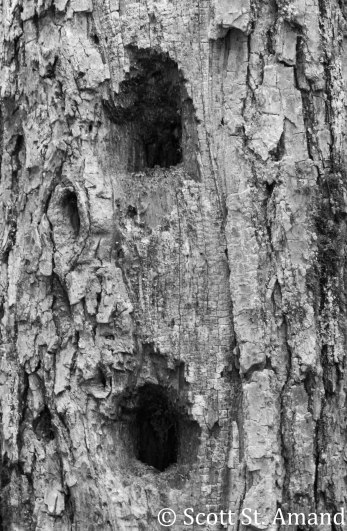
This old pignut hickory (Carya Glabra) has seen better seasons, but the beak of a red-cockaded woodpecker (Picoides Borealis) has extensively excavated the trunk, reaching through the growth rings of those seasons for the tunneling larvae of hickory bark beetles (Scolytus Quadrispinosus).  Although I only captured two of the woodpecker’s cavities in this photograph, the length of the trunk of the dead pignut hickory was pocked with them on every side.  I had hoped to capture the guilty woodpeckers in flagrante delicto, but I was only able to capture the evidence of their tenacious, voracious nature.

The black and white captures the deep shadows of the holes, and gives the bark an almost tessellated appearance, which is true to form.  The gray lichen on the bark just to the right of the lower cavity is almost inconspicuous, but I would be remiss to not note the thin layer of crustose lichen, perhaps Pertusaria Epixantha, which gives a more complete vision of this small ecosystem with tree, and bird, and insect, and fungi within millimeters of each other–coexisting in harmony, even after the tree has lost its sap and vigor.  Nothing in the woods of North Carolina goes to waste.  Even the autumnal leaves that fall by the wayside eventually feed the very trees that shed them, not to mention the other fauna and flora that feast upon them.  Thus, even in the hollowed, cored trunk of this long dead tree, I saw embodied a brief arc of the circle of life.

Click here for a larger version.

Cypress Sunset

SSA Photography (277 of 400)

I have observed many sunsets in California over the past three years.  The view west from my in-laws’ house peeks through the greenery to a patch of ocean and sky.  There was nothing particularly special about this night’s sunset.  The sky was a bit hazy, which somewhat amplified the corona, but there were no pinks or purples to speak of just above the horizon, as I had seen on a number of occasions.  Still, I managed to wrestle myself away from the others and stroll down to the path that runs along the ocean on Scenic Drive in Carmel-by-the-Sea.  I took a number of shots of the setting sun, but this one, framed by two yin and yang Monterey cypresses, was my favorite of the lot.

Click here for a larger version.

Climbing

LittleTalbot-4

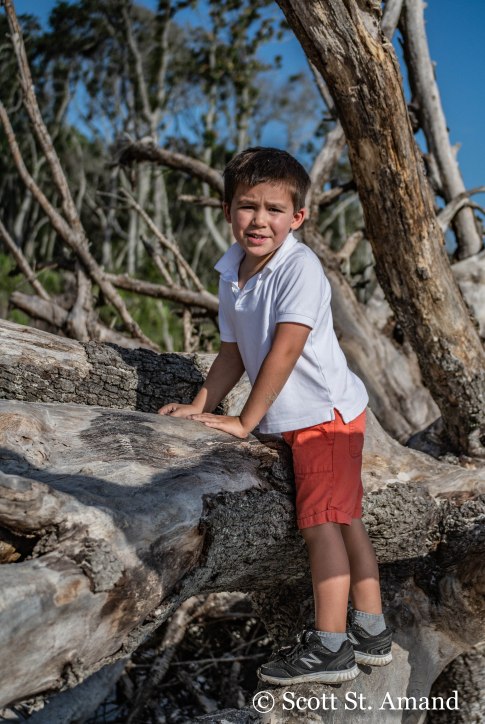
My parents have identical photographs of me at Kemper’s age climbing amongst the rocky shores of Maine and up to the narrowest branches in the trees in our yard, which in hindsight (now as a parent) was a terrible, horrible, no good, very bad practice.  Kemper is a bit more grounded than me, less of a risk-taker, which is why in his almost six years, he has not yet broken a bone.  By his age I had already broken both of my wrists (at the same time), a few ribs, and a number of toes.  I look back at this period of my life and laugh, though as a parent, I cannot imagine what I put my own through.

Kemper found the supine trees on Boneyard Beach at Big Talbot Island, which have been the subject of many posts in the past, and though they were only feet off the ground, he was still tentative in climbing them.  I urged him, almost begged him, to overcome his fears and climb.  As you can see by the wry smile on his face, it was a worthwhile pursuit.  Of course, once I got him to climb one without incident, every new one we came upon needed to be ascended, which made for a fitful photography session of the trees, but was great fodder for capturing him candidly enjoying his boyhood.  When we were in North Carolina last week, he had shed his fear of climbing somewhat, and mounted the rocks on the property with great aplomb.  Still, he was more keen to slosh in the creeks and melted snow puddles with his wellingtons.  He is grounded, and this will undoubtedly bode well for him in the future.  Breaks are a part of childhood, a part of life, but his caution may let him escape the many breaks of bone and heart that I experienced.  This is my hope, perhaps a naive one, but my hope no less.

Click here for a larger version.

Panthertown Skies

Panthertown Valley-6

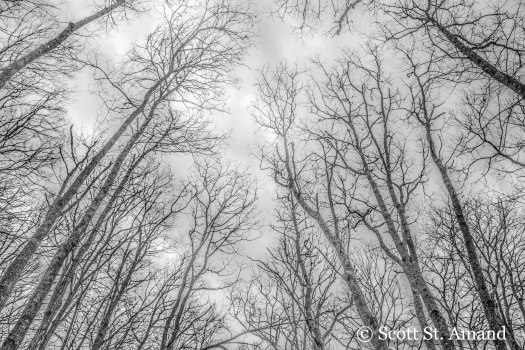
North Carolina in the winter is breathtaking.  I haven’t spent a full winter there in over ten years, since Anna and I graduated from Wake Forest.  The little time I do spend there is with family over the holidays, and the less than frequent trip back to our Alma Mater.  So often now, I find myself looking down, whether it be watching the footfalls of Kemper and Nora, or searching out the low-lying objects that I neglected for so many years as I grew taller and less aware of the beauty that only years before had been at eye level.  As a child, though, I often looked towards the sky.  It was a predilection of mine, and was lost through high school, college, law school, and then my post-graduate work.  As a litigator, I have been trained to look ahead and anticipate the roadblocks before me, and  I have, along the way, lost the penchant for gazing into the clouds above the treetops.  Photography, though in many ways a mature art, has brought me back to my childhood wonder of nature, and as we hiked through Panthertown Valley over the New Year, I caught myself looking upwards once again.

This photograph, though a simple composition, captures some of the innocent wonder.  The clouds of the late morning were beginning to roll in, heavy with precipitation, and we laconically raced to avoid the rain that settled in as we reached the trailhead.  The fingers of the maples and sweet gums and oaks looked like arteries against the pale sky, and in many ways this is a fitting simile.  Nature is a lifeblood–one that I am reconnecting with after years of the wonder of it lied fallow.  Even though I am at my desk from the darkness of the morning through to the early darkness of the winter evenings, I catch myself looking often to the sky, especially as the sun rises and sets.  Jacksonville, to its credit, is beautiful at these times of day.  The rich colors wrought by the low sun are no match to a North Carolina dawn, but then I am biased and nostalgic for the old days, when I could skip my morning lectures and find myself in an hour at the base of Pilot Mountain as the leaves were beginning to redden at the first breath of winter.  Until we return, I will always long for those days, simpler by measure and winsome.  For now, I will console myself with the memories and the short trips when I will fill my camera with shots such as this of the mountain skies on a chilled winter day.

Click here for a larger version

Morning through the Maples

NCWinter2018-85

Dawn is often a foggy affair in the mountains.  This photograph was taken off of the front porch of our cabin in Brevard, North Carolina.  We have come up for a week, and though we have been up for only two days, I am reinvigorated after a long year at work.  Foggy beginnings seem familiar and yet foreign.  Though I am nostalgic for many things, living in a metaphorical fog is not amongst them.  Waking up, walking outside with a hot cup of tea, and watching as the low clouds creep through the maples is something different entirely.  Being here with my family, who walked through the fog with me, and seeing my son slushing through the creeks on the property like I did when I was his age is inspiring.  Even though the dawn is foggy, the sunlight burns through in the end.

Click here for a larger version.

Drifting Together

September hurricanes framed this photograph of three water oaks (Quercus Nigra) astride one another on the shore of Little Talbot Island.  I took this photograph three years ago, and it remains one of my favorites of the driftwood beaches of Northeast Florida.  I returned to this spot with Kemper in early September, three hurricanes later, and the topography of the beach had changed radically.  The hulking live oak (Quercus Virginiana) skeletons with their naked root clusters, ten feet in diameter, perched in the air remained, but the smaller water oaks had been scattered by the waves.  This arrangement of trunks and limbs was no more.  I was disappointed that I could not point out to Kemper where I had taken the photograph that is displayed on a canvas in our living room, but then my mind wandered to the Romantic poets (which happens more than I care to admit).  They found beauty in the ephemeral existence of objects and life.  This photograph is my Ode to the West Wind, which rent the trees asunder with its driving gales and its nautical forces.  Like Blake, and Wordsworth, and Shelley, and Keats, I captured something fleeting, though, admittedly, I did not think that these huge skeletons were mutable, even through the power of a glancing blow of a hurricane.  But nature is ever-changing, and I took this for granted three years prior when I framed the scene in my camera and released the shutter.  It is a lesson to me to not underestimate the power of the elements and to capture what I can, when I can, lest it be gone in another season.

Click here for a larger version.

Symptoms

SSA Photography (109 of 400)

These desiccated little smoky polypore mushrooms (Polyporus Adustus), like a resurrection fern, will spring back to life after a brief winter rain.  Unfortunately, for the hardwood trees that they are found on, the time for resurrection has long past.  The enzymes in the mushrooms help to speed the decay of dead and dying trees in forests all over the world, including this one in North Carolina, west of Asheville.  Interestingly, they also can eat away synthetic materials, such as synthetic dies in plastics, and research is being done to see what role these common little mushrooms can play in bioremediation.  This dwarf American Chestnut (Castanea Pumila) still bore leaves, and but for the polypores on its bark, the tree would have otherwise appeared healthy.  But alas, it is the beginning of the end for the august old tree.  The mushrooms are a symptom of death and disease, otherwise invisible until the tree succumbs.

I think of my favorite aunt on my dad’s side, Irene, who died of cancer when I was younger.  I had seen her soon before the cancer took over, and she appeared healthy on the outside — albeit crusty and sarcastic to the end.  I regret not knowing her better, as she was a huge influence on my dad’s life.  My dad and I went to Maine to visit her and my memere, who was in the throes of dementia, and I spent most of the time in the back of Irene’s house on the rocky outcroppings looking for moose and wild blueberries.  I told her that I would bring her a harvest of the blueberries, which grew low to the ground, rooted in the interstices of the rocks.  I failed in my mission, eating at least two-thirds of what would eventually make it into my small bucket.  I told her that I had not found as many as I had wanted (which, I suppose, was true), but my lips, stained a dark shade of purple, belied my foraging skills.  She laughed and smiled her ever present wry smile, and we had an understanding.  I was the chubby kid who was not to be trusted gathering fruit, and she was the understanding aunt, too kind to say anything cross.  Perhaps if there were outward signs, I would have stayed inside longer to hear her stories of my dad and uncle, Harvey, and perhaps I would have been more judicious with the blueberries I promised her.

Click here for a larger version.


The Lone Cypress

SSA Photography (238 of 400)

I often wonder how this iconic tree took root.  For those who don’t immediately recognize the scene, this is the “Lone Cypress” off the coast of Monterey, California.  This photograph was taken during the height of the Soberanes Fire southwest of here in the valleys just off the coast of Carmel and Big Sur.  Although likely surpassed by the recent Woolsey Fire, the Soberanes was the costliest wildfire in the history of California.  It coated everything in a thin layer of ash, and the smoke that hung thickly, almost unctuously in the air made shots of the coastline nigh impossible.  This photograph was taken towards the tail end of the trip, as the fire was winding down, and still the haze bled the details from the shot.

When the sun managed to pour through the thick air, the sky took on a burnt, sepia tone, which made every picture I took look like I had applied a strong filter to it.  The tree is at least 250 years old, and for the last 65 or so has been held in place by strong metal cables.  When I saw the cables in person, I thought that it was a supremely arrogant act by man to forestall the inevitable cycle of nature for the sake of Japanese tourists (and me) making a pilgrimage to gaze through chain-linked fence to snap an awkward photograph of the icon sitting on its outcropping, engirded as it is by a brick and mortar parapet.  But still, we come en masse, ogling the tree with a misplaced reverence.  When this one dies, as it will, it will be replaced with a fellow that I am certain is already being grown for its stead, like a Cardinal waiting in quiet for the Pope to abdicate.

Click here for a larger version.

Hollow

_DSC6019.jpg

I have long since wondered what befell this little pignut hickory tree (Carya Glabra) that I found on a walk in the Pisgah National Forest, just outside Asheville, North Carolina.  Its brothers and sisters in the grove around it were healthy, but perhaps this one was hollow from an early age.  In my journey through the morass of my own personal demons, I met many individuals who were all but hollowed-out inside.  For some, their facade mirrored their inner emptiness, like this little hickory stump.  For many, however, they looked strong and confident and healthy on the surface, all the while roiling with anguish inside.  Even those of us who manage to come out the other side still have hollow pockets, places where the memories of the shadows still live, which catch us by surprise every so often.  Eventually, for the fortunate few, these shadows subside, but they remain–never to fade completely into the light, like scars that sometimes catch the sunlight at just the right angle to remind you that you were once injured, too.  And every once in a while, you may come upon a hollow stump, a not so subtle memento of the emptier days.  Maybe you walk by it, trying not to remember those times, but maybe, just maybe, you snap a photograph, a token to hold close to you, reminding you how insidious the hollowness can be.

Click here for a larger version and a color version.

Boneyard Beach

SSA Photography (84 of 400)

I do not know who settled on the name Boneyard Beach for this stretch of coastline on Big Talbot Island, just north of Jacksonville, Florida.  It is fitting, though, that the skeletons of the old live oaks (Quercus Virginiana) stretch towards the ocean like Tantalus stretched towards the water beneath his feet and fruit above his head.  This photograph was taken three years ago, before the northeast coast of Florida was battered by hurricanes Irma and Matthew.  Kemper and I went to Boneyard Beach earlier this year, in the height of summer, to take photographs.  I figured to get some photographs of him among the stripped, bleached bones.  To my great surprise, many of the trees that I had become accustomed to (which are featured in my gallery Driftwood), had vanished into the sea since I had been there last.  Kemper was disappointed for a moment, but then he caught sight of a ghost crab skittering around the base of a monolithic oak, unaffected by the reshaping of the coastline.  It would have taken a much stronger act of God, or His hand itself, to move that oak from its spot.  Innumerable hurricanes have battered the island over the centuries, and as the new oaks, themselves, fall to the beach, the skeletons will once again reappear–until, of course, another set of storms carries them off to the sea.

Click here for a larger version.