Lion’s Teeth

SSA Photography (125 of 400)

I am a philologist, a lover of words.  As an English and Latin double major in college, I pursued my love of language (even through the trials of reading Beowulf in its original Old English).  As you have seen in many of my previous posts on nature, I like to include the taxonomic name of the plants, not because I want to show off my knowledge of nature – it’s a notch above rudimentary, at best – but because I love the Latin names.  A white oak is so much more august as a Quercus Alba, or the sweet-gum tree as Liquidambar Styraciflua, which literally means a tree flowing with amber liquid (referring to the gum that exudes from the tree when it is cut).

In this vein, I give you a (false) dent de lion, a lion’s-tooth flower, better known as a dandelion.  Although the appellation refers to the coarsely toothed leaves, this photograph – one of my early macro lens experiments – focuses on the petals and the pseudanthium, or false flower head in the middle, which is actually a small cluster of tiny flowers grouped together.  The pictured flower is actually a false dandelion, or a Carolina desert chicory flower (Pyrrhopappus Carolinianus).

The simplicity of the composition is appealing to me on the one hand, and on the other, I have always been troubled by the dead center focus on the flower.  Unfortunately, when I was first taking my macro shots, I was more concerned with aperture and focus than I was with composition.  I have sincerely amended my ways.  Nevertheless, the clarity and the stark contrast of the petals and the void behind them have always been pleasing to me.

Click here for a larger version.


Glacier Bay

SSA Photography (17 of 400)

This photograph was taken in Glacier Bay National Park in Southeast Alaska, just west of Juneau.  President Calvin Coolidge proclaimed the area around Glacier Bay a national monument under the Antiquities Act on February 25, 1925. Subsequent to an expansion of the monument by President Jimmy Carter in 1978, the Alaska National Interest Lands Conservation Act enlarged the national monument by 817.2 square miles on December 2, 1980, and created Glacier Bay National Park and Preserve.

This is the Johns Hopkins Glacier, named in 1893 by H.F. Reid after the Johns Hopkins University in Baltimore, Maryland, which sponsored an expedition to this glacier.  It is the only advancing tidewater glacier now (its advance started in 1924 when Grand Pacific Glacier started receding towards Tarr Inlet) and is combined with Gilman Glacier (first got attached to Hopkins in the 1990s, broke off and rejoined several times and once again it appears joined since 2000); both are advancing as one single ice block, and at the waterfront, has a width of 1 mile with a depth of 250 feet, rises to a height of 250 feet and stretches to about 12 miles  upstream.

Click here for a larger version.

Jellyfish #4

SSA Photography (230 of 400)

This photo of a Moon Jellyfish (Aurelia Labiata) was taken on a past trip to the Monterrey Bay Aquarium just outside of Carmel, California.  The invertebrate room at the aquarium is huge, and must contain thousands of jellyfish of every shape, size, and color.

Instead of long, trailing tentacles, moon jellies have a short, fine fringe (cilia) that sweeps food toward the mucous layer on the edges of the bells. Prey is stored in pouches until the oral arms pick it up and begin to digest it. The coloration of a moon jelly often changes depending on its diet. If the jelly feeds extensively on crustaceans, it turns pink or lavender. An orange tint hints that a jelly’s been feeding on brine shrimp.  Found worldwide in temperate and tropical waters (as well as the Monterrey Bay itself and up and down the California coast), moon jellies feed in quiet bays and harbors. Although moon jellies have a sting, they pose little threat to humans.

Click here for a larger version.

Atop the Moors

SSA Photography (396 of 400)

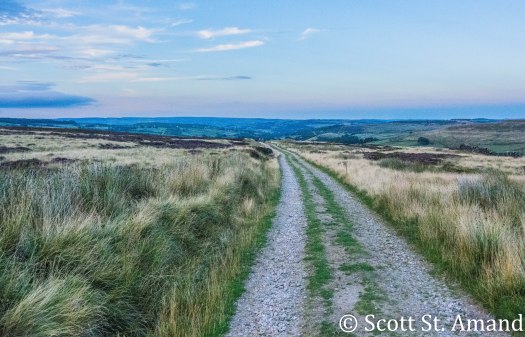
Another selection from my “Paths” portfolio, this photograph of a rocky road was taken on the the moors just outside of Haworth, England.  Almost indiscernible at the end of the road, towards the horizon, are the minuscule figures of my mother-in-law, Vivien, and her brother, Robin, who both grew up wandering the moors like the Brontës, who lived in a parsonage in Haworth, adjacent to the church where their father Branwell preached.  The moors are the inspiration of many of the gothic scenes in their novels, in particular Emily’s Wuthering Heights.  Wuthering is a Yorkshire word meaning blustery and turbulent, and often describes the fierce, noisy winds that blow across the moors.  The winds were calm this day, but only the day before, they were truly wuthering, rattling the shutters and whipping horizontal rain against the panes of crown glass in the home that Anna’s grandfather built, stone by stone, from the ruins of an ostler barn, where the horses were housed during the construction of the Worth Valley railway.  

Whether to give Anna and I our own space on the hike up and down the steep moors, or because we could not keep up, Vivien and Robin always appeared as part of the horizon, which in this photograph looks south towards Ostlerhouse.  As the sun set on us, the sky became iridescent, the faintest inchoate hint of which can be seen in this photograph.  Having finally caught my breath from the harrowing ascents and descents, through many of which I cursed my mother-in-law for promising a nice calm amble through the heather, I could at last appreciate the beauty that would have only come from striding atop the moors.  I have captured, between heavy, heaving chestfuls of fresh Yorkshire air, these breathtaking (pun intended) views of the moors in my portfolio, aptly titled, albeit simply, “The Moors.” 

Click here for a larger version.

Tulips at Noon

SSA Photography (97 of 400)

The main draw to Big Talbot Island State Park, just north of Jacksonville, Florida, is the driftwood beach, commonly referred to as “Boneyard Beach.”  The first time I went to Boneyard Beach with my camera, I was so focused on the gorgeous shells of the trees scattered across the beach, some of them with full root systems intact, as if they just had been uprooted the day before, I failed to notice the smaller elements around me, such as these gorgeous tulip snails, which I featured in one of my first posts to this page – and still one of my favorite photographs, “Three Hermits.”

It was not until I bought a good macro lens and began avidly looking for the beauty of the minutiae that I first discovered the snails, and their unique patterns of verdigris and Tyrian purple.  The ancient Romans valued the murex shell for its dying purposes, and purple robes dyed with the tint were reserved for royalty (and during the Republic, for senators and upper statesmen).  The murex snail was found only in Carthage, the capital of which was Tyre, hence the appellation of the deep purple hue.

The deep saturation of the shells only shows up when the light hits them just right (or in some minor post-processing of the photographs), and I was lucky enough to catch them early on a sunny Florida afternoon.  They congregate on the trunks and branches of the driftwood trees, often in the crooks and interstices that are too small for even barnacles to have taken hold.  They must live in such crevasses for months, perhaps years, because their shells are too large to have found their way into them fully grown.  These two were on the top of a lower branch of a white oak (Quercus Alba), which was drying out from the ever more distant ebb and flow of the tide.

The patterns and gradients of the shells are almost abstractly perfect.  Looking at them that day, and again as I began to write this post, reminds me of the divinity of nature.  Although Darwin explained the evolution of creatures in his Origin of the Species, he did not (to my knowledge) opine on the divine proportions of the carapace of the Galapagos tortoise.  It took me many years to accept that there was a divinity common in all living things, but now that I have seen it, it cannot be unseen.  God, as you understand Him, is present in these snails – you just have to find the trees in the forest and look a little closer.

Click here for a larger version.

No Handbills

NCWinter2018-46

The floods from the melting snow unearthed two old metal signs on the property in Brevard, North Carolina, which we found on a morning walk.  They fallowed under cover of sweetgum leaves and time.  The signs, rusted and riddled with bullet holes, were still legible, and demonstrated the disdain for the hippies that once made the property their home, before they were forced out by a more puritanical wave of valley residents.

The property sits on a geologic fault line, and the streams on the property are headwaters for the French Broad River, one of the oldest rivers in the world.  The property was a summer camp in a former age, and the ruins of the old stone buildings are still visible.  As I mentioned in a previous post, the property was once a common stopping ground of a folk-singing, free-loving, cache of hippies and musicians, including Pete Seeger and Woodie Guthrie.

These signs are further reminders that we were not the first to enjoy the hills and fields where generations of boys spent their summers away from home and hippies did – well, what hippies do…

In the seven years my family has been coming here, the land has become a part of us, a memory we carry with us in our day to day lives in Florida.  I will never know who put the bullet holes in the signs, but they will remain nevertheless.  We have left our own marks on the property, no less visible or timeless.  Generations from now, the cabins may fall and the sapling white pines may overtake them, but our time on the property will still be felt.

Click here for a larger version.

Rocks of the Bay

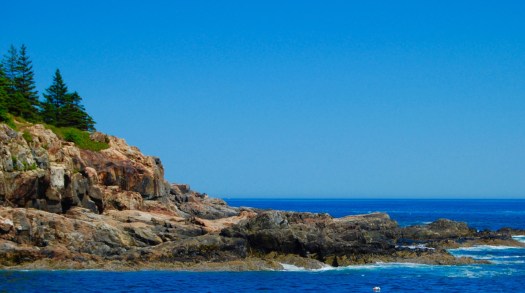
My dad grew up in Biddeford, Maine (south of Portland) and spent his summers in Old Orchard Beach.  My mother’s parents would rent a house on the coast during the summers when I was much younger, and all I can remember from those days is climbing through the rocks that lined the shore.  Because of this, I have a certain affinity for Down East (the coast of Maine).  So when my in-laws decided to take a vacation to Bar Harbor, I was excited to be able to personally revisit some of my childhood memories.

We took a small boat around the harbors, and saw many of the lighthouses that dot the coastline.  The stones along the coast longed to be climbed on, but that was a long while ago.  My son, Kemper, is as old as I was then, and he would love the (relative) safety of climbing on the rocks of the bay (versus the cherry tree in my parents’ front yard, which mercifully died before I got too big for the topmost branches to hold me).  He is not a risk-taker, for which I am very grateful.  His impulsivity would not be well met by fearlessness.

Although I usually prefer black and white photographs, the contrasts of the trees and coastline to the skies and water were to beautiful to reduce to monochrome.  For whatever reason, the photographs I have taken in Maine tend to end up in color.  This is a testament to the natural beauty of Down East (and to the fact that I always visit in the summer).

Click here for a larger version.

Usnea

ChristmasEveNoWatermark-9

This little piece of lichen (Usnea Florida) was the first photograph I took in North Carolina when we arrived in late December.  I had always known that the property was surrounded by natural beauty, but I took for granted the embarrassment of natural riches that the property had to offer.

I have spoken before about my reconnection with nature which coincided organically with taking up photography seriously in my late twenties and early thirties.  I had already begun a phase of my photography journey in which I was concentrating on lichen, and mushrooms, and other overlooked pieces of nature, and so when I arrived in North Carolina with that focus, I was almost overwhelmed by the proliferation of mushrooms and orchids pushing up from beneath the dense layer of fallen leaves.

As I mentioned previously, we go to North Carolina with my family – my parents, my sister, my niece and our clan of Nora, Kemper & Anna.  As much as I enjoyed spending time with them (and it was the best vacation we have ever taken in that regard), when everyone else was resting from a long hike, I would often try to sneak off with my camera to capture the little bits of nature that ordinarily go without notice.

Invariably, my father or mother would want to come with me, as they get to spend so little time with me during the rest of the year because of work (even though we live less than half-an-hour apart).  I was always happy to have them come along, and my dad even took it upon himself to be my “spotter” when I was so busy behind the lens to quite literally see the forest for the trees.  When I was accompanied, however, I always felt that my pace quickened, and I was not able to amble as slowly as I would have liked to take in as much as the wilderness had to offer.  That being said, I would not have changed those walks with my parents for anything.  Someday I will get the chance to walk alone through the woods, and I know then that I will long to have my “spotter” with me (or to have my mother asking whether I am taking my vitamins regularly, as mothers are wont to do).

Like this photograph, it is all about perspective.

Click here for a larger version.

Driftwood Core

LittleTalbot-13

At the core, we all have holes.

Some are larger than others, and while most can eventually be filled in, some remain empty.  My paralegal lost her daughter in August just after childbirth.  The sorrow was unimaginable, and we did all that we could for her, but nothing we did or said could fill the hole of the loss of her only child.  Her daughter left behind a husband and three children, five, two, and a newborn.  Our paralegal was out for three months, and our practice slowed in her understandable absence.  More than anything, I missed my friend, and I looked forward to the day that she returned.

She came back at the start of January, less than complete and not totally present, but she was managing better than I could have.  My job (self-appointed) was to keep a smile on her face, to listen when she needed it, and to offer a shoulder to cry on in the moments when she needed to be vulnerable.  I brought her lunch, and we joked with each other, superficially, but still she laughed.  It was a little thing, but it was a bit of normalcy.

On Saturday tragedy struck again.  The baby stopped breathing, and could not be resuscitated.  He was gone, and so too was she once more.  I could not do a thing but tell her that I loved her and that I was here for her – howsoever she needed me.  I cannot imagine the gaping hole that this tragedy tore asunder, ripping the partially healed one of her daughter’s death back open to the elements.  I don’t know if it will ever heal.

My own holes are filled for the most part.  There are still remnants of them, cavities and interstices that remind me of the voids that were once a part of my life.  I do not dwell on them as a practice, but at times like these, I am reminded of the grace and providence that allowed me to see the faintest hint of light peeking through the chasms.

We all have holes at our core.  Some will be filled by time, but the unimaginable others, I just don’t know.

Click here for a larger version.
Growth

Panthertown Valley

Christmas break was supposed to be a reset.

Kemper had begun showing out at school, becoming increasingly obstinate to the teachers.  It had not fully made its way home, but we received emails every night or notes home in his folder that he had refused to do work or told the teacher he did not want to do something she asked.  He was five, and she was a brand new teacher, so we thought he might just be going through a phase and feeling out her boundaries.  Little did we realize that it was just the beginning of a truly rough patch.  But Christmas break was going to be a reset.  We would go to North Carolina, and all of the energy that he longed to let loose could be released in the mountain air.

We started the year with high hopes for Kemper.  We had begun to see a child psychologist before we left for North Carolina, and Kemper seemed to react well to him.  He showed none of the behavior that had been plaguing him at school, and we thought that he might have moved past the obstinance that he had begun to show.  The first day back was a disaster.  He yelled at the teacher, swatted at her, and flatly refused to do his math work.  He was sent to the principal, and Anna was called in to pick him up.  We disciplined him as we then thought appropriate, taking away his beloved stuffed animals, and this seemed to affect a change in his temperament.  The next day was as bad, if not worse.  The day after that he barely made it into the classroom before he had an outburst that sent him to the principal’s office.

We had him tested, and he proved to be off-the-charts gifted (which came as no surprise to us), and we thought he was just bored.  After many tears and gritted words, we walked away with a diagnosis of severe AD/HD.  The poor little guy could not physically sit still long enough to focus on his work, which he was being forced to do and then being scolded for not doing appropriately.  The psychiatrist suggested medication, which we very reticently put him on.  The change was immediate. Saturday was his sixth birthday, and we saw for the first time in a while the true Kemper coming back to us.

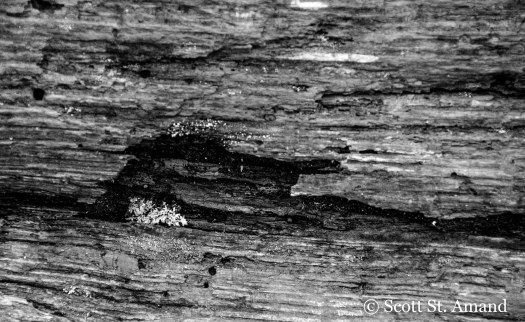
I took this photograph of a small patch of crustose lichen growing on the fallen trunk of a large red oak (Quercus Rubrum) in passing while on one of the many hikes that Kemper enjoyed (though he lamented his boredom along the way).  It did not mean much to me at the time, but in context it illustrates to me the rebirth of a new year.  Christmas break was not the reset we expected.  The fallen oak did not immediately sprout new leaves.  But in the darkness, there was a hint of life anew.  I may come upon this tree when we go back to North Carolina in June, and the lichen may cover the trunk by that point…or, it may just remain there in that little patch, growing slowly but steadily.  And that progress, as small as it might be, is enough.

Click here for a larger version.