Lion’s Teeth

SSA Photography (125 of 400)

I am a philologist, a lover of words.  As an English and Latin double major in college, I pursued my love of language (even through the trials of reading Beowulf in its original Old English).  As you have seen in many of my previous posts on nature, I like to include the taxonomic name of the plants, not because I want to show off my knowledge of nature – it’s a notch above rudimentary, at best – but because I love the Latin names.  A white oak is so much more august as a Quercus Alba, or the sweet-gum tree as Liquidambar Styraciflua, which literally means a tree flowing with amber liquid (referring to the gum that exudes from the tree when it is cut).

In this vein, I give you a (false) dent de lion, a lion’s-tooth flower, better known as a dandelion.  Although the appellation refers to the coarsely toothed leaves, this photograph – one of my early macro lens experiments – focuses on the petals and the pseudanthium, or false flower head in the middle, which is actually a small cluster of tiny flowers grouped together.  The pictured flower is actually a false dandelion, or a Carolina desert chicory flower (Pyrrhopappus Carolinianus).

The simplicity of the composition is appealing to me on the one hand, and on the other, I have always been troubled by the dead center focus on the flower.  Unfortunately, when I was first taking my macro shots, I was more concerned with aperture and focus than I was with composition.  I have sincerely amended my ways.  Nevertheless, the clarity and the stark contrast of the petals and the void behind them have always been pleasing to me.

Click here for a larger version.


Jellyfish #4

SSA Photography (230 of 400)

This photo of a Moon Jellyfish (Aurelia Labiata) was taken on a past trip to the Monterrey Bay Aquarium just outside of Carmel, California.  The invertebrate room at the aquarium is huge, and must contain thousands of jellyfish of every shape, size, and color.

Instead of long, trailing tentacles, moon jellies have a short, fine fringe (cilia) that sweeps food toward the mucous layer on the edges of the bells. Prey is stored in pouches until the oral arms pick it up and begin to digest it. The coloration of a moon jelly often changes depending on its diet. If the jelly feeds extensively on crustaceans, it turns pink or lavender. An orange tint hints that a jelly’s been feeding on brine shrimp.  Found worldwide in temperate and tropical waters (as well as the Monterrey Bay itself and up and down the California coast), moon jellies feed in quiet bays and harbors. Although moon jellies have a sting, they pose little threat to humans.

Click here for a larger version.

Tulips at Noon

SSA Photography (97 of 400)

The main draw to Big Talbot Island State Park, just north of Jacksonville, Florida, is the driftwood beach, commonly referred to as “Boneyard Beach.”  The first time I went to Boneyard Beach with my camera, I was so focused on the gorgeous shells of the trees scattered across the beach, some of them with full root systems intact, as if they just had been uprooted the day before, I failed to notice the smaller elements around me, such as these gorgeous tulip snails, which I featured in one of my first posts to this page – and still one of my favorite photographs, “Three Hermits.”

It was not until I bought a good macro lens and began avidly looking for the beauty of the minutiae that I first discovered the snails, and their unique patterns of verdigris and Tyrian purple.  The ancient Romans valued the murex shell for its dying purposes, and purple robes dyed with the tint were reserved for royalty (and during the Republic, for senators and upper statesmen).  The murex snail was found only in Carthage, the capital of which was Tyre, hence the appellation of the deep purple hue.

The deep saturation of the shells only shows up when the light hits them just right (or in some minor post-processing of the photographs), and I was lucky enough to catch them early on a sunny Florida afternoon.  They congregate on the trunks and branches of the driftwood trees, often in the crooks and interstices that are too small for even barnacles to have taken hold.  They must live in such crevasses for months, perhaps years, because their shells are too large to have found their way into them fully grown.  These two were on the top of a lower branch of a white oak (Quercus Alba), which was drying out from the ever more distant ebb and flow of the tide.

The patterns and gradients of the shells are almost abstractly perfect.  Looking at them that day, and again as I began to write this post, reminds me of the divinity of nature.  Although Darwin explained the evolution of creatures in his Origin of the Species, he did not (to my knowledge) opine on the divine proportions of the carapace of the Galapagos tortoise.  It took me many years to accept that there was a divinity common in all living things, but now that I have seen it, it cannot be unseen.  God, as you understand Him, is present in these snails – you just have to find the trees in the forest and look a little closer.

Click here for a larger version.

Steve at the Falls

Panthertown Valley-27

My family became the subject of a number of portraits during our post-Christmas vacation in Brevard, North Carolina.  On the whole, the portraiture was done mostly willingly (except my mother, who loathes having her picture taken – much like me).  I did not push her, except for one photograph with the grand-kids and one family portrait, which even I deigned to sit for.  This photograph was a candid of my father admiring Schoolhouse Falls in Panthertown Valley.

Although the falls were admittedly beautiful from the front, the view from behind the falls was something else entirely.  We had met a sweet older lady on the hike, just as we were about to turn around, who advised us to take ten minutes and hike to the falls that were running more strongly than she had ever seen due to the rain and snow melt.  She said that if we were careful, we could even hike behind the falls, which piqued my curiosity.  As soon as we turned the corner onto the side path, we heard the crashing of the falls.  The hike was easy to the falls itself, and I took a number of photographs of the falls that I have added to my portfolio “Falls.”

Click here for a larger version.

Cheeky

NCWinter2018-71

This photograph of Kemper, and my niece Brynn, was taken a few weeks ago in Brevard, North Carolina.  The two cheeky little gremlins had just been sloshing through the creek that was running higher than I had ever seen it on account of the torrential rain and snow melt.  Still, it was shallow enough in places to come just over their wellingtons, thereby defeating the boots’ entire purpose.  I think they had more fun splashing in their boots on dry land, listening to the sucking sounds that their feet made within the boots, than they did in the creek itself.

Living square in the suburbs, Kemper and Brynn play “outside” all of the time, meaning they play with chalk on the driveway, ride their bikes and trikes, but they do not have the chance to slosh through the creeks in Florida.  There are too many unseen dangers, the least of which are alligators and moccasins.  So, to be able to traipse through the mud and cold water in North Carolina was as much a release for the kids as it was to watch for the grownups – my sister, Claire, Anna and me.  We got to see the nature of our kids come out in the natural elements.  Though Kemper lamented the long hikes, he loved to play with the sticks and threw the rocks that he found along the way.  Give him a mud puddle, and he will have fun for longer than any sow or elephant might.  It was heartening to see them both having fun, and whats more, having fun together.

Click here for a larger version.

Cored

SSA Photography (144 of 400)

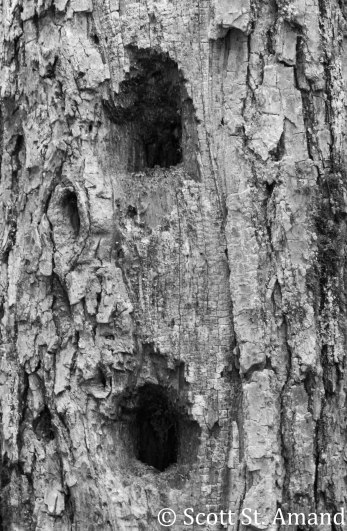
This old pignut hickory (Carya Glabra) has seen better seasons, but the beak of a red-cockaded woodpecker (Picoides Borealis) has extensively excavated the trunk, reaching through the growth rings of those seasons for the tunneling larvae of hickory bark beetles (Scolytus Quadrispinosus).  Although I only captured two of the woodpecker’s cavities in this photograph, the length of the trunk of the dead pignut hickory was pocked with them on every side.  I had hoped to capture the guilty woodpeckers in flagrante delicto, but I was only able to capture the evidence of their tenacious, voracious nature.

The black and white captures the deep shadows of the holes, and gives the bark an almost tessellated appearance, which is true to form.  The gray lichen on the bark just to the right of the lower cavity is almost inconspicuous, but I would be remiss to not note the thin layer of crustose lichen, perhaps Pertusaria Epixantha, which gives a more complete vision of this small ecosystem with tree, and bird, and insect, and fungi within millimeters of each other–coexisting in harmony, even after the tree has lost its sap and vigor.  Nothing in the woods of North Carolina goes to waste.  Even the autumnal leaves that fall by the wayside eventually feed the very trees that shed them, not to mention the other fauna and flora that feast upon them.  Thus, even in the hollowed, cored trunk of this long dead tree, I saw embodied a brief arc of the circle of life.

Click here for a larger version.

Crescent

SSA Photography (99 of 400)

The whirls of the driftwood on Big Talbot Island, just north of Jacksonville, Florida, are peculiarly wonderful to me.  My father is a woodworker in his spare time, and throughout the years, we have made scores of pieces of furniture, boxes, and we have even turned a number of bowls on the lathe.  As such, I am a constant admirer of wood and its natural beauty.  I have turned beautifully featured bowls from a pecan log wrought with worm holes, and ambrosia maple, and spalted sweetgum, but the oak bowls I have turned are lovely, but plain, almost like Shaker furniture.  They have a very ordinary grain, and little about them is exceptional.  The fallen oaks on Big Talbot Island, however, have fantastic patterns, some like the ornamentation of a medieval Celtic manuscript.

I do not know how these patterns came to be, though I speculate that it has something to do with the effect of the sea air on the tree’s formation, both nurturing and stunting the growth at the same time.  Some of the trees must have been tall and vast when they stood decades, or perhaps centuries, ago, but it is the smaller ones that have the more intricate patterns like this one.  To capture the perspective of this photograph, I set the aperture (depth of field) quite low, so that only a piece of the limb was in total tack focus.  The foreground and background are blurred, and the focused piece catches your attention, not only because of its placement in the composition (according to the rule of thirds), but also because of its contrasting sharpness.  I would have loved to turn a bowl from this tree, if only to see whether the patterns on the surface came through onto the finished product.  But now I have turned my artistic attention away from woodworking to photography, and so I must satisfy myself with capturing the beauty of the wood rather than pulling it from an unfinished block.  It is a different approach, but no less satisfying when the photographs turn out like this.

Click here for a larger version.

Posted

SSA Photography (105 of 400)

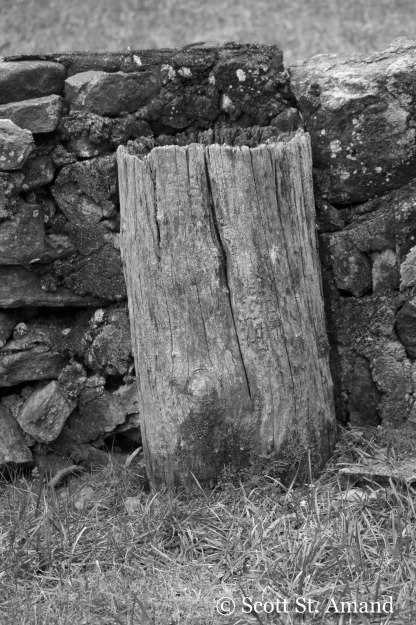
The provenance of this post is unknown.  I took the photograph right as I began to become serious about my photography.  The post is within the ruins of what used to be a gym for a boys camp in North Carolina, but the property was also a hippie commune, which the likes of Pete Seeger and Woody Guthrie graced with their presence.   The photograph is a simple composition, and if I would have taken it now, this one would likely have found itself on the cutting room floor.  Nevertheless, the photograph is nostalgic, and as my posts have shown, this is a flaw of mine.

Click here for a larger version.

Climbing

LittleTalbot-4

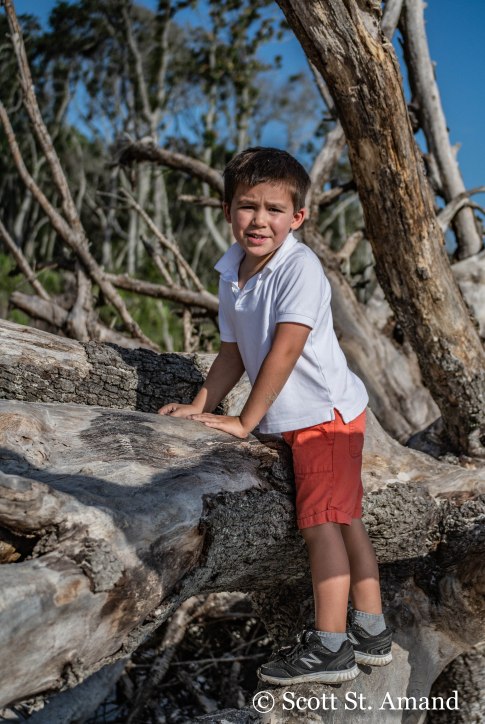
My parents have identical photographs of me at Kemper’s age climbing amongst the rocky shores of Maine and up to the narrowest branches in the trees in our yard, which in hindsight (now as a parent) was a terrible, horrible, no good, very bad practice.  Kemper is a bit more grounded than me, less of a risk-taker, which is why in his almost six years, he has not yet broken a bone.  By his age I had already broken both of my wrists (at the same time), a few ribs, and a number of toes.  I look back at this period of my life and laugh, though as a parent, I cannot imagine what I put my own through.

Kemper found the supine trees on Boneyard Beach at Big Talbot Island, which have been the subject of many posts in the past, and though they were only feet off the ground, he was still tentative in climbing them.  I urged him, almost begged him, to overcome his fears and climb.  As you can see by the wry smile on his face, it was a worthwhile pursuit.  Of course, once I got him to climb one without incident, every new one we came upon needed to be ascended, which made for a fitful photography session of the trees, but was great fodder for capturing him candidly enjoying his boyhood.  When we were in North Carolina last week, he had shed his fear of climbing somewhat, and mounted the rocks on the property with great aplomb.  Still, he was more keen to slosh in the creeks and melted snow puddles with his wellingtons.  He is grounded, and this will undoubtedly bode well for him in the future.  Breaks are a part of childhood, a part of life, but his caution may let him escape the many breaks of bone and heart that I experienced.  This is my hope, perhaps a naive one, but my hope no less.

Click here for a larger version.

Dreamcatchers

SSA Photography (126 of 400)

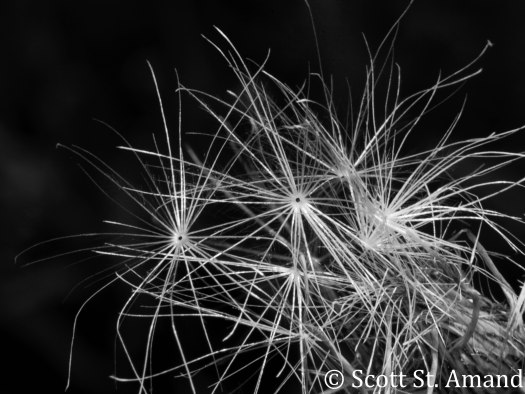
This photograph of the achenes or diaspores of a “horrible” thistle (Cirsium Horridulum) was captured two summers ago with my macro lens.  The diaspores have evolved over millions of years to to be light and airy, with tendrils that catch the air for dispersal far afield of their mother plant.  Though not the best composition, I was struck by the symmetry of the achenes and their simple utility.  The swampy path I was walking when I came upon them during the summer was littered with thistles for miles.  The evolution, though perhaps not complete, had certainly served its purpose well.  The most recognizable achenes are those of the dandelion clock, which children gather up with some eagerness only to blow the diaspores unwittingly throughout their parents’ front yard.

I wish Kemper had been old enough to accompany me when I took this photograph.  He finds great sport in blowing the silky white seeds from their presently denuded and spent host.  He was three then, and not quite up to a long jaunt in the summer heat.  The mosquitoes were particularly bad this day, and to be honest, I am surprised that I did not capture one in this photograph–they were so thick.  But this is Florida, and the beauty of nature invariably carries with it some danger, whether an alligator lurking silently beneath the surface of a calm fishing pond, or a rattlesnake blending in with the underbrush.  Having grown up here, these are calculated risks, and readily mitigated.  For the uninitiated, however, Florida is as wild as the outback of Australia.  This results, I think, in a fair bit of pride for us native Floridians who would as soon approach a four foot long gator, knowing full well it will quickly shy away, as a New Yorker would cross a busy intersection at the height of the noon-day traffic.  I do not begrudge the out-of-towners the novelty of seeing an alligator in the wild for the first time, but to us they are quotidian and predictable.  Yet, as this photograph shows, even the most commonplace native objects, when viewed with a different perspective, yield beauty.

Click here for a larger version.