Posted

SSA Photography (105 of 400)

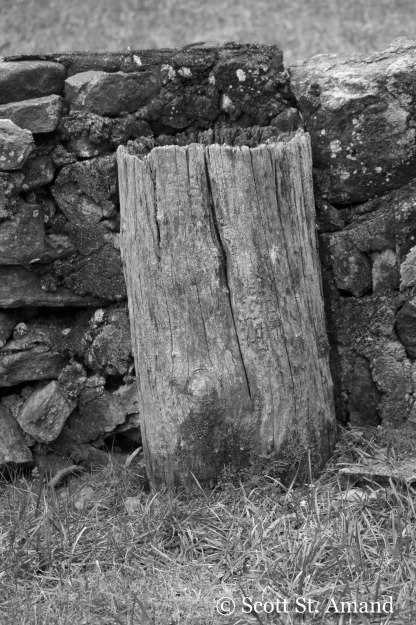
The provenance of this post is unknown.  I took the photograph right as I began to become serious about my photography.  The post is within the ruins of what used to be a gym for a boys camp in North Carolina, but the property was also a hippie commune, which the likes of Pete Seeger and Woody Guthrie graced with their presence.   The photograph is a simple composition, and if I would have taken it now, this one would likely have found itself on the cutting room floor.  Nevertheless, the photograph is nostalgic, and as my posts have shown, this is a flaw of mine.

Click here for a larger version.

Worth

MoorWalk-8.jpg

How I arrived at the top of this particular moor, I don’t really care to recount.  It suffices to say, that in a land of paths cut by more intrepid travelers over the centuries, there were no paths at the top of this moor, as we were, apparently, four of the only masochists to decide that it was prudent to visit the rock in the left foreground of the photograph.  I would have grumbled the entire way, as I am wont to do, but I had no breath.  Thus, the grumbling was internal–albeit vociferous.  Nevertheless, when we reached the apex of this last moor (we had already traversed at least four), my grumbling ceased.  I even managed to catch my breath, and yet I did not utter a discouraging word.  How could I at such a magnificent sight.  The purple heather that I disregarded with certain animosity as I trapsed through it was gorgeous, and gave the moors on the horizon an almost surreal violet hue in patches.

Three miles or so down in the Worth Valley is where Anna’s grandfather build their house, stone by stone, from the ruins of an ostler barn.  It is where Anna’s mother grew up, and where I proposed to her in a field across the valley from the house–but in a line of sight from the kitchen window, so that we could always look over to the field when we were at the house.  Looking further into the horizon, you can make out a pinpoint landmark, which is the rock outcropping that we came to mount.  This is where the Brontë sisters wrote their novels, and in fact Top Withens, the inspiration for Heathcliff’s home in Wuthering Heights, sat only minutes away atop an adjacent moor.  A steam train runs through the middle of the valley, on which tracks Anna’s great-great-grandfather was an engineer.  The valley is of another time, and it affects me like no other place I have visited in the world.

Click here for a larger version.

Crash

SSA Photography (266 of 400)

The Pacific intrigues me like no other body of water.  Having grown up minutes from the Atlantic Ocean, I am accustomed to what I always considered crashing waves.  I remember the muscle memory as a child of being tossed and rolled in the waves after a visit to the beach lasting for hours after we arrived back home.  The sheer strength of the Pacific dulls these memories somewhat, and forces me to reconsider the awe of my childhood fascination with the placid Atlantic.

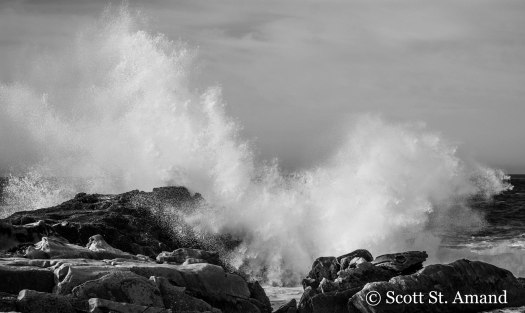
This photograph was taken amongst the rocks in Carmel Bay.  Although the crash of the waves in this photograph is impressive, the highest swells and tallest sprays seemed to come the moment I turned my camera off after waiting for the next great wave to roll in.  Kemper joined me on this trek down to the water’s edge, but he was more interested in throwing pebbles to the tide pools than the august waves and cacophony of them extinguishing themselves on the rocks.  Perhaps he is jaded, having grown up with the Pacific, or perhaps he is simply a child, whose attention is drawn more by his controlling of nature than nature’s control over the elements.

The morning layer was thick when I dragged him from bed to amble down to the coastline, and the colors were muted.  The deep dark shades of the wet rocks and the brilliant white of the salt spray were perfect contrasts, and so my inclination to monochrome most of my photographs was well founded in this one.   Although I am taking more photographs with Kemper in them, which capture his growth and my fondness of him journeying with me as I did with my father, I had not yet begun this practice when I captured this wave against the rocks of Carmel Bay.  When we return, hopefully soon, to California, I will rectify this shortcoming.  Perhaps he is old enough now to appreciate the power of the Pacific, but more likely, he will return to his old pursuits of watching his ripples in the tide pools as I wait for the great wave.

Click here for a larger version.

Drifting Together

September hurricanes framed this photograph of three water oaks (Quercus Nigra) astride one another on the shore of Little Talbot Island.  I took this photograph three years ago, and it remains one of my favorites of the driftwood beaches of Northeast Florida.  I returned to this spot with Kemper in early September, three hurricanes later, and the topography of the beach had changed radically.  The hulking live oak (Quercus Virginiana) skeletons with their naked root clusters, ten feet in diameter, perched in the air remained, but the smaller water oaks had been scattered by the waves.  This arrangement of trunks and limbs was no more.  I was disappointed that I could not point out to Kemper where I had taken the photograph that is displayed on a canvas in our living room, but then my mind wandered to the Romantic poets (which happens more than I care to admit).  They found beauty in the ephemeral existence of objects and life.  This photograph is my Ode to the West Wind, which rent the trees asunder with its driving gales and its nautical forces.  Like Blake, and Wordsworth, and Shelley, and Keats, I captured something fleeting, though, admittedly, I did not think that these huge skeletons were mutable, even through the power of a glancing blow of a hurricane.  But nature is ever-changing, and I took this for granted three years prior when I framed the scene in my camera and released the shutter.  It is a lesson to me to not underestimate the power of the elements and to capture what I can, when I can, lest it be gone in another season.

Click here for a larger version.

Kemper

SSA Photography (187 of 400)

How my son has changed in the brief time since I took this candid portrait of him sitting on the parapets of his appropriated, improvised stone castle on the beach in Carmel-by-the-Sea, California…  This is my favorite picture of him at this age, then just four, and now about to turn six at the end of January.  I took a number of shots with him looking the camera dead to rights, but something, perhaps a wanton setter or retriever frolicking in the surf, caught his eye, and the shutter released at just the right moment to capture him as I see him often, wondering at the world, a younger version of me–for better or worse.

I have a distinct sense that he will eclipse me with photography.  His sensibilities and sensitivities are beyond his years, and he is patient and kind.  He is gregarious, unlike me, and perhaps he will be more comfortable approaching a stranger for a portrait.  Above all, he is curious.  He has not yet ceased to find awe in the smallest things, which it took me years and a good macro lens to rediscover from the bowers of my childhood.  We are going to North Carolina just after Christmas and for the New Year, and I will bring my old camera and kit lenses to see what he will be able to find through them.  His attention span is limited, but his wonder of nature will, I think, balance the scales appropriately…or it could be a quick introduction to a skill for which his maturity is not yet prepared.

Like the rock in this photograph, which he gravitated towards as if he were a satellite, he has a favorite stone perch in North Carolina, though it is not a castle there, but the great jutting precipice in the Lion King movie from which Simba was introduced to the kingdom.  The Lion King rock is on the property of a family friend where we stay, along the drive to the upper cabin, and scarcely will the wheels have stopped their revolutions before he is unbuckled and hastening towards it.  Perhaps this year he will be able to climb it by himself, a feat he has yet to master.  If so, I fear we will see little of him that first day.  I was like him as a child, happy to be within myself amongst nature and my own thoughts on any manner of subjects.  Perhaps this year, I will send him out with a camera in hand to find what he finds interesting or beautiful.  Photography has been a window into my psyche, and perhaps it will give me an even better view into his.

Click here for a larger version.

Cumulus Trails

SSA Photography (30 of 400)

The beautiful irony of this photograph is that I have little memory of where it was taken in Alaska.  The tall mountain, offset by thirds from the center, may or may not have a name, and then, it may only be known to the natives.  It is tall enough to be the highest peak in a number of the contiguous states, tall enough to catch the cumulus clouds that passed by, hooking them on its summit, and tall enough that it should be memorable–but that is the awful truth of Alaska’s wilderness, the majesty is overwhelming.  For nature lovers like I am, it was a total sensory overload.  I snapped thousands of pictures, not photographs, but pictures to simply document what I could not trust my visual cortex to process.  That I managed to take this photograph and others as beautiful was simple dumb luck.  Even a blind squirrel finds an acorn every once in a while.

I long to go back to Alaska with better gear and a better understanding of what to expect.  Using kit lenses on my Nikon D40 in automatic mode was like cutting one’s first filet mignon with a teaspoon, ultimately effective, but crude and personally unsatisfying in hindsight.  Still, I cannot regret the photographic experience totally.  I stumbled on some amazing photographs through the law of averages.  When your subject is so magnificent, it is hard not to capture some inkling of the awe, as here with this unnamed mountain, likely passed by in a matter of minutes during our cruise up the inside passage as the clouds passed with equal celerity over the peak, trailing it like a wispy pennant casually waving in the boreal air.

Click here for a larger version, and see the rest of my Alaska portfolio here.

Setting above the Sycamores

SSA Photography (397 of 400)

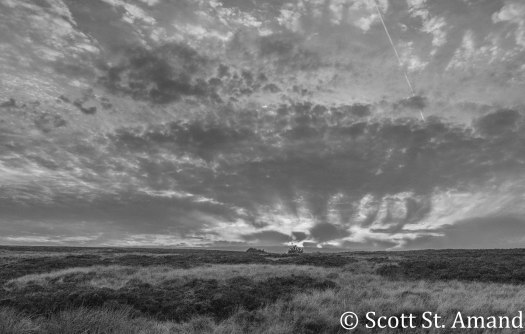
This was the last photograph I took on our trip to England in late August of this year.  I was tired, having climbed over moors, through the dales and back again at least four times over the course of the three hours or so.  The flatness of this picture belies the vertical bent of everything in England.  The sunset was magnificent because the clouds in the sky possessed such an impressionist character.  The patch of sycamores on the horizon grew closer and closer as we approached the setting sun, with Top Withens (the inspiration for Wuthering Heights) behind us.  There were no paths towards the top of the hike, which should have been an early harbinger of the difficulty of the climb.  For all I knew (and willingly shared with the rest of the hiking group), we were likely the only masochists to have made the hike for generations.  As we wended our way through the dense heather and tall wild grasses and bracken ferns, and I gasped for breath at manageable intervals, I thought back on that field twelve years prior where I proposed in a similar field across the valley from Anna’s grandparent’s house, amongst a small herd black and white Friesians.

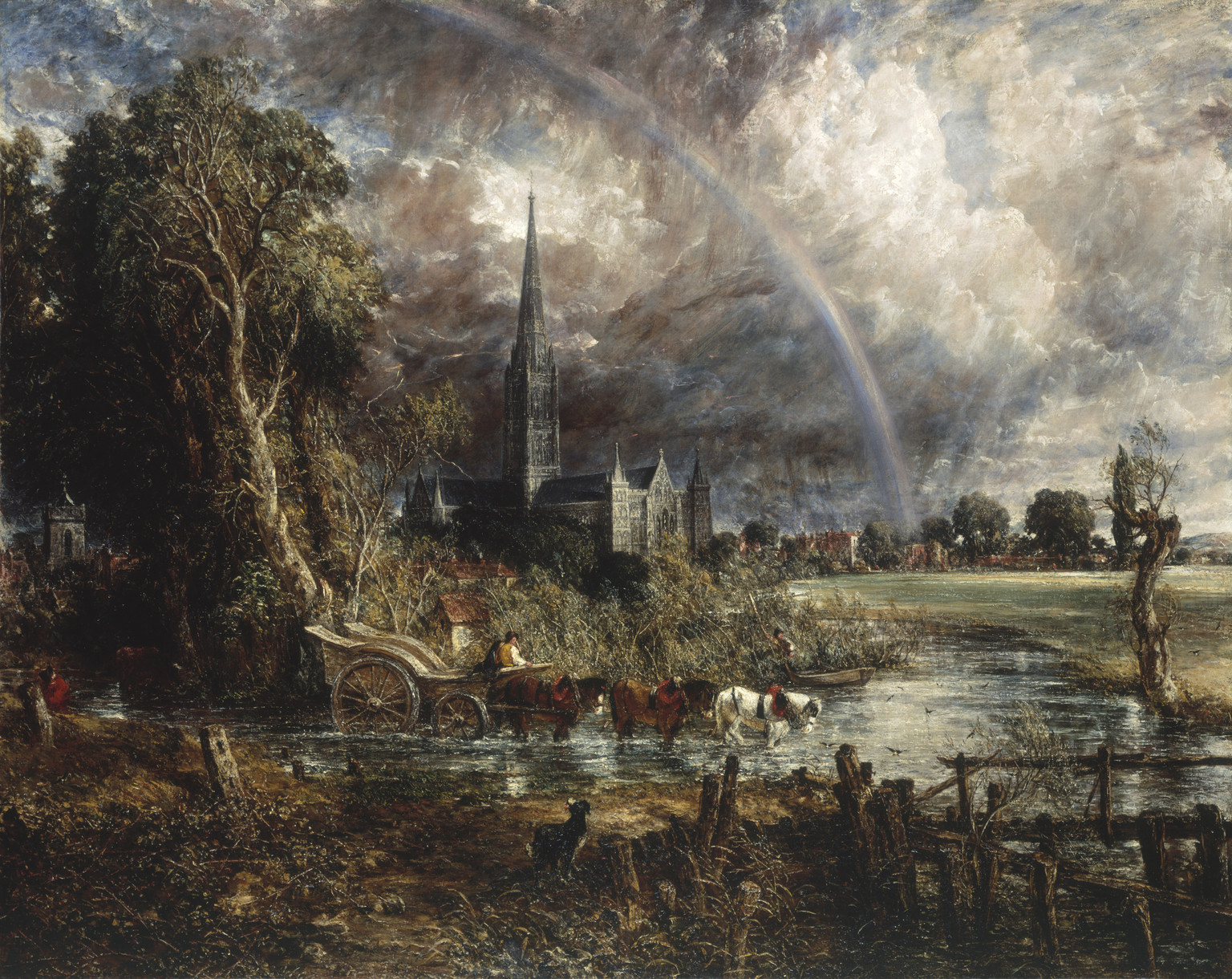
The beauty of Yorkshire has ceased to surprise me.  By this, I do not mean that it has become any less wondrous or awe inspiring, only that I have come to expect to look out on a field and see the beauty that inspired the Brontës and Wordsworth and John Constable and all of the other artists that have spent their lives’ work attempting to capture the magnificence of this landscape.  Indeed, the sky was something out of Constable’s painting of Salisbury Cathedral (sans the rainbow).  The beauty is almost laughably ubiquitous.  I have been to England three times now, and each time I am left with the distinct sensation that I was born on the wrong continent.  My archaic turns of phrases, my passion for history and ancient things, all find root in the mother country.  Anna’s grandmother, a strong Yorkshire woman, who still travels the world at 94, has adopted me as her “cloth” grandson, an appellation that I take very seriously, and I have been warmly embraced by the network of aunties and cousins — just the toe-holds I needed to claim a bit of Yorkshire as my own.

Click here for a larger version.

The Lone Cypress

SSA Photography (238 of 400)

I often wonder how this iconic tree took root.  For those who don’t immediately recognize the scene, this is the “Lone Cypress” off the coast of Monterey, California.  This photograph was taken during the height of the Soberanes Fire southwest of here in the valleys just off the coast of Carmel and Big Sur.  Although likely surpassed by the recent Woolsey Fire, the Soberanes was the costliest wildfire in the history of California.  It coated everything in a thin layer of ash, and the smoke that hung thickly, almost unctuously in the air made shots of the coastline nigh impossible.  This photograph was taken towards the tail end of the trip, as the fire was winding down, and still the haze bled the details from the shot.

When the sun managed to pour through the thick air, the sky took on a burnt, sepia tone, which made every picture I took look like I had applied a strong filter to it.  The tree is at least 250 years old, and for the last 65 or so has been held in place by strong metal cables.  When I saw the cables in person, I thought that it was a supremely arrogant act by man to forestall the inevitable cycle of nature for the sake of Japanese tourists (and me) making a pilgrimage to gaze through chain-linked fence to snap an awkward photograph of the icon sitting on its outcropping, engirded as it is by a brick and mortar parapet.  But still, we come en masse, ogling the tree with a misplaced reverence.  When this one dies, as it will, it will be replaced with a fellow that I am certain is already being grown for its stead, like a Cardinal waiting in quiet for the Pope to abdicate.

Click here for a larger version.

Post & Lintel

SSA Photography (95 of 400)

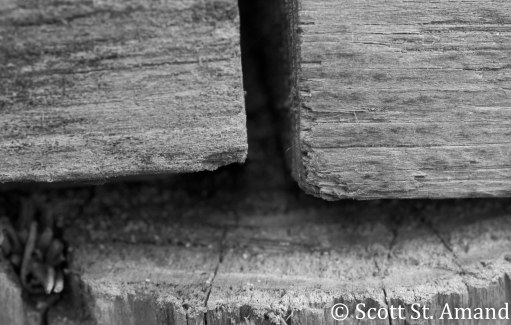
Though I do not take many abstract shots, this one came rather organically.  Taken at Big Talbot Island, just north of Jacksonville, Florida, I had fixed my macro lens on my camera halfway through the long walk down the driftwood-strewn beach.  I had already taken many photos of the fossil-like trees, languishing and bleaching in the hot sun, and so I set out to capture the little elements that required me to look closer and actually observe the microcosms of barnacles and tulip snails and patterns in the grains of the wood.  The day was cut short by the heat, which beaded down my forehead into my eyes, making the very act of photography an unpleasant task.

As I walked back the mile or so to my car, I left the lens cap off of my camera in case anything small, otherwise insignificant, caught my eyes, which burned with the sweat.  Near my car, there was a rickety old circular wooden handrail.  I cannot say why, but the way the rough-hewn logs stretched horizontally around, propped up by a glorified dock piling, reminded me of Stonehenge.  I’ve never been, though I did see a large stone circle in the Lake District years ago.  I scrunched up to where the post met the lintels, and manually focused my lens on the dark interstice between them.  I thought nothing of the photograph until I got home and began editing the photographs which I had taken that day.  There was something appealing about the abstract composition of the capture that pleased me, and, what’s more, intrigued me.

Photography has a way of elevating the mundane to art.  Whether that was achieved here, I leave up to you, but in this particular perspective, the photograph seems to create something far more significant than a fence and its post.  It is, itself, a simile without words.  By giving it a title, I was able to ascribe significance to it–it was no longer simply pressure treated lumber bolted together.  It was like Stonehenge.  This photograph taught me a lesson, which I carry with me to this day.  What may seem insignificant may be given artistic meaning, sometimes simply by capturing it with the camera, and other times simply by giving it a name, an identity.  In this way, photography is kin to poetry, revealing the beauty and grace within the quotidian.

Click here for a larger version.

Whirls

SSA Photography (101 of 400)

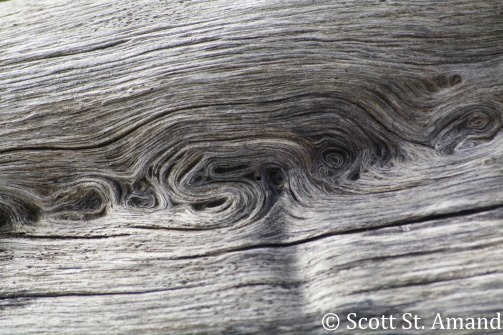
As I have mentioned before, the patterns of nature fascinate me.  The swirls and whirls on this driftwood tree, most likely a live oak (Quercus Virginiana), caught my eye immediately when I took to the beach with my macro lens.  I had passed the tree numerous times before, camera in hand, but I overlooked the fascinating, almost embryonic patterns along the large branch that reached towards the ocean.  I cannot believe that I missed it, but in hindsight, I was not looking for the little intricacies of nature when I first came to Boneyard Beach; instead, I was looking for patterns in the trees strewn about the sand, which I found in the hulking driftwood trees.

A certain bit of melancholy washed over me as I returned a few months ago, two years hence, and two hurricanes since.  The beach was not as I remembered it.  The huge live oaks were still there; not even a category three storm could have moved them.  Yet the smaller ones, like this one with the whirls, had been washed away.  Perhaps they will be rolled back to shore by the heavy waves of a nor’easter, or, perhaps, by another hurricane.  But for now, they were gone.  I brought my son to the beach when I returned, hoping that he would find the same beauty in his five year old eyes.  He, too, was enamored by the tulip snails, and he let go of his fears long enough to sidle up the trunk of one of the supine live oaks.  I let go of the melancholy, as well, and I ventured to find new patterns in the niches where limb meets branch or branch meets trunk.  Someday, Kemper will be old enough to mind the patterns, but for now, I will let him find the joy in the bigger picture.

Click here for a larger version.