Steve at the Falls

Panthertown Valley-27

My family became the subject of a number of portraits during our post-Christmas vacation in Brevard, North Carolina.  On the whole, the portraiture was done mostly willingly (except my mother, who loathes having her picture taken – much like me).  I did not push her, except for one photograph with the grand-kids and one family portrait, which even I deigned to sit for.  This photograph was a candid of my father admiring Schoolhouse Falls in Panthertown Valley.

Although the falls were admittedly beautiful from the front, the view from behind the falls was something else entirely.  We had met a sweet older lady on the hike, just as we were about to turn around, who advised us to take ten minutes and hike to the falls that were running more strongly than she had ever seen due to the rain and snow melt.  She said that if we were careful, we could even hike behind the falls, which piqued my curiosity.  As soon as we turned the corner onto the side path, we heard the crashing of the falls.  The hike was easy to the falls itself, and I took a number of photographs of the falls that I have added to my portfolio “Falls.”

Click here for a larger version.

Emma

Panthertown Valley-5

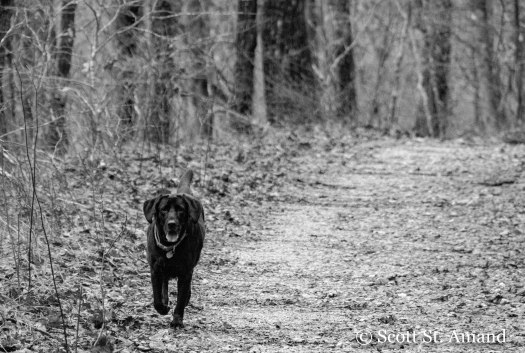
My parent’s black lab, Emma, was our constant companion on our hikes in North Carolina.  We hiked five miles in Panthertown Valley, and she must have covered at least twice that.  She would run ahead, just far enough that my mother was still in her line of sight, and then run back, as if to report that there were no obstacles in our path to come.  I took many photographs of her along the way, but this one best captured her reconnaissance endeavors.

We have had a number of dogs growing up, and they would all have been faithful companions on the walk.  My parents’ dog, Tam, whom I remember as a kind old yellow rug, came first, and then we rescued Sadie, a bright red golden retriever, who I grew up with as a child.  Dylan, Emma’s great-uncle, came when Sadie was getting along in her years, and brought out the youth in her once more.  Hannah, who was the mother of my sister’s lab Zinger, was my girl all the way through college and law school.

Anna and I now have Zoe, whom we rescued ten years ago.   She is completely deaf now, and Anna claims her sight is going, too.  She has been there through the ups and downs in our marriage, at our kids’ births, and through it all with us.  I know that we will have to say goodbye, sooner rather than later, and it breaks my heart to think that one day, she will not be the first to greet me when I come home from work.  That will be a devastating day.

For now, I am patient with her as she lolls through the backyard when I let her out, stopping and sniffing at the wind, using the one sense that has not yet failed her.  She moves more slowly, and she will not get up from her bed in the morning until she is ready to take on the new day.  I admire this about her.  I took many photographs of her on this trip to North Carolina, because she was in her element in the cool mountain air with new smells to pursue laconically as she ambled ten steps in front of me at all times.  She is more wary of leaving me behind than Emma ever will be, and I am wary of ever leaving her behind either.

Click here for a larger version.

Paper Birch

NCWinter2018-64

The winter leaves had fallen on all of the trees on the property in Brevard, North Carolina, when we visited at the end of December.  The lone holdouts were the thin, wispy leaves of the white birch trees (Betula Papyrifera), which clung on despite the snowstorm that had toppled many larger trees.  The scientific name, Betula Papyrifera, literally means paper-bearer, and indeed the leaves were paper-thin and fluttered at even the slightest hint of wind.  (In truth, however, the “paper birch” is named due to the thin white bark which often peels in paper-like layers from the trunk.)

The paper-birch is a short lived species of the birch family, and in the climate of North Carolina will likely only live thirty to fifty years (though in colder, less humid climates it may live for a hundred years or more).  Despite the relatively short life of the tree, it is a survivor, as the leaves attest.  The paper birch is a “pioneer species,” meaning it is often one of the first trees to grow in an area after other trees are removed by some sort of disturbance. When it grows in these pioneer, or early successional woodlands, it often forms stands of trees where it is the only species.

What struck me the most, however, was that despite the relatively small stature of the trees (there were a number on the property easily recognizable due to its leaves), they were the only ones that held fast to their leaves, almost refusing to let them fall.  I admire this stubbornness, even in a tree.  What’s more, the leaves, though faded and whitened by the fall, were still beautiful, and decorated the tree admirably.  We can, perhaps, learn something from the paper birch about retaining beauty in the winters of our lives.

Click here for a larger version and a color version.

Astride

LittleTalbot-10

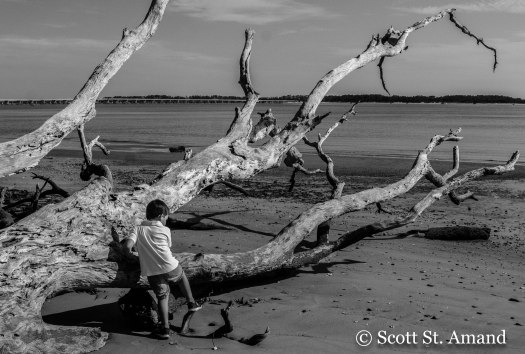
This photograph of Kemper was taken not too long ago at Big Talbot Island.  He is in his element among the low-lying branches of the fallen live oak (Quercus Virginiana).  Kemp is ever-cautious, and consequently has not broken any bones (so far).  Even convincing him to climb the trunk, no more than four feet off the ground, took some coaxing.  I am fine with his wariness of danger.  It would have served me well as a child, who, by his age, had already broken both wrists and a couple of toes.

Despite his cautious nature, he is impulsive and fiery.  His temper burns hot, though it is extinguished quickly with proper redirection.  This has caused great consternation at school, where someone will call him a name, and he will explode momentarily.  In that instant, he cannot control himself.  I was not as impulsive as a child, though as an adult, I find myself irrationally upset at times, which quickly cools.  I cannot help but think that he has seen me in such moments of weakness, where my sarcasm and passive aggression come through in full technicolor.  I hate that he has witnessed this, and since his temper has blossomed at school, I have made every effort I can to dull my own temper — especially around him.

He is a sweet child, and wants nothing more than to make those around him smile or laugh.  His intelligence is off the charts, but his emotional maturity lags behind significantly.  Eventually this, too, will catch up (though I admit, I am waiting for my emotional maturity to catch up even at age 34).  By every account, we are good parents, and he is a good kid.  Nevertheless, since he returned from Christmas break, he has been sent to the principal’s office nearly every day by his young teacher, who appears incapable of managing his behavioral outbursts.  He sees no point in doing the multitude of worksheets, on subjects that he has known since he was three or four, and he is overwhelmingly bored.

We have sat down with the principal, assistant principal, grade level chair, and his teacher, but the conflict between Kemper and his teacher persists.  Anna, especially, is questioning our decision to place him at this particular school, which is, admittedly, rigid in its principles.  Her years of training as a behavior specialist gives her great insight into how to manage children with his unique blend of intelligence and immaturity, which makes it all the more difficult to see him go unmanaged and unmotivated.  This, too, shall pass, and we may move him before the school year is up.  For now, we will provide him the positive reinforcement that he so thrives upon, and continue to embrace his unique personality.  I will continue to bring him to Big Talbot, where he has begun to climb the trees with less and less coaxing, and I will pick him up when he inevitably falls.

Click here for a larger version.
Cheeky

NCWinter2018-71

This photograph of Kemper, and my niece Brynn, was taken a few weeks ago in Brevard, North Carolina.  The two cheeky little gremlins had just been sloshing through the creek that was running higher than I had ever seen it on account of the torrential rain and snow melt.  Still, it was shallow enough in places to come just over their wellingtons, thereby defeating the boots’ entire purpose.  I think they had more fun splashing in their boots on dry land, listening to the sucking sounds that their feet made within the boots, than they did in the creek itself.

Living square in the suburbs, Kemper and Brynn play “outside” all of the time, meaning they play with chalk on the driveway, ride their bikes and trikes, but they do not have the chance to slosh through the creeks in Florida.  There are too many unseen dangers, the least of which are alligators and moccasins.  So, to be able to traipse through the mud and cold water in North Carolina was as much a release for the kids as it was to watch for the grownups – my sister, Claire, Anna and me.  We got to see the nature of our kids come out in the natural elements.  Though Kemper lamented the long hikes, he loved to play with the sticks and threw the rocks that he found along the way.  Give him a mud puddle, and he will have fun for longer than any sow or elephant might.  It was heartening to see them both having fun, and whats more, having fun together.

Click here for a larger version.

Fjords

SSA Photography (27 of 400)

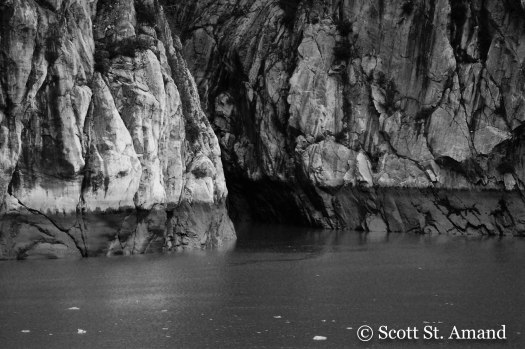
This photograph was taken on the journey to Skagway, Alaska up the Inner Passage from Juneau.  I must admit that I was unaware that there were fjords in Alaska, as in Norway and Iceland.  A fjord is simply a long waterway cut by glaciers into the bedrock.  The stone walls of the fjords were incredible, as were the markings on them.  You can see in this photograph the dark tide lines on the stones which lead into a deep chasm in the rock.  Alaska was mysterious to me.  It was true wilderness, which fascinates me.  Even in the wilds of North Carolina, I am still mindful that I was not the first person to trod upon the dirt.  There is a distinct possibility that if you stray to far afield of the paths in Alaska, you may be the first human to do so.  I long to go back to Alaska.

Click here for a larger version.

Cored

SSA Photography (144 of 400)

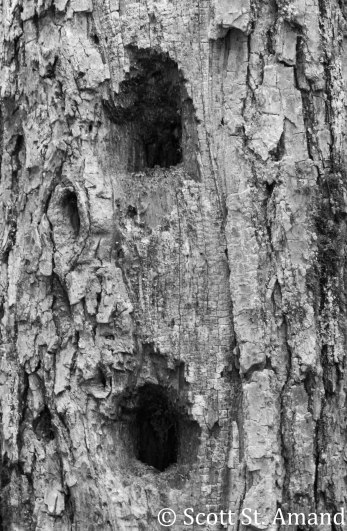
This old pignut hickory (Carya Glabra) has seen better seasons, but the beak of a red-cockaded woodpecker (Picoides Borealis) has extensively excavated the trunk, reaching through the growth rings of those seasons for the tunneling larvae of hickory bark beetles (Scolytus Quadrispinosus).  Although I only captured two of the woodpecker’s cavities in this photograph, the length of the trunk of the dead pignut hickory was pocked with them on every side.  I had hoped to capture the guilty woodpeckers in flagrante delicto, but I was only able to capture the evidence of their tenacious, voracious nature.

The black and white captures the deep shadows of the holes, and gives the bark an almost tessellated appearance, which is true to form.  The gray lichen on the bark just to the right of the lower cavity is almost inconspicuous, but I would be remiss to not note the thin layer of crustose lichen, perhaps Pertusaria Epixantha, which gives a more complete vision of this small ecosystem with tree, and bird, and insect, and fungi within millimeters of each other–coexisting in harmony, even after the tree has lost its sap and vigor.  Nothing in the woods of North Carolina goes to waste.  Even the autumnal leaves that fall by the wayside eventually feed the very trees that shed them, not to mention the other fauna and flora that feast upon them.  Thus, even in the hollowed, cored trunk of this long dead tree, I saw embodied a brief arc of the circle of life.

Click here for a larger version.

Cypress Sunset

SSA Photography (277 of 400)

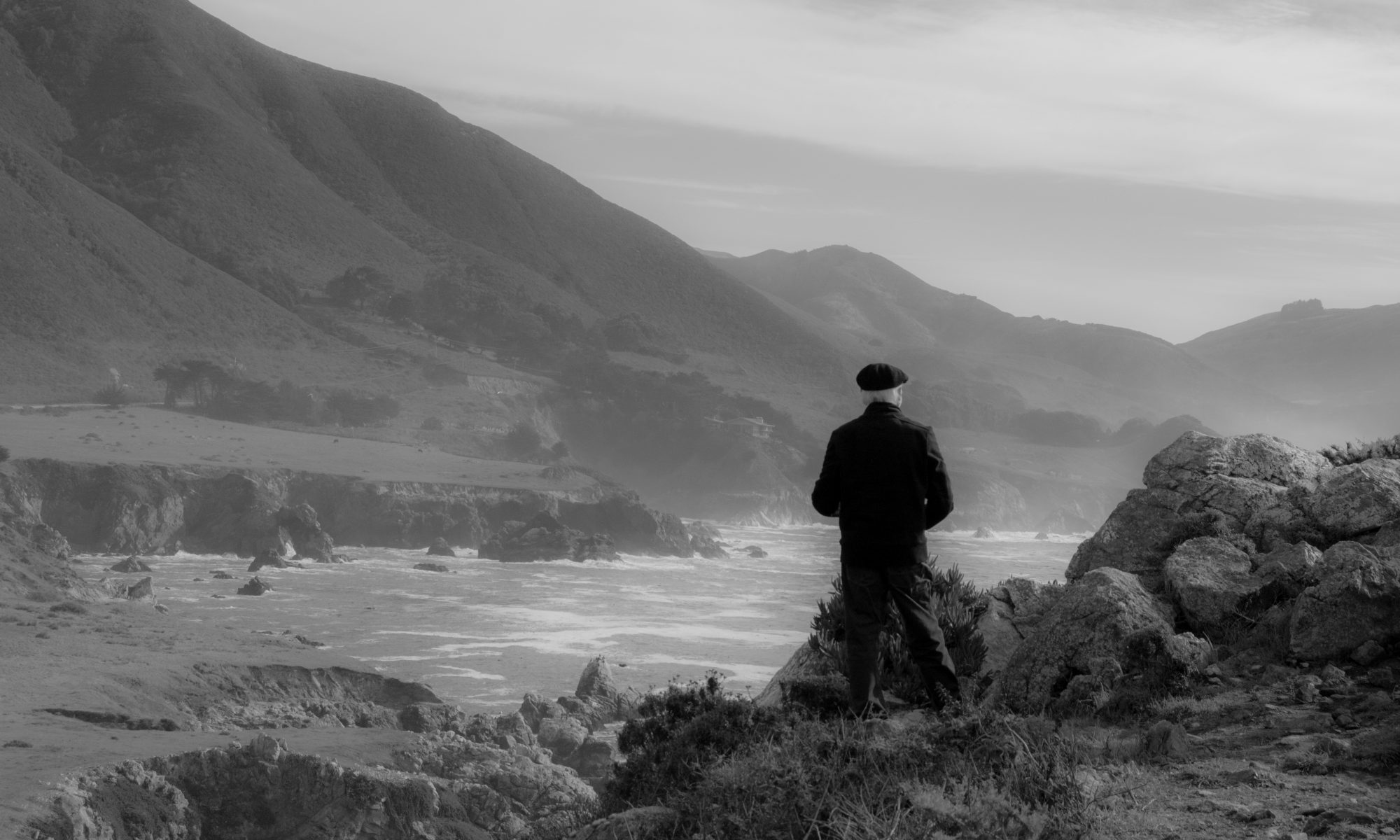
I have observed many sunsets in California over the past three years.  The view west from my in-laws’ house peeks through the greenery to a patch of ocean and sky.  There was nothing particularly special about this night’s sunset.  The sky was a bit hazy, which somewhat amplified the corona, but there were no pinks or purples to speak of just above the horizon, as I had seen on a number of occasions.  Still, I managed to wrestle myself away from the others and stroll down to the path that runs along the ocean on Scenic Drive in Carmel-by-the-Sea.  I took a number of shots of the setting sun, but this one, framed by two yin and yang Monterey cypresses, was my favorite of the lot.

Click here for a larger version.

Lichen

AngelColor

This little lichen (Usnea Florida) hung from the limb of a eastern red cedar (Juniperus Virginiana – not to be confused with the live oak (Quercus Virginiana)) dithering ever so slightly in the wind that had been left over from the storm the day prior.  I chronicled the Sunday walks I take through the swamp in Nocatee Preserve in an earlier post, and this day was no different, save for a different lens.   Instead of capturing the hidden beauty of the swamp in a macroscopic, wide angle tilt, I opted to only bring along my macro lens and lighting apparatus, which makes for a very serious looking photography setup to the uninitiated.  Few people passed me this day, on bike or foot, as the paths were still muddy from the day before.  The epiphytes, like this lichen, were bright and renewed from the downpour.  This particular varietal reminded me of the microscopic pictures of neural pathways and ganglia in the brain.  The common pattern, I am certain, is no coincidence of nature.

Interestingly, I later found out that usnea lichen contain potent antibiotics which can halt infection and are broad spectrum and effective against even tuberculosis. Usnic acid (C18H16O7), a potent antibiotic and antifungal agent, is found in most species, including this Usnea Florida.  This, combined with the hairlike structure of the lichen, means that Usnea lent itself well to treating surface wounds before sterile gauze and modern antibiotics.  It is also edible and very high in vitamin C.  As I mentioned in a previous post, I am not confident enough in my sight identification of mushrooms or lichen to test the medicinal properties of either, though there are no lichens nicknamed “Death Angel” or anything so nefarious, so I might be more willing to nibble on the ganglia of this lichen than an anonymous mushroom–if push came to absolute shove.

Click here for a larger version.

Crescent

SSA Photography (99 of 400)

The whirls of the driftwood on Big Talbot Island, just north of Jacksonville, Florida, are peculiarly wonderful to me.  My father is a woodworker in his spare time, and throughout the years, we have made scores of pieces of furniture, boxes, and we have even turned a number of bowls on the lathe.  As such, I am a constant admirer of wood and its natural beauty.  I have turned beautifully featured bowls from a pecan log wrought with worm holes, and ambrosia maple, and spalted sweetgum, but the oak bowls I have turned are lovely, but plain, almost like Shaker furniture.  They have a very ordinary grain, and little about them is exceptional.  The fallen oaks on Big Talbot Island, however, have fantastic patterns, some like the ornamentation of a medieval Celtic manuscript.

I do not know how these patterns came to be, though I speculate that it has something to do with the effect of the sea air on the tree’s formation, both nurturing and stunting the growth at the same time.  Some of the trees must have been tall and vast when they stood decades, or perhaps centuries, ago, but it is the smaller ones that have the more intricate patterns like this one.  To capture the perspective of this photograph, I set the aperture (depth of field) quite low, so that only a piece of the limb was in total tack focus.  The foreground and background are blurred, and the focused piece catches your attention, not only because of its placement in the composition (according to the rule of thirds), but also because of its contrasting sharpness.  I would have loved to turn a bowl from this tree, if only to see whether the patterns on the surface came through onto the finished product.  But now I have turned my artistic attention away from woodworking to photography, and so I must satisfy myself with capturing the beauty of the wood rather than pulling it from an unfinished block.  It is a different approach, but no less satisfying when the photographs turn out like this.

Click here for a larger version.